
You're deploying a large-scale AI pipeline on a Kubernetes cluster. A colleague asks you what Kubernetes actually does for your models. Which two of the following are core orchestration capabilities that Kubernetes directly provides to manage containerized AI workloads?
Select all correct answers, then click Submit.
Short Explanation and Infographic
Okay, let's dive in. Think of Kubernetes as the ultimate traffic cop and logistics manager for your data center, not the engine builder. It doesn't know how to compile your CUDA code or make your models train faster—that's the job of the NVIDIA driver, CUDA, and frameworks like PyTorch. What Kubernetes does do, and does incredibly well, is make sure your containers run in isolation so they don't fight over libraries, and schedule your workloads onto the right nodes across the cluster. If you expect Kubernetes to optimize GPU memory directly, trust me, you're looking at the wrong layer of the stack.
Full explanation below image
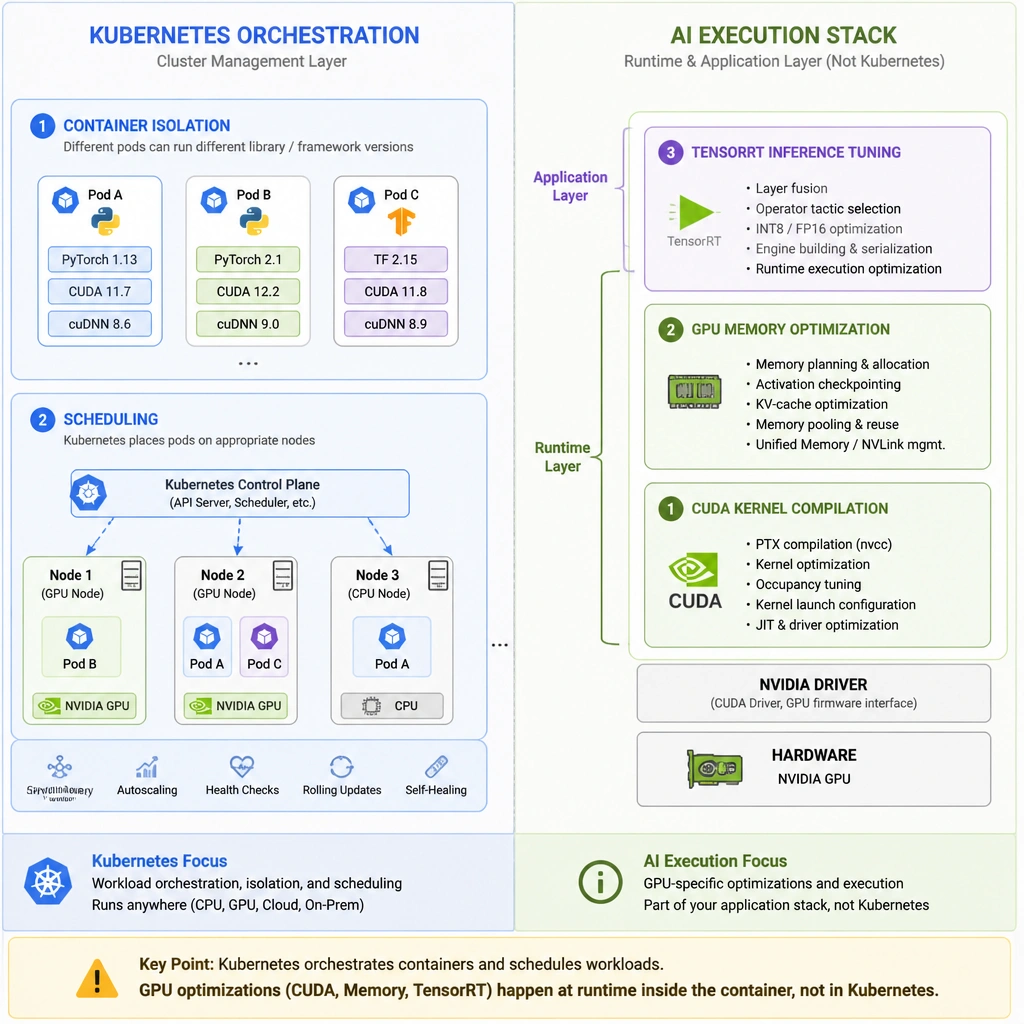
Full Explanation
Kubernetes (K8s) is an open-source container orchestration platform designed to automate the deployment, scaling, and management of containerized applications. When running AI workloads in cloud-native environments, Kubernetes provides essential infrastructure-level orchestration, but it does not run, compile, or optimize the AI models themselves.
Let's break down the core capabilities that K8s brings to the table: 1. Container Isolation: AI applications often rely on different versions of libraries (such as conflicting PyTorch or TensorFlow/JAX versions). Containers package these dependencies, and Kubernetes isolates them so they run consistently without interfering with other applications on the same host. 2. Automated Scheduling and Resource Allocation: K8s schedules workloads across a cluster of nodes based on resource requests and limits. With the NVIDIA Device Plugin, it can request and assign specific GPU resources to container instances.
Conversely, capabilities like CUDA compilation, GPU memory optimization, training acceleration (e.g., via TensorRT or FP8 precision), and real-time inference latency tuning are handled at the application, runtime (CUDA), or specialized software framework (Triton Inference Server) levels, not by Kubernetes itself. Confusing the orchestration layer with the hardware-acceleration layer is a common pitfall on the exam.