
A small medical research group wants to train a custom computer vision model on high-resolution MRI scans. They are building a local workstation and need to balance computational performance with a tight startup budget. Which of the following configurations offers the most cost-effective entry point while providing sufficient processing power and memory for model training?
Select an answer to reveal the explanation.
Short Explanation and Infographic
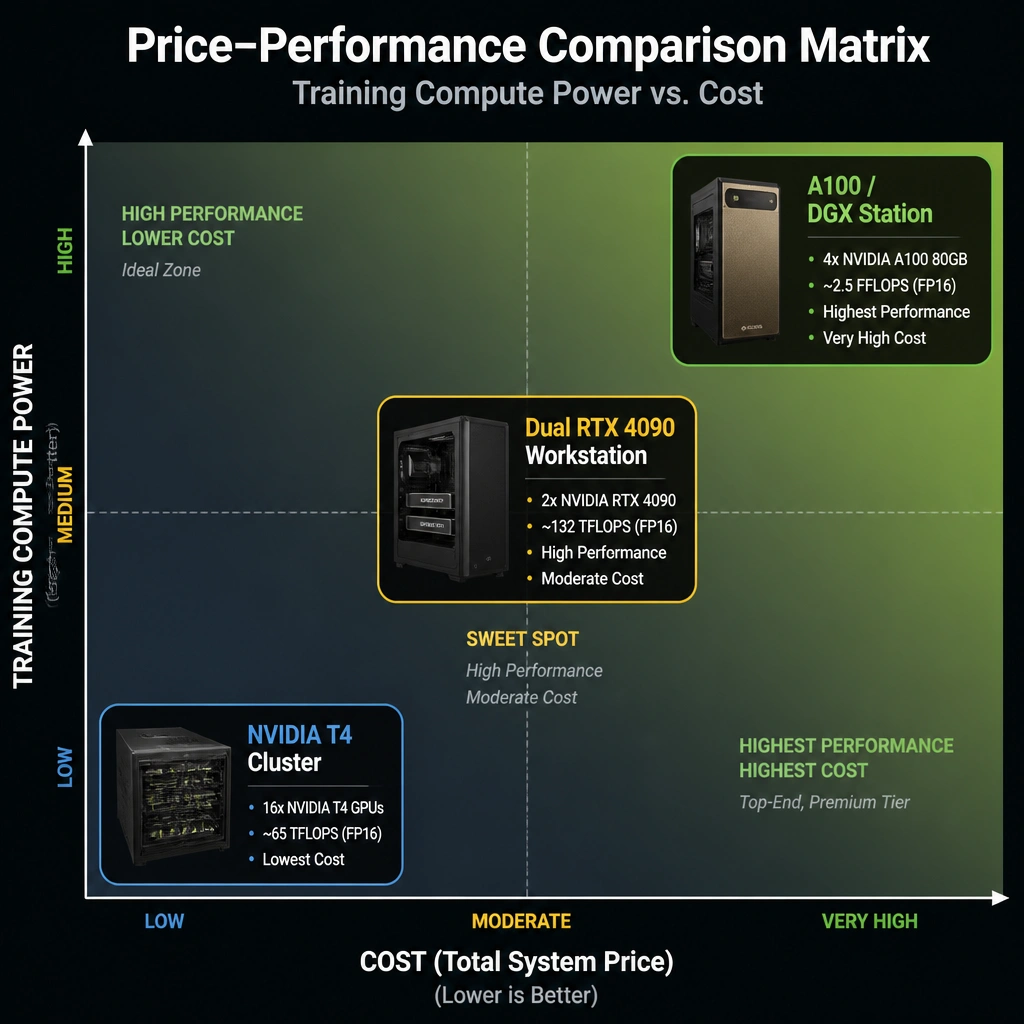
Trust me on this: when you're starting out on a budget, you have to be smart about where you spend your cash. An enterprise beast like the A100 or a full DGX Station will set you back tens of thousands of dollars—amazing performance, but way too expensive for a small startup team's initial workstation. On the flip side, four T4 cards might look tempting because they're cheap, but the T4 is an older, low-power inference card. It lacks the raw compute power and memory speed you need to train large vision models. Putting two RTX 4090s in a workstation gives you massive compute power and plenty of VRAM at a fraction of the cost of enterprise silicon. It's the perfect sweet spot for getting off the ground!
Full explanation below image
Full Explanation
For small research teams or startups initiating local deep learning projects, hardware selection involves balancing compute capabilities (specifically floating-point operations and memory capacity) against capital expenditure. Two NVIDIA RTX 4090 GPUs (Option C) represent a highly cost-effective and powerful solution for an initial workstation. The RTX 4090, despite being a consumer-class GPU, features 24 GB of high-speed GDDR6X VRAM and exceptional FP32/FP16 performance, making it highly capable for training computer vision models. Running two of these cards in parallel provides 48 GB of aggregate VRAM and massive computational throughput at a cost far below equivalent enterprise hardware.
Let's analyze why the other options are less suitable: - Four NVIDIA T4 GPUs (Option A) are low-power (75W) accelerators optimized primarily for inference workloads. They have limited FP32 capability and slow GDDR6 memory, making them slow and inefficient for training large models. - A single NVIDIA A100 GPU (Option B) is an outstanding enterprise-grade choice with HBM2e memory, but the cost of the GPU itself and the required server-grade host infrastructure is significantly higher than a dual RTX 4090 setup. - An NVIDIA DGX Station A100 (Option D) is a high-end, turnkey enterprise desktop supercomputer featuring four A100 GPUs and a liquid-cooled design. While it offers unmatched performance, its capital cost is prohibitive for teams looking for a cost-effective initial entry point.