
You are building an on-premise GPU cluster to support multi-node deep learning training. You need a platform that can manage the complete machine learning lifecycle, schedule distributed training jobs across multiple servers, maximize GPU utilization, and handle node failures automatically. Which tool is designed specifically for this orchestrating role?
Select an answer to reveal the explanation.
Short Explanation and Infographic
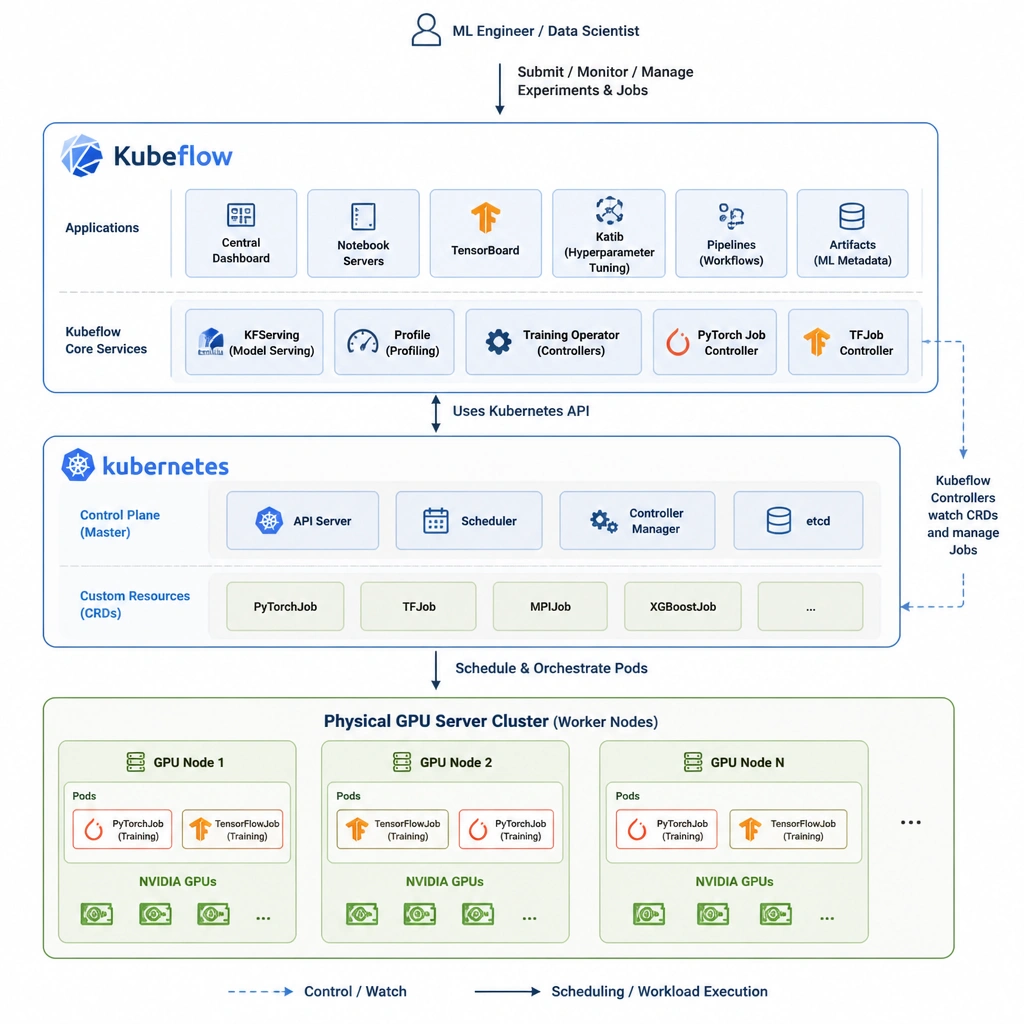
Okay, let's dive in. When you're managing a cluster of servers packed with GPUs, you can't just manually log into each machine and run scripts—that’s a nightmare. You need an orchestrator that can look at the cluster, see which GPUs are free, spin up your containers, and clean up when they’re done. That's where Kubeflow comes in. Since it runs on top of Kubernetes, it's the king of container orchestration for ML. If a node dies mid-training, Kubeflow handles the rescheduling so you don't lose all your progress. Don't confuse it with PyTorch or TensorFlow—those are the libraries you use to write the models. Kubeflow is what runs and manages those workloads at scale. Got it? Sweet.
Full explanation below image
Full Explanation
Kubeflow is a dedicated, open-source cloud-native platform designed to run machine learning workloads on Kubernetes. It functions as an orchestration layer that automates the deployment, scaling, and management of distributed AI training and inference jobs across a cluster of machines. By utilizing Kubernetes' native scheduling and resource management, Kubeflow ensures that containerized training jobs (such as those using PyTorchJob or TFJob operators) are allocated to nodes with available GPUs, maximizes cluster utilization, and provides built-in fault tolerance by automatically restarting failed training tasks on healthy nodes.
Let's review the other options to clarify their roles: - PyTorch (Option B) and TensorFlow (Option A) are the core deep learning frameworks used to define neural network architectures and calculate gradients, but they do not manage cluster-level hardware orchestration. - Horovod (Option D) is a distributed training framework that implements efficient ring-allreduce communication, but it relies on an underlying orchestrator (like Kubernetes/Kubeflow or Slurm) to allocate nodes and schedule the processes. - CUDA (Option E) is NVIDIA’s parallel computing platform and API that allows developers to use GPUs for general-purpose processing, operating at the hardware/driver level rather than the cluster orchestration level. - Ray (Option F) is a runtime library for scaling Python and AI applications, but Kubeflow provides the broader container-based lifecycle orchestration specifically built for enterprise Kubernetes environments.