
When you are running a massive distributed training job for a large language model across multiple DGX nodes, how should you store and read your training data from a shared network storage system (such as NFS or Lustre) to achieve the highest I/O throughput?
Select an answer to reveal the explanation.
Short Explanation and Infographic
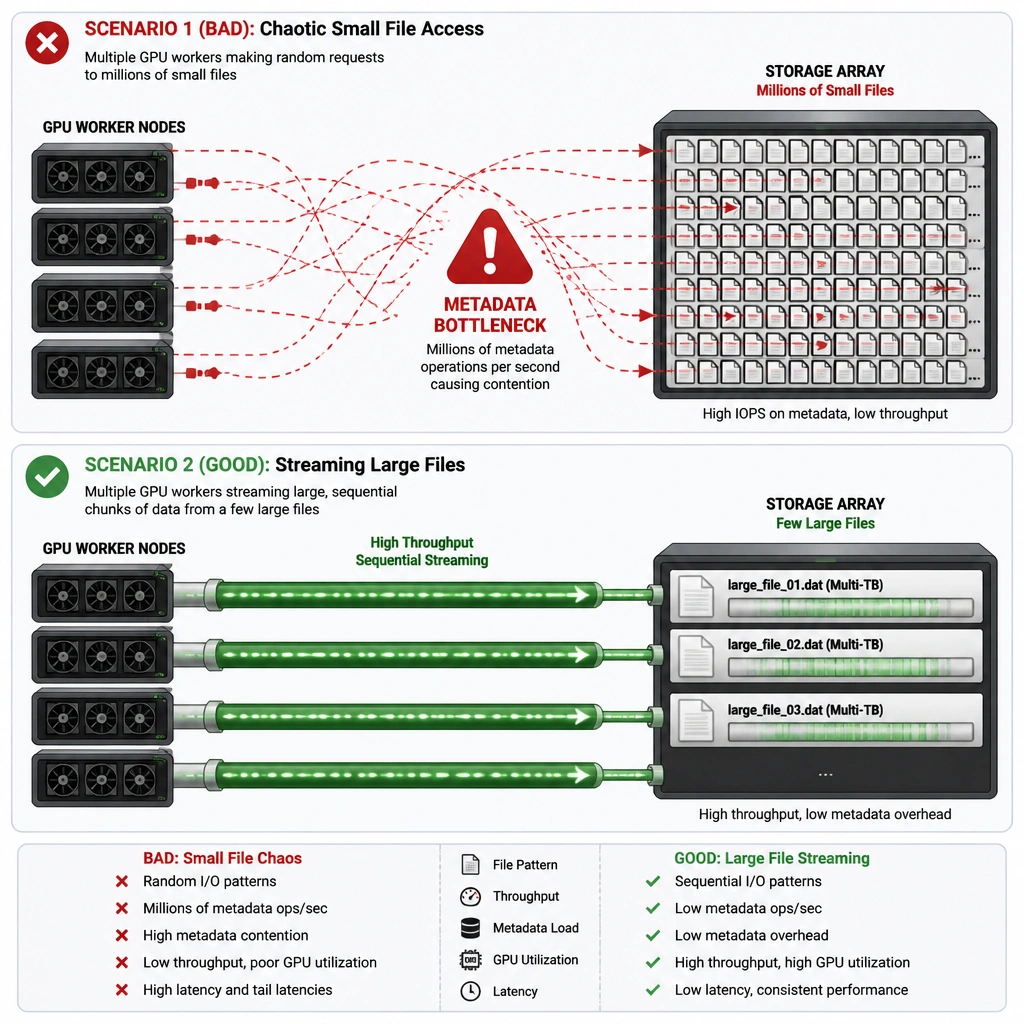
Here's the deal: network file systems absolutely hate dealing with millions of tiny, random reads. If you have hundreds of GPUs constantly asking the storage system to find and open a tiny file over and over, your storage controllers are going to choke on the metadata lookups, and your GPUs will sit idle waiting for data. That's a massive waste of expensive compute! To keep those GPUs fed, you want to bundle your data into a few large files (like TFRecord or WebDataset formats) and stream the data sequentially in large chunks. It's like buying groceries in bulk instead of driving to the store every time you need a single grape. Trust me, sequential reads of large blocks keep the pipeline full and your GPUs running at 100%.
Full explanation below image
Full Explanation
In distributed deep learning training, storage I/O is often a significant bottleneck, especially when scaling across multiple nodes using network-attached storage (NAS) or parallel file systems. The key to high performance is maximizing bandwidth utilization while minimizing metadata operations. Reading large blocks sequentially from a small number of large aggregated files (such as TFRecord, HDF5, or WebDataset formats) is the most efficient pattern (Option A). Network storage systems are highly optimized for sequential streaming, which allows the storage controller to prefetch data and saturate the network link. It also keeps metadata operations—which are highly CPU-intensive and slow—to an absolute minimum because the system only has to open and close a few files.
Let's examine why the other patterns are inefficient: - Option B (concurrent random reads within the same file) creates intense lock contention and cache thrashing on the storage server, as multiple workers compete to access non-contiguous blocks of the same file simultaneously. - Option C (randomly accessing millions of small files) causes severe metadata bottlenecks. The storage server spends more time navigating directory structures, opening, and closing files than actually transmitting data, leading to low GPU utilization. - Option D (reading all metadata at the beginning of an epoch) does not solve the underlying I/O bottleneck and can cause the master node or storage server to freeze under the weight of massive directory listing requests at scale.
Consequently, reading large sequential chunks is the most efficient data access pattern.