
Your team needs to run a large language model (LLM) for real-time customer support, but you are limited to a single, lower-spec NVIDIA GPU with limited VRAM. Which of the following approaches is most effective for shrinking the model's memory footprint and speeding up its response times (inference latency)?
Select an answer to reveal the explanation.
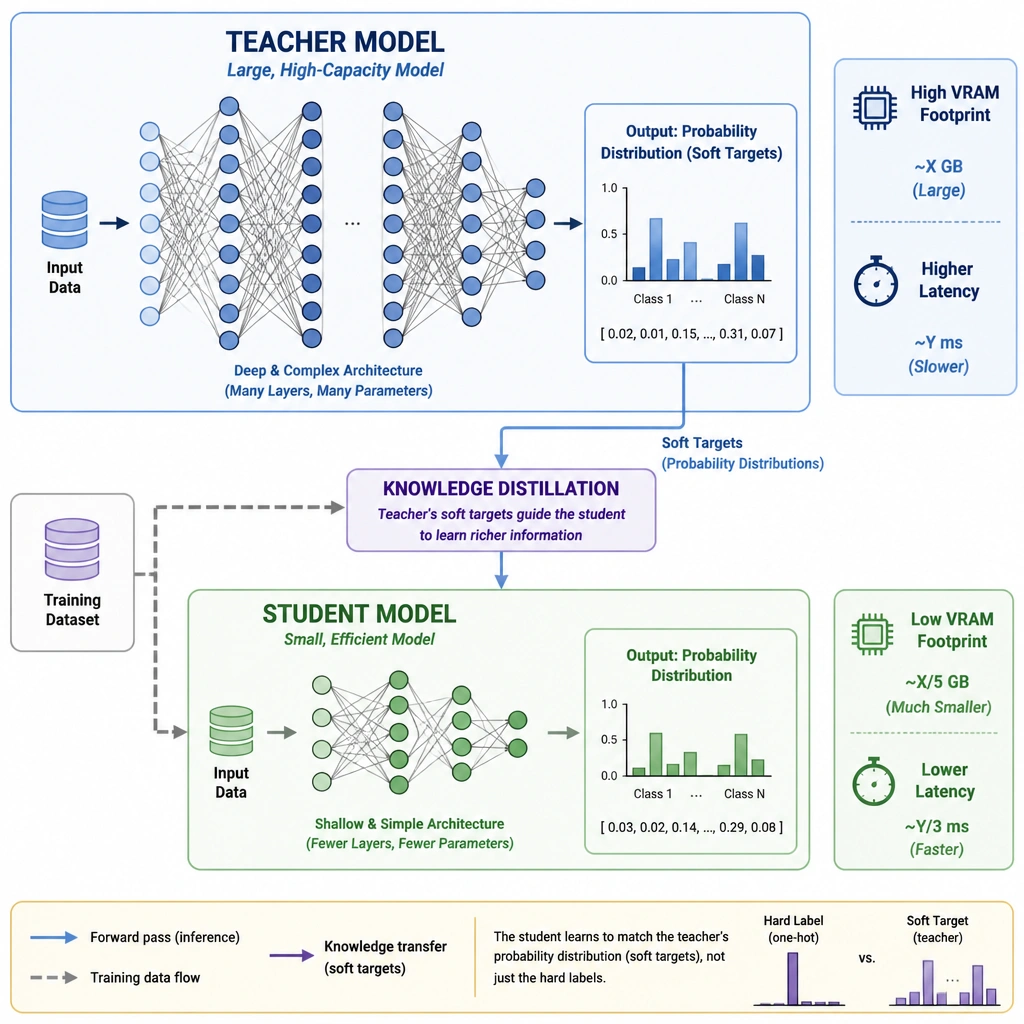
Short Explanation and Infographic
Think of it like this: you have a world-class professor who knows everything about history, but they're way too busy (and expensive) to answer simple student questions all day. What do you do? You have a teaching assistant sit in their lectures, learn the core material, and answer the undergraduate questions instead. That's knowledge distillation. You take a massive, heavy model (the teacher) and use its predictions to train a lightweight model (the student). The student model is much smaller and runs lightning-fast on restricted hardware, while keeping most of the teacher's smarts. Pretty cool, right? Adding layers or going to FP64 will just choke your GPU, and boosting batch size increases your memory footprint, which is the exact opposite of what we want here.
Full explanation below image
Full Explanation
When deploying large language models on resource-constrained hardware, memory capacity (VRAM) and latency are the primary bottlenecks. Knowledge distillation is a compression technique specifically designed to address these limitations. In knowledge distillation, a large, pre-trained model (the 'teacher') is used to guide the training of a smaller, more computationally efficient model (the 'student'). The student model is trained to minimize the difference between its outputs and the teacher's soft probability distributions (dark knowledge) or intermediate representations. Because the student model contains significantly fewer parameters, it requires much less VRAM and executes feed-forward passes much faster, directly reducing latency and memory usage during inference.
Let's analyze the incorrect options: - Option A is incorrect because adding layers to a model increases its parameter count, which expands its memory footprint and increases computational complexity. - Option C is incorrect because increasing the batch size during inference actually increases memory usage (as more activations must be stored in VRAM simultaneously), even though it can improve overall system throughput. - Option D is incorrect because FP64 (double precision) requires twice as much memory and compute bandwidth as standard FP32, and even more compared to the FP16/BF16 formats typically used for AI. Running FP64 on resource-constrained GPUs would severely degrade performance and cause Out-of-Memory (OOM) errors.
Therefore, knowledge distillation is the most effective choice.