
Which two statements accurately describe the functionality and role of Remote Direct Memory Access (RDMA) in high-performance networking fabrics?
Select all correct answers, then click Submit.
Short Explanation and Infographic
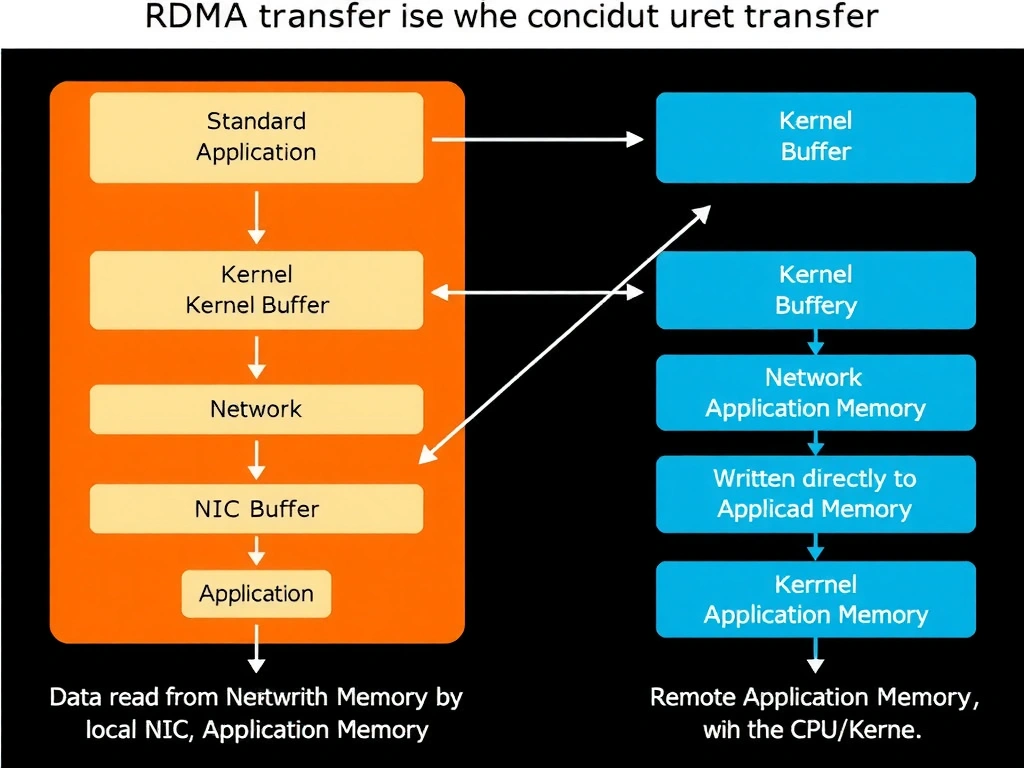
Let's get clear on RDMA because it's a huge deal for both InfiniBand and high-speed Ethernet (using RoCE). Normally, when a computer wants to send data over a network, the CPU has to get involved, copy the data to kernel space, wrap it in a network protocol, and send it out. On the receiving end, the other CPU does the exact same process in reverse. That's a lot of context switching and CPU overhead! RDMA cuts out the middleman. It allows the network adapter to write data directly into the RAM of a remote computer without asking that remote CPU for help. This is crucial for distributed AI training because it allows GPU nodes to swap massive amounts of data with almost zero latency. Remember: RDMA is NOT about compression, it's not a database tool, and it definitely doesn't use the CPU—it bypasses it!
Full explanation below image
Full Explanation
Remote Direct Memory Access (RDMA) is a network technology that enables host-to-host data transfers directly between the memory (RAM) of two computers without involving the operating systems, kernels, or CPUs of either system.
In standard TCP/IP networking, data transfer requires multiple memory copies (moving data between user space and kernel space buffers) and significant CPU intervention to process the protocol stack. RDMA eliminates these overheads through a process called "kernel bypass." The network interface card (NIC) or Host Channel Adapter (HCA) accesses the host memory directly. This leads to two major benefits: 1. Low Latency: Because the OS kernel and CPU are bypassed, latency is reduced to the sub-microsecond range. 2. High Efficiency (Zero-Copy): The host CPU is freed from network stack processing, allowing it to devote its cycles to computation (e.g., training tasks) rather than network I/O.
These characteristics make RDMA indispensable in distributed AI cluster environments, where hundreds or thousands of GPUs must work in parallel, constantly synchronizing weight matrices and gradients.
Let’s review the incorrect options: - Option A: RDMA is not a data compression technique. It transfers raw memory contents without altering or compressing the data. - Option B: One of the primary advantages of RDMA is that it avoids CPU intervention, thereby reducing CPU utilization and overhead. - Option D: RDMA was originally developed for InfiniBand and is a native feature of InfiniBand architectures. It is also supported on Ethernet via RoCE, but is not exclusive to Ethernet. - Option F: RDMA is a transport-level data transfer mechanism. It does not manage higher-level database transaction consistency or application-level error correction.