
Which NVIDIA SDK is specifically used by developers to optimize and run high-performance deep learning inference workloads, focusing on minimizing latency and maximizing throughput on NVIDIA GPUs?
Select an answer to reveal the explanation.
Short Explanation and Infographic
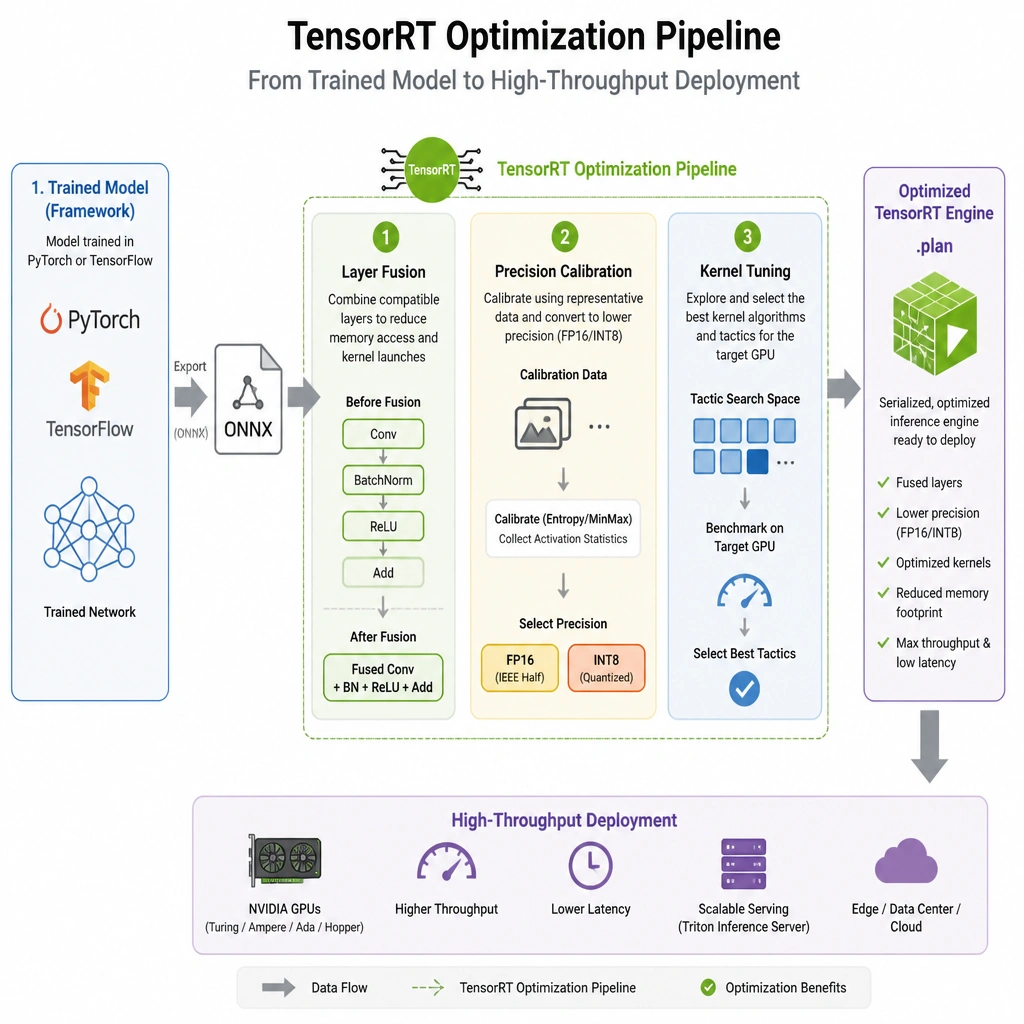
Okay, you've spent weeks training your model, and now it's time to put it to work in production. But wait, it's running too slow and eating up too much memory! What do you do? You compile it using NVIDIA TensorRT. Think of TensorRT as a high-performance optimizer for your trained neural network. It takes your model, fuses redundant layers, removes unused paths, and converts data types (like FP32 to FP16 or INT8) to make it run lightning-fast on NVIDIA GPUs. Now, don't confuse this with Triton Inference Server. Triton is the 'host' or web server that manages incoming requests and routes them to your models. TensorRT is the actual engine under the hood doing the speed optimization. cuDNN is a library of building blocks for deep learning (used by frameworks during training), and CUDA is the general programming platform. If you want maximum inference performance, TensorRT is the answer!
Full explanation below image
Full Explanation
NVIDIA TensorRT is a high-performance deep learning inference optimizer and runtime library designed to deliver low latency and high throughput for production applications. When a deep learning model is trained (using frameworks such as PyTorch or TensorFlow), it is typically not optimized for deployment. TensorRT takes these trained models and performs several structural and mathematical optimizations.
Key optimizations performed by TensorRT include: - Layer and Tensor Fusion: Combining adjacent layers (e.g., convolution, bias, and ReLU) into single operations to reduce memory transfers. - Precision Calibration: Converting model weights from FP32 to lower-precision formats like FP16 or INT8 while maintaining accuracy, which accelerates computation. - Kernel Auto-Tuning: Selecting the optimal algorithms (kernels) for the specific GPU architecture being used. - Dynamic Memory Management: Reusing memory buffers to reduce allocation overhead.
Let’s review the incorrect options: - NVIDIA Triton Inference Server is a model serving software that manages inference requests, queues inputs, and deploys multiple models on GPUs. Triton can use TensorRT as a backend, but it is not the optimization library itself. - cuDNN (CUDA Deep Neural Network library) is a GPU-accelerated library of primitives for deep neural networks. It is used primarily by training frameworks (like PyTorch) to perform operations like convolutions and pooling, rather than optimizing compiled models for inference. - CUDA is NVIDIA's general-purpose parallel computing platform and programming model. It provides the foundation upon which TensorRT, cuDNN, and other GPU libraries are built, but it is not a deep learning optimization SDK.