
In an InfiniBand-based storage and compute network, Remote Direct Memory Access (RDMA) is considered a key technology. Which two of the following statements accurately describe how RDMA operates and the benefits it brings to an InfiniBand architecture? (Choose two)
Select all correct answers, then click Submit.
Short Explanation and Infographic
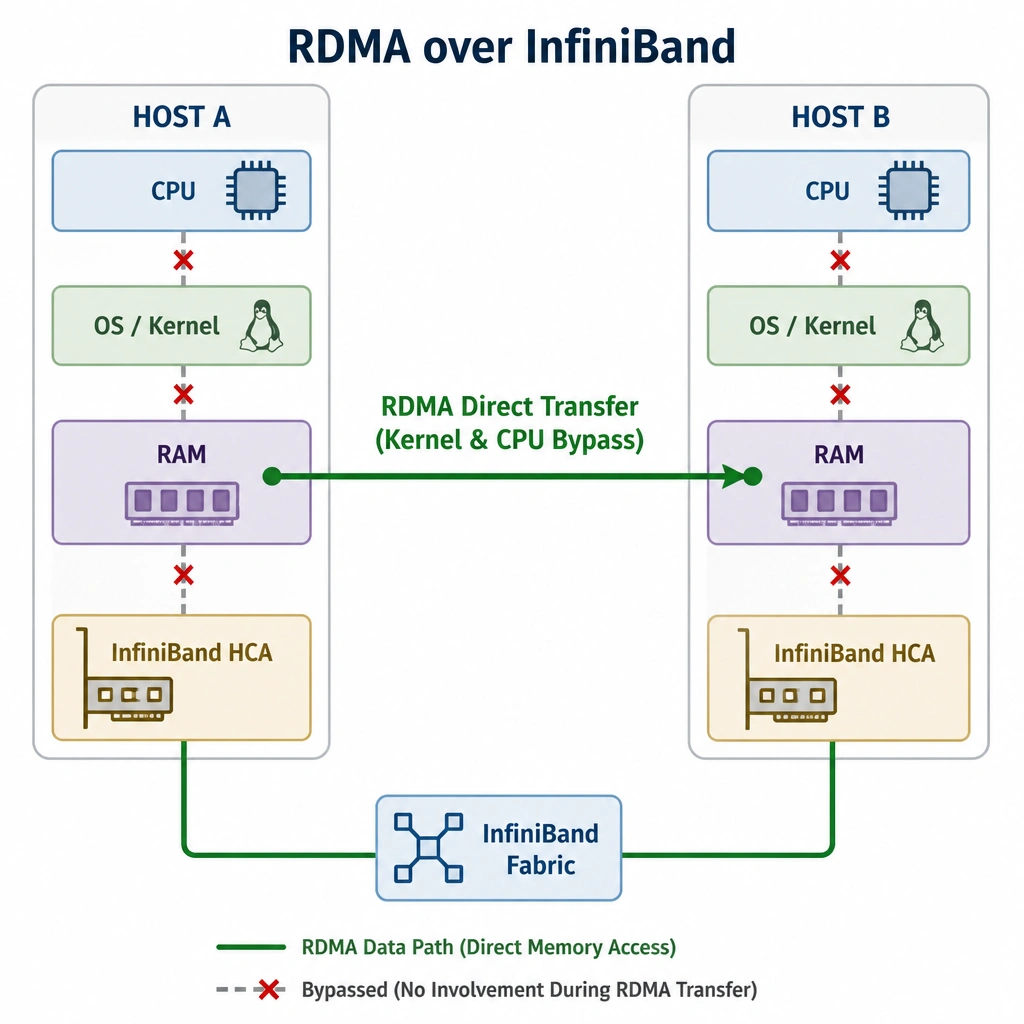
Alright, let's dive into RDMA on InfiniBand. If you're building a cluster of servers to train a giant AI model, those servers need to share data constantly. If every data transfer had to stop and ask the host CPU for permission, and go through the operating system kernel, your network would crawl. RDMA solves this by letting the network adapters talk directly to the memory of other computers in the cluster. No CPU intervention, no operating system overhead. It's like having a direct highway between server memories. This keeps latency incredibly low and throughput high, which is exactly what we need for parallel processing. Remember: RDMA is native to InfiniBand, it's not a compression tool, and it frees up the CPU rather than overloading it!
Full explanation below image
Full Explanation
Remote Direct Memory Access (RDMA) is a core feature of InfiniBand architectures, designed to solve the network latency and CPU overhead challenges associated with traditional TCP/IP networking. RDMA enables a network adapter (Host Channel Adapter, or HCA, in InfiniBand) to transfer data directly between the memory of a local application and the memory of a remote host. By bypassing the operating system kernel and the host CPU on both ends (kernel bypass and zero-copy), RDMA reduces network latency to the sub-microsecond range and minimizes CPU overhead. This capability is essential in distributed computing environments, such as AI training clusters running MPI or NCCL, where massive amounts of data must be synchronized between nodes performing parallel matrix operations. Option A is incorrect because RDMA was natively designed for InfiniBand before being adapted to Ethernet as RoCE. Option B is incorrect because RDMA is a transport mechanism, not a data compression technique. Option D is incorrect because RDMA offloads the transfer process, lowering CPU utilization. Option F is incorrect because RDMA relies on the transport layer (InfiniBand transport or UDP/IP in RoCE) for reliable delivery and error correction rather than providing it independently.