
Which two developments have been the most pivotal in driving the rapid scaling and widespread adoption of Large Language Models (LLMs)?
Select all correct answers, then click Submit.
Short Explanation and Infographic
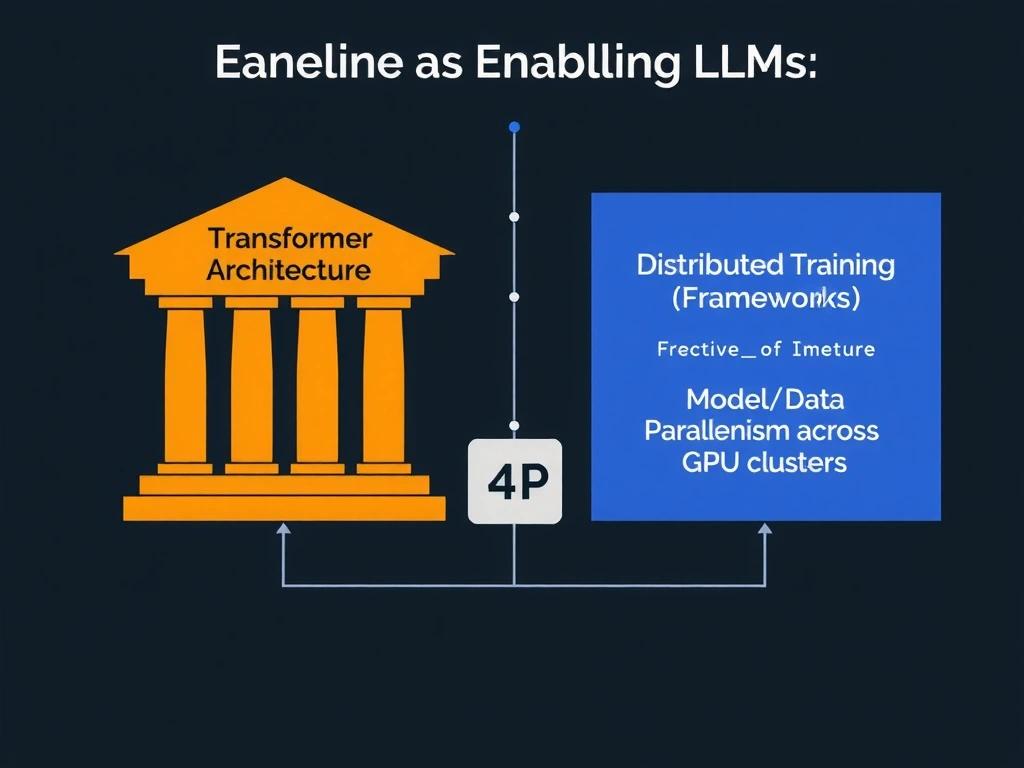
If you've paid attention to the news lately, you know Large Language Models are everywhere. But how did we get here? It didn't happen by accident. Two massive pieces of the puzzle had to fall into place. First, we got the Transformer architecture. Before Transformers, we used older architectures that struggled to process long sentences and couldn't be trained in parallel. The Transformer changed the game by allowing parallel processing of text. Second, we needed a way to train these massive models across hundreds or thousands of GPUs. That's where distributed training frameworks (like Megatron-LM or DeepSpeed) come in. They split the model and data across multiple chips so we can actually finish training before we grow old. The other options are just distractors—inference costs are still high, cloud investments are skyrocketing, and proprietary software lock-in didn't cause this boom. It's all about the math (Transformers) and the scale (distributed training)!
Full explanation below image
Full Explanation
The recent revolution in Large Language Models (LLMs) was enabled by two primary pillars: architectural breakthroughs and distributed system scalability.
First, the introduction and refinement of the Transformer architecture (originally proposed in the "Attention Is All You Need" paper) replaced older sequential architectures like Recurrent Neural Networks (RNNs) and Long Short-Term Memory (LSTM) networks. Transformers leverage self-attention mechanisms, which allow the model to process all tokens in a sequence simultaneously rather than one by one. This parallelism made it computationally feasible to train much larger models on massive datasets.
Second, because LLMs contain billions or trillions of parameters, they cannot fit into the memory of a single GPU. The development of efficient distributed training frameworks (such as Megatron-LM, DeepSpeed, and PyTorch FSDP) enabled model and data parallelism. These frameworks partition the model's weights, gradients, and optimizer states across thousands of accelerator nodes, allowing cluster-scale training with high hardware utilization.
Let’s review why the other options are incorrect: - Option A: While inference cost optimization is active, it is a consequence of model scaling, not the primary driver that enabled the LLM surge. - Option C: Open-source frameworks (like PyTorch and Hugging Face) have been the primary drivers of LLM development, rather than a reliance on proprietary software. - Option D: Cloud infrastructure investments have surged dramatically, not decreased. - Option E: Access to vast, diverse training datasets was necessary for LLMs. Strictly regulating or restricting data access would have hindered the growth of these models.