
The artificial intelligence landscape has recently been dominated by the rapid development and deployment of Large Language Models (LLMs). Which two of the following advancements have been most critical in enabling researchers to successfully train and scale these multi-billion parameter models? (Choose two)
Select all correct answers, then click Submit.
Short Explanation and Infographic
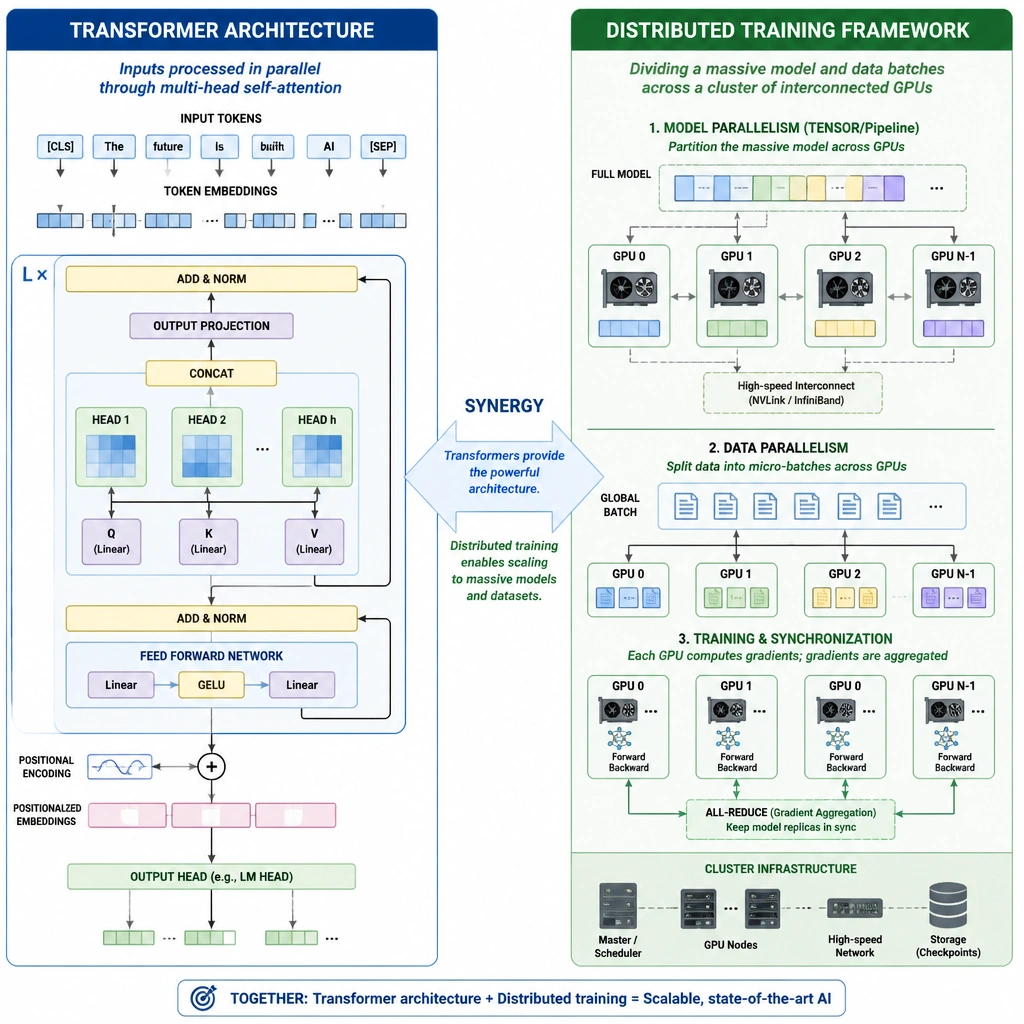
Check this out: LLMs didn't just appear out of thin air. They represent a massive leap in both software design and infrastructure scaling. First, you've got the Transformer architecture. Before Transformers, we struggled to process long sequences of text efficiently. The self-attention mechanism changed everything by allowing parallel processing of words. Second, even with Transformers, these models are too big for one computer. We needed software frameworks that could split the training workload across thousands of GPUs—things like Megatron-LM or DeepSpeed. That's distributed training, and it's the engine behind modern AI. The other options? They would slow us down, not speed us up!
Full explanation below image
Full Explanation
The recent revolution in Large Language Models (LLMs) is built upon two major breakthroughs: architectural innovations and engineering scale. The introduction of the Transformer architecture (utilizing self-attention mechanisms) allowed neural networks to process sequence data in parallel rather than sequentially, which was a major limitation of older architectures like RNNs or LSTMs. This enabled the design of much larger models. However, training models with tens or hundreds of billions of parameters requires more memory and compute than any single machine can provide. The development of distributed training frameworks (such as Megatron-LM, DeepSpeed, and PyTorch FSDP) made it possible to split models and datasets across thousands of GPUs (using data, tensor, and pipeline parallelism), enabling practical training timelines. Option A is incorrect because while inference optimization is important, it is a downstream benefit rather than the enablement of the initial development and training surge. Options C, D, and E describe negative factors (closed-source lock-in, reduced infrastructure funding, and data restrictions) that would hinder rather than enable the development and scale of LLMs.