
A DevOps engineer needs to coordinate, monitor, and scale a multi-node distributed deep learning training job across a large Kubernetes cluster. Which tool is specifically designed to manage this entire machine learning workflow?
Select an answer to reveal the explanation.
Short Explanation and Infographic
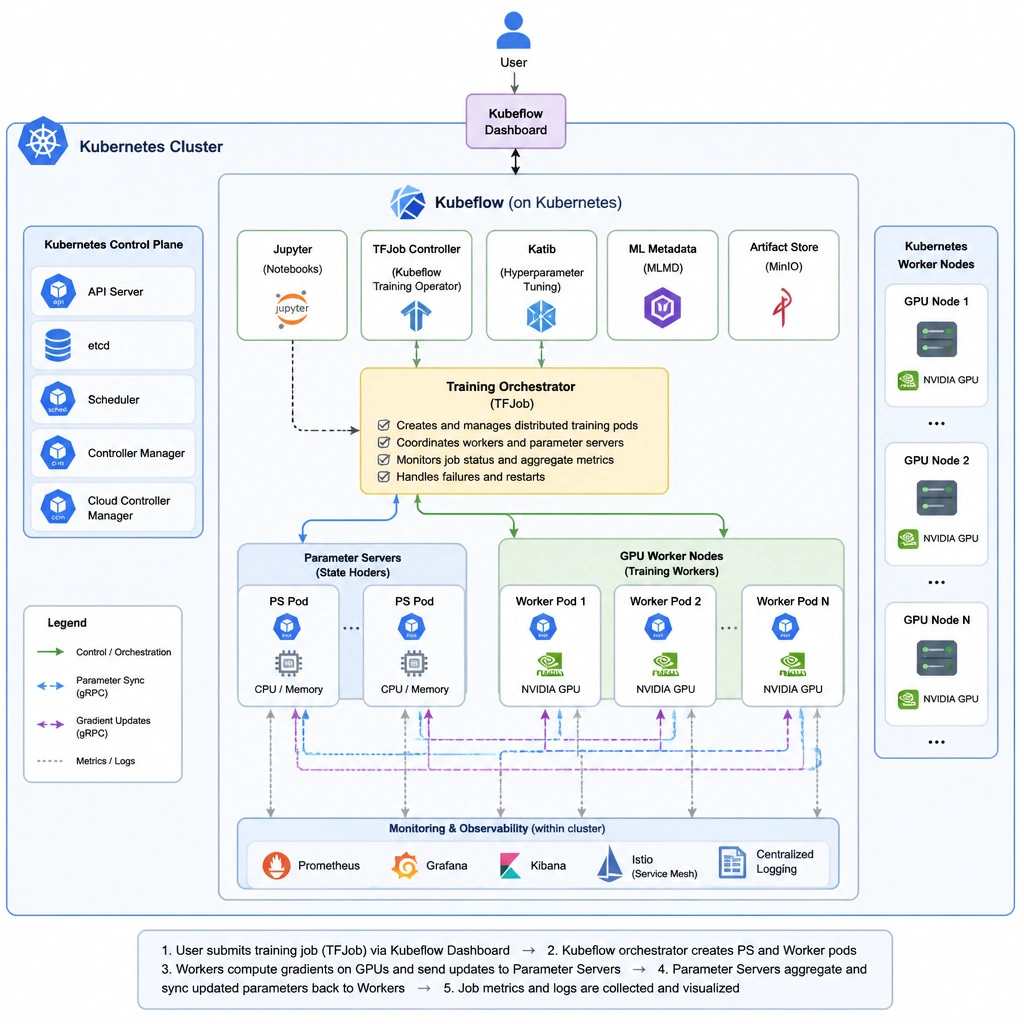
Okay, let's look at the toolbox here. You've got a Kubernetes cluster, you've got a ton of GPUs, and you want to run a massive distributed training job. How do you orchestrate the whole ML pipeline? You need a tool that speaks machine learning. That's Kubeflow. It's built specifically on top of Kubernetes to handle the end-to-end ML lifecycle—from training to deployment. Think of it as the conductor of your AI orchestra. Now, let's look at the other tools so you don't get tripped up on the exam. Ansible is great for configuring servers—like setting up users or installing packages. Helm is a package manager for Kubernetes (think of it like an app store). And Docker Compose? That's strictly for running a few containers on a single host, not managing distributed training across a whole cluster. So for distributed AI workflows on Kubernetes, Kubeflow is the absolute way to go!
Full explanation below image
Full Explanation
Kubeflow is an open-source machine learning (ML) toolkit designed specifically for Kubernetes. It focuses on making deployments of machine learning workflows on Kubernetes simple, portable, and scalable. In a large-scale AI infrastructure, Kubeflow provides custom controllers and operators (such as the TFJob or PyTorchJob operators) that simplify the orchestration of distributed training jobs across multiple nodes and GPUs. It handles the complex coordination of parameter servers and worker nodes, which is necessary for frameworks like TensorFlow and PyTorch.
Let's break down why the other options are not the primary tool for this task: - Helm is a package manager for Kubernetes. While you might use Helm to install Kubeflow or other applications onto a Kubernetes cluster, Helm itself does not orchestrate or manage the execution and scaling of distributed machine learning workflows. - Ansible is an IT automation and configuration management tool. It is excellent for provisioning infrastructure, installing software packages, and configuring operating systems, but it is not designed to manage dynamic, containerized machine learning pipelines at runtime. - Docker Compose is a tool for defining and running multi-container Docker applications on a single host. It lacks the clustering capabilities, scheduling logic, and scalability required to manage distributed AI training workloads across a cluster of multi-GPU servers.