
When building out the networking environment for a large-scale GPU cluster, why is it critical to set up a dedicated Out-of-Band Management (OOBM) network for the switches?
Select an answer to reveal the explanation.
Short Explanation and Infographic
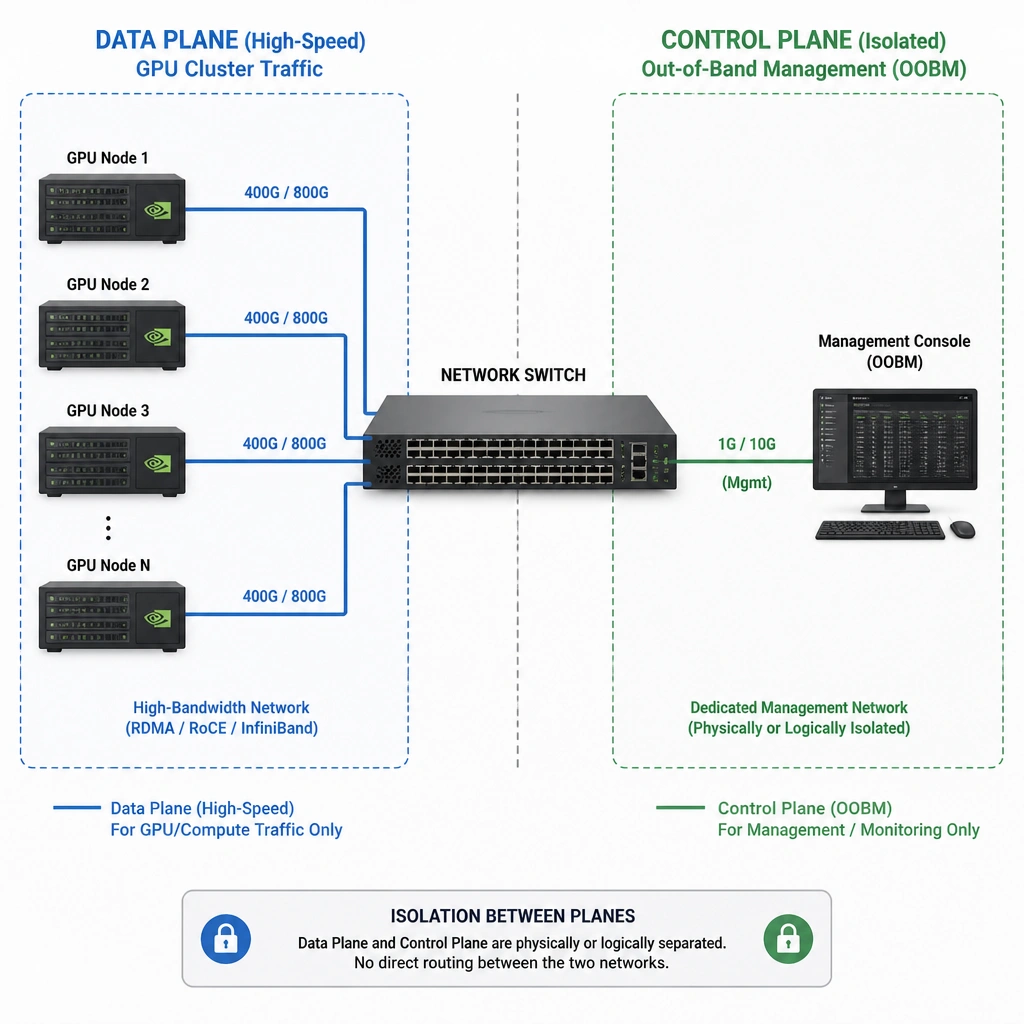
Let's talk about network management. Imagine if the roads in your town were completely jammed with cars, and the police couldn't get through to clear an accident because they had to drive on the same roads. That's what happens when you combine your management traffic with your data traffic—called In-Band management. If your high-speed data fabric gets congested or attacked, you lose access to your switches! Out-of-Band Management (OOBM) is like having a private, dedicated helicopter path for the administrators. It uses a completely separate physical network to monitor and configure the switches. This is huge for security because it keeps the management interfaces off the public or data network. Even if the data plane is saturated with heavy GPU traffic or hit with a denial-of-service attack, you can still log in and manage the gear securely. Trust me on this: keep your control plane separate, or you'll regret it when things go south!
Full explanation below image
Full Explanation
Out-of-Band Management (OOBM) is a security and operational best practice in network engineering, especially critical in high-performance AI clusters. It involves creating a dedicated physical or logical network interface solely for management traffic—such as console access, SSH, SNMP, and firmware updates—that is entirely separate from the primary data network (data plane) where GPU-to-GPU and node-to-node storage traffic flows.
The primary benefit of this separation is enhanced security and system resilience. By isolating the management plane, administrators prevent standard users, workloads, or malicious actors on the data network from accessing sensitive switch configuration interfaces. This significantly reduces the attack surface of the network infrastructure. Furthermore, if the data plane experiences severe congestion (which is common during intensive distributed AI training jobs) or a network-level outage, the OOBM network remains functional. This allows engineers to troubleshoot, configure, or reboot switches remotely without relying on the degraded data path.
Let's review the incorrect options: - Option A: OOBM does not dynamically reallocate data plane bandwidth or optimize GPU utilization; that is the job of traffic scheduling, quality of service (QoS) on the data plane, or the cluster orchestrator. - Option B: OOBM is used for device management and configuration, not for automating the deployment of machine learning models or containers. - Option D: Out-of-band networks carry management traffic, not application data. Therefore, they have no impact on the latency of AI inference requests.