
When architecting hardware infrastructure for an enterprise AI lifecycle, how do the resource requirements typically compare between the model training phase and the production inference phase?
Select an answer to reveal the explanation.
Short Explanation and Infographic
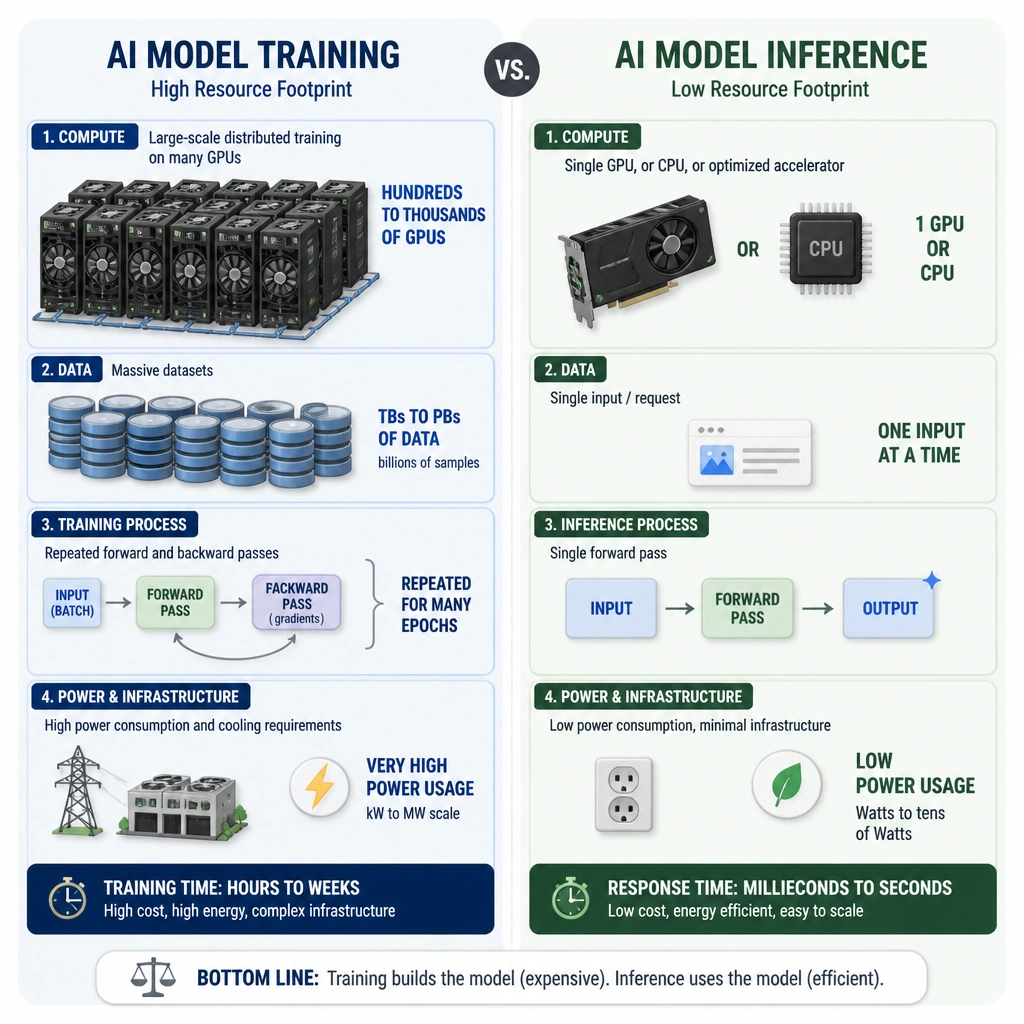
Here's the deal on training versus inference: they are two completely different beasts. Think of training like studying for a PhD in quantum physics. You need to read thousands of books, ingest massive datasets, and run calculations over and over again. That takes a ton of brainpower—or in our case, massive GPU or TPU clusters with high-bandwidth memory (HBM). It's computationally heavy, and it takes days or weeks of intense crunching. Now, think of inference like taking a quick multiple-choice quiz. The AI has already studied. It just needs to look at a prompt and give you a response. That takes way less power! You can often run inference on a single GPU, or even a standard CPU if latency isn't a huge blocker. Don't fall for the trap of thinking they need the same horsepower—training is where the heavy lifting happens, and inference is just applying what was learned.
Full explanation below image
Full Explanation
The AI lifecycle is divided into two distinct phases with highly asymmetric resource requirements: training and inference. Understanding this asymmetry is crucial for designing cost-effective and performant AI infrastructure.
Model training is the process of teaching a neural network by feeding it large datasets, calculating prediction errors (loss), and updating weights through backpropagation. This process requires massive computational power (often distributed across clusters of high-end GPUs or TPUs) and huge memory capacity to store model weights, gradients, and optimizer states. High-bandwidth interconnects (like NVLink and InfiniBand) are also essential to facilitate rapid data transfer between GPUs during distributed training.
In contrast, inference is the process of using a trained model to make predictions on new, unseen data. During inference, only the forward pass of the neural network is executed. There is no backpropagation, no gradient tracking, and no weight updates. As a result, the computational and memory footprint of a single inference request is a fraction of what is required for training. While inference still requires low-latency performance to meet user SLA guarantees, it can often be served on smaller, lower-power accelerators, single GPUs, or even standard CPUs.
Let’s review the incorrect options: - Option A: While FPGAs or ASICs are sometimes used for inference, they are not universally required over GPUs or CPUs, nor is inference more resource-demanding than training. - Option C: Training and inference have highly asymmetric footprints. Training involves backward passes and weight updates, making it far more compute- and memory-intensive. - Option D: Training is never optimized for low-spec hardware due to the sheer volume of operations required. Inference, while needing to be fast, is computationally much lighter than training.