
You are deploying a distributed microservices-based AI application inside a Kubernetes cluster. Which two of the following statements accurately describe how Kubernetes handles network routing, service discovery, and external traffic management within its architecture? (Choose two)
Select all correct answers, then click Submit.
Short Explanation and Infographic
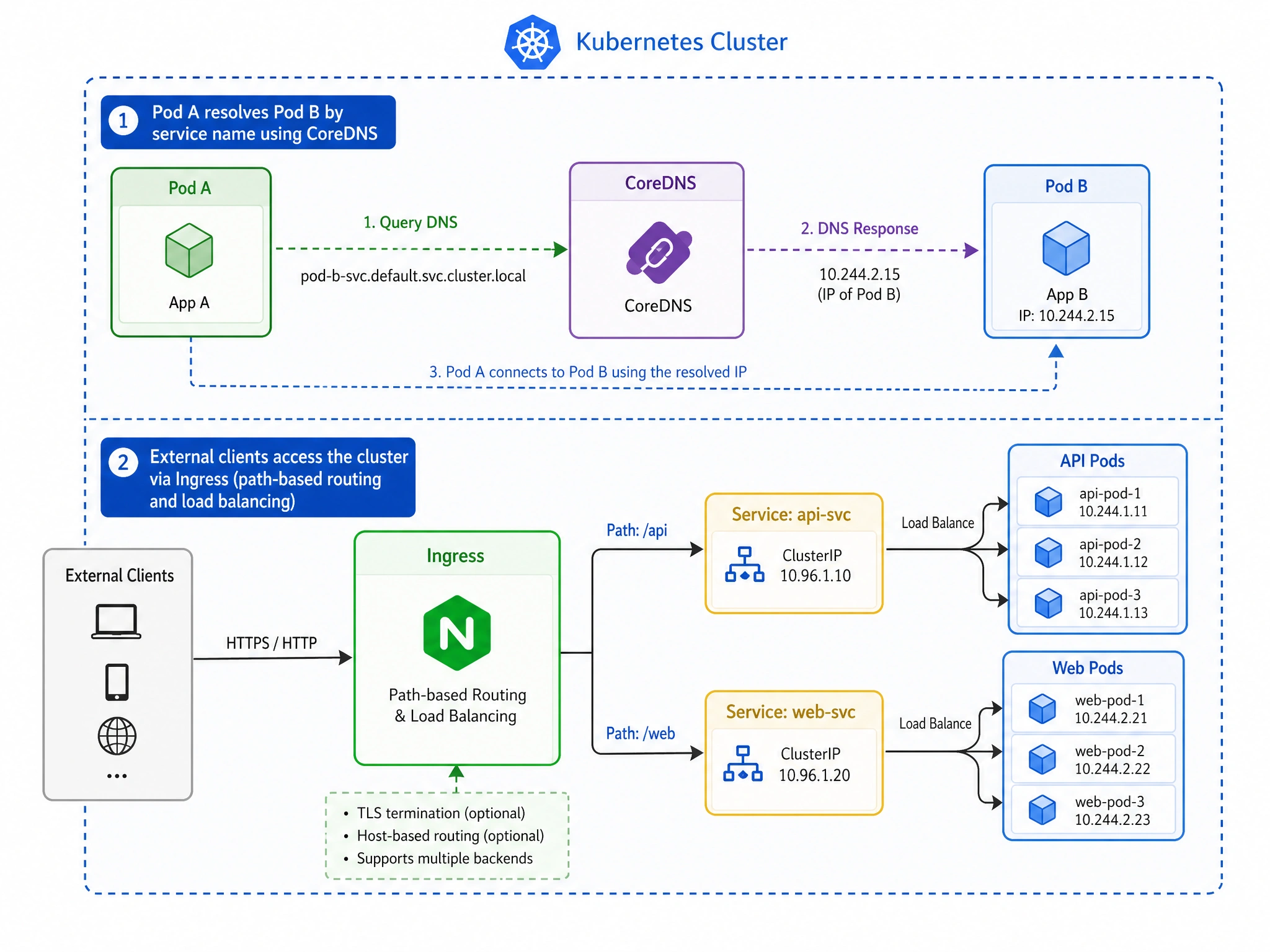
Alright, let's talk Kubernetes networking. It's a huge topic, and there are a couple of core concepts you must know. First off, how do pods find each other? Do we have to hardcode IP addresses? No way! Kubernetes has a built-in DNS service (usually CoreDNS) that lets pods find each other by name. Nice and clean! Second, how do we let customers outside the cluster access our application? We use Ingress resources. Think of Ingress as a smart traffic cop at the edge of your cluster that handles routing, SSL termination, and load balancing for HTTP/HTTPS traffic. Options A, B, C, and F are incorrect because Kubernetes networking is way more flexible than that—it supports UDP, handles basic pod networking, and uses NetworkPolicies to secure namespace communication.
Full explanation below image
Full Explanation
Kubernetes provides a robust networking model designed to simplify service discovery and external traffic management. A core feature of this model is the integrated DNS service (typically CoreDNS), which automatically registers new services and allows pods within the cluster to resolve other services by their logical DNS names (e.g., my-service.my-namespace.svc.cluster.local). This dynamic service discovery eliminates the need for hardcoded IP addresses or static environment variables. To manage incoming traffic from outside the cluster, Kubernetes defines Ingress resources. An Ingress controller acts as an entry point, routing external HTTP and HTTPS traffic to the appropriate internal services based on hostnames or URL paths, while also providing load balancing and SSL/TLS termination. Option A is incorrect because Kubernetes supports dynamic DNS-based service discovery. Option B is incorrect because while Kubernetes uses the CNI specification to integrate network providers, many standard installations include a default or simple network provider, and third-party plugins are not strictly 'proprietary' requirements for basic setup. Option C is incorrect because Kubernetes supports both TCP and UDP protocols for Services. Option F is incorrect because NetworkPolicies do allow administrators to control pod-to-pod communication based on labels and namespaces, acting as a firewall inside the cluster.