
An AI engineering team needs to run distributed deep learning workloads that dynamically scale containers across dozens of GPU-enabled physical servers. Which platform is best suited for automating the deployment, scaling, and orchestration of these distributed workloads?
Select an answer to reveal the explanation.
Short Explanation and Infographic
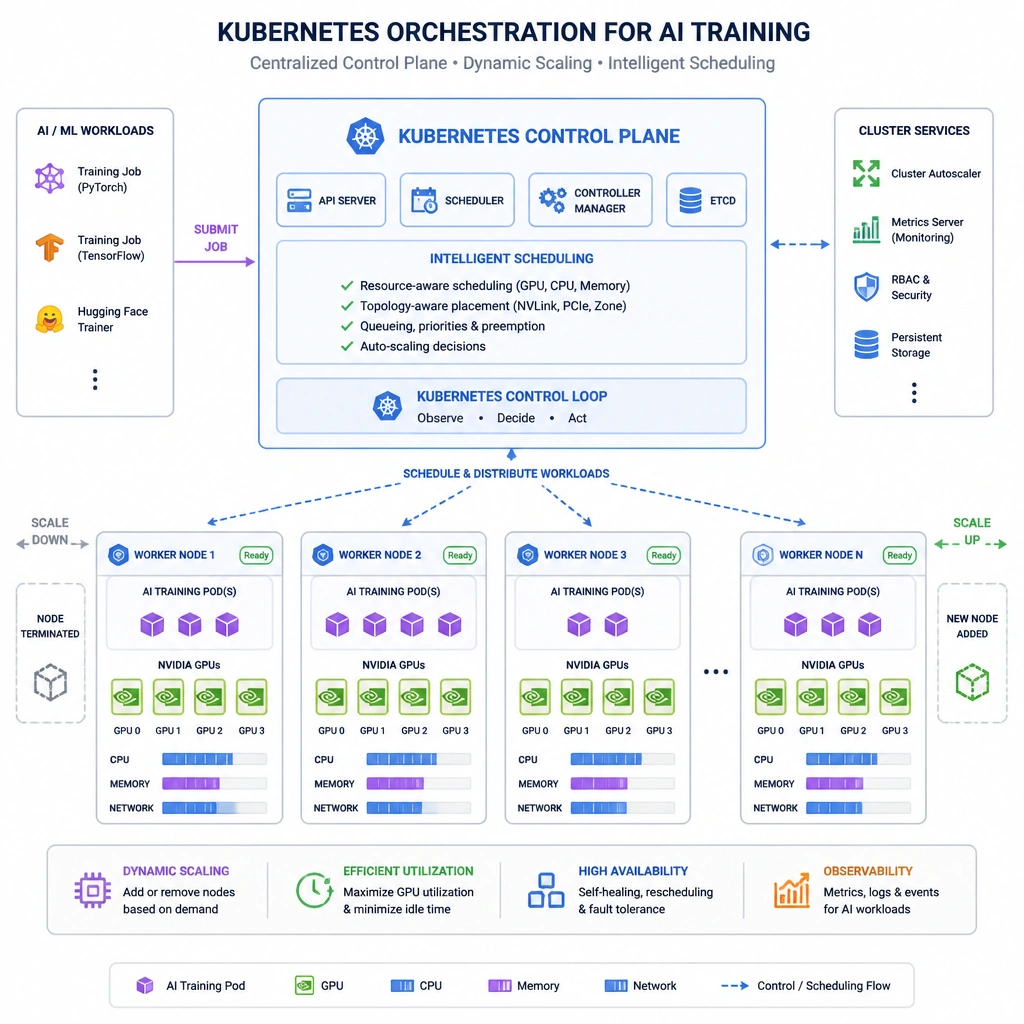
Imagine your boss walks in and says we need to scale up our training run from 4 GPUs to 64 GPUs by this afternoon. If you try to manage that manually using raw Linux servers or custom Bash scripts, you are going to have a very bad day. Bash scripts lack the built-in logic to handle container orchestration or recover from node failures. Ansible is great for configuring servers initially, but it's not meant to dynamically schedule containers on the fly. Docker Compose is awesome for running a multi-container app on your local laptop, but it doesn't scale across multiple servers. That is where Kubernetes (K8s) comes to the rescue! It acts as the brain of your cluster, automatically scheduling containers, managing GPU resources, scaling pods up or down based on demand, and self-healing if a server goes down. In the modern AI data center, Kubernetes is the gold standard for container orchestration.
Full explanation below image
Full Explanation
In modern distributed AI training and inference infrastructures, orchestrating workloads across clusters of GPU servers requires dynamic scheduling, resource isolation, auto-scaling, and fault tolerance.
Kubernetes (Option D) is an open-source container orchestration platform that has become the industry standard for managing containerized workloads at scale. It offers several features critical for distributed AI environments: - GPU Scheduling: Through device plugins (such as the NVIDIA GPU Device Plugin), Kubernetes can discover and allocate physical GPU resources to specific containers. - Dynamic Scaling: The Horizontal Pod Autoscaler (HPA) can scale application instances up or down based on resource metrics like CPU/GPU utilization or custom metrics. - Self-Healing: Kubernetes automatically restarts failed containers and reschedules them on healthy nodes if hardware faults occur. - Integration with AI Tools: Frameworks like Kubeflow, KubeRay, and Volcano run on top of Kubernetes to manage complex training pipelines and distributed execution.
In contrast: - Ansible (Option A) is a configuration management tool. It is excellent for provisioning operating systems, installing drivers, and configuring networking on servers, but it is not designed to orchestrate running container workloads in real time. - Bash Scripting (Option B) is an imperative scripting method. While useful for automation tasks, it lacks the orchestration logic, state management, and scheduling capabilities required to manage distributed clusters. - Docker Compose (Option C) is a tool for defining and running multi-container Docker applications on a single host. It lacks the clustering capabilities and scaling mechanisms required for multi-node deployments.