
A startup on a limited budget is developing a custom machine learning model. A decade ago, this would have required proprietary software and expensive local hardware. Which two of the following developments have been the most significant drivers in democratizing AI development, making it accessible to smaller organizations?
Select all correct answers, then click Submit.
Short Explanation and Infographic
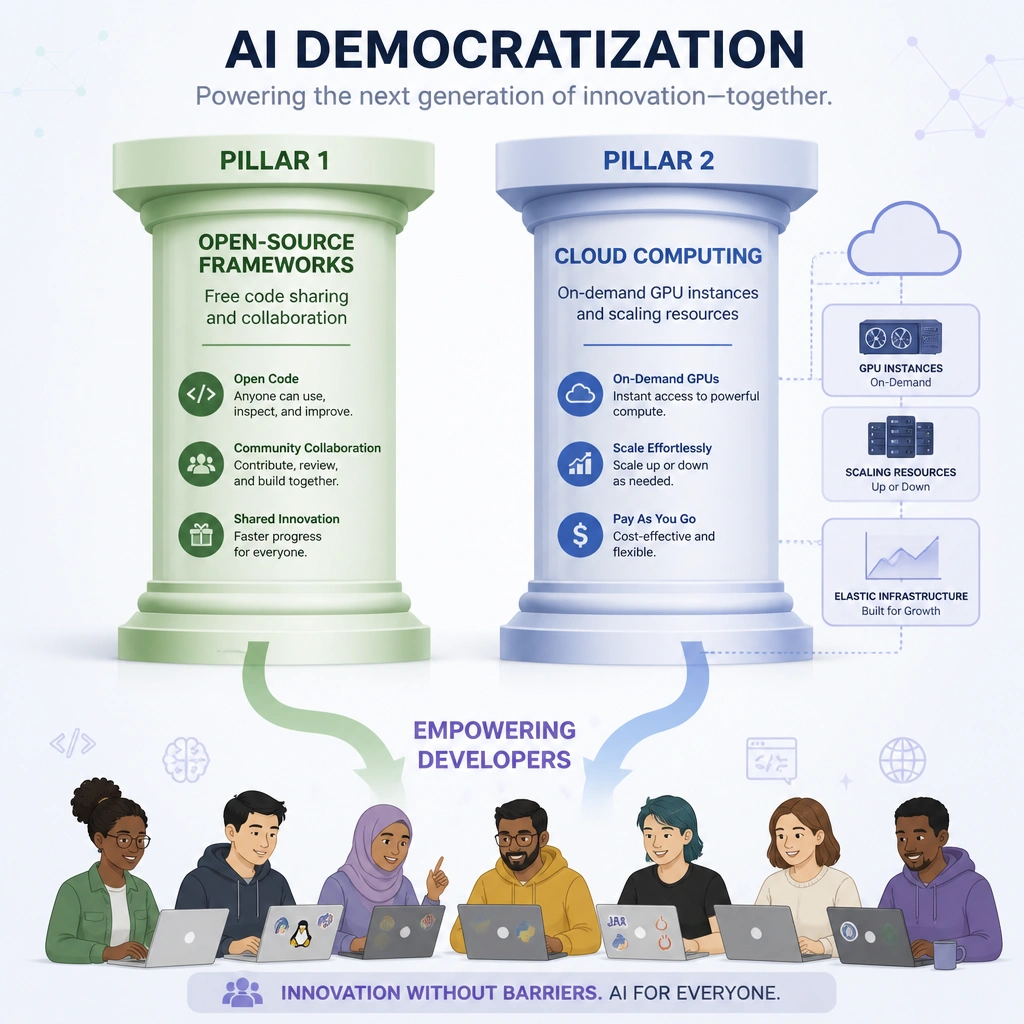
Think of it like this: back in the day, if you wanted to build anything resembling artificial intelligence, you needed a massive vault of cash, a PhD in mathematics, and a private data center. Not anymore! Today, anyone can spin up a state-of-the-art neural network. Why? First, check out the open-source movement. Frameworks like PyTorch are free for anyone to download, meaning you don't have to write backpropagation algorithms from scratch. Second, you have cloud computing. Instead of buying a million-dollar GPU cluster, you just rent GPU instances by the hour. These two factors blew the doors wide open, democratizing AI for everyone. The other options are actually barriers—things like proprietary code, complex architectures, and high costs make AI harder to access, not easier. Got it? Sweet. Let's keep rolling.
Full explanation below image
Full Explanation
The democratization of artificial intelligence refers to the process of making AI development tools, frameworks, and resources accessible to a broader audience, ranging from independent developers and startups to academic researchers, rather than restricting these tools to large technology corporations with vast capital. Two primary drivers have enabled this shift: the proliferation of open-source AI libraries and the rise of cloud computing.
First, open-source software libraries (such as PyTorch, TensorFlow, and Scikit-Learn) provide free, publicly accessible codebases that implement complex machine learning algorithms, optimization routines, and neural network layers. By leveraging these community-driven frameworks, developers do not need to write foundational mathematical operations or hardware-specific acceleration code from scratch. This significantly lowers the barrier to entry for software engineers entering the AI domain.
Second, the rise of cloud computing services (such as AWS, Google Cloud, and Microsoft Azure) has revolutionized access to computational resources. Deep learning training requires specialized hardware, particularly high-performance GPUs and TPUs, which are capital-intensive to purchase, house, and power. Cloud platforms allow organizations to rent these resources on an on-demand, pay-as-you-go basis, eliminating upfront capital expenditure (CapEx) and making high-performance computing accessible to anyone with an internet connection.
Conversely, the other options represent barriers to accessibility. Increased complexity in model architectures (Option C) and the scarcity of pre-trained foundation models (Option F) increase the difficulty and cost of development. Proprietary, closed-source libraries (Option B) restrict modification and require costly licensing fees, while high data storage and processing costs (Option D) further exclude resource-constrained developers.