
You are logged directly into an NVIDIA DGX server via SSH and want to check the current, real-time power draw (in Watts) of each individual GPU while a training job is running. Which built-in command-line utility should you run to view this granular power telemetry immediately?
Select an answer to reveal the explanation.
Short Explanation and Infographic
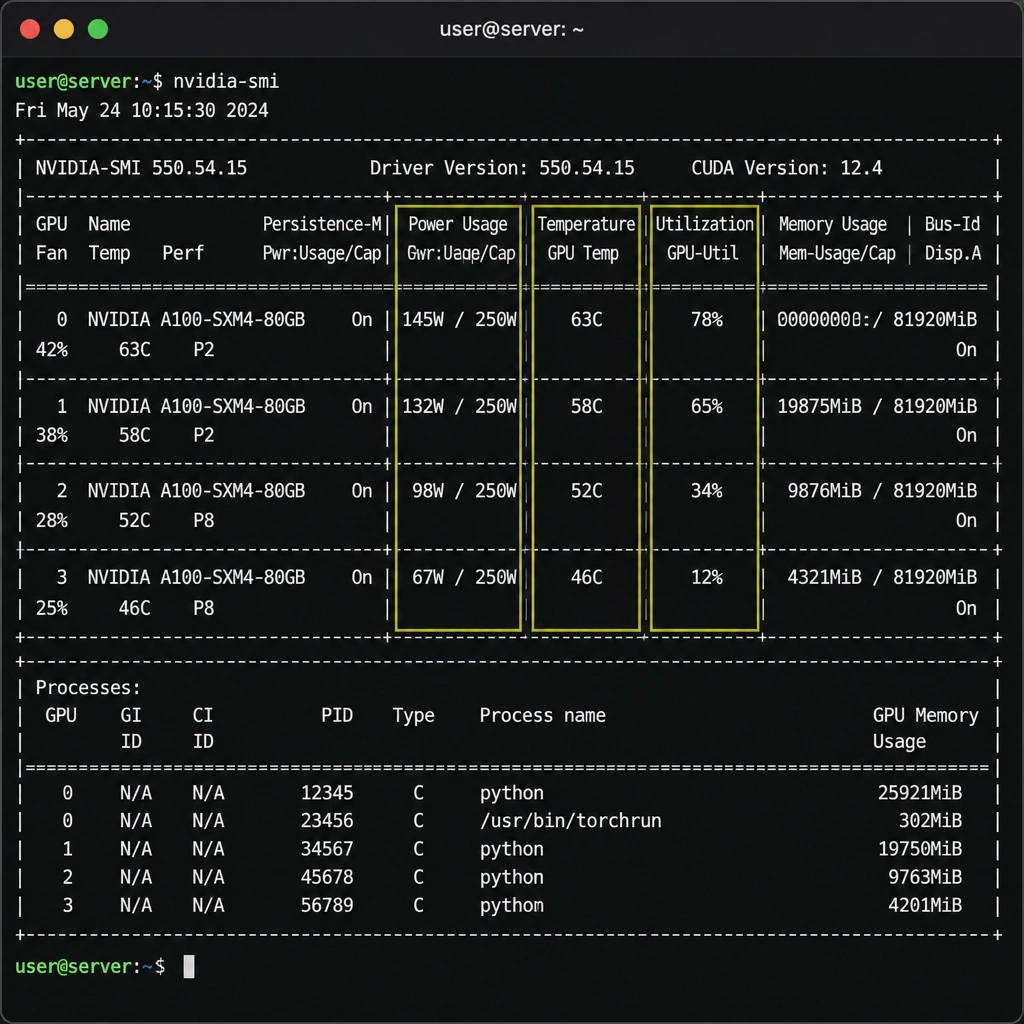
Alright, here you are, logged into your DGX server and you want to see exactly how much power your GPUs are sucking down right this second. What command do you type? It's nvidia-smi—the NVIDIA System Management Interface. This tool is your Swiss Army knife for local GPU monitoring. It displays everything: temperature, memory usage, fan speed, and, yes, the exact wattage each GPU is pulling. If you run top or ps, you're only going to see CPU usage and system processes, which won't tell you a thing about GPU power. And nvcc? That's the CUDA compiler, so running that will just give you compiler options, not real-time telemetry. Get comfortable with nvidia-smi—you'll be using it every single day.
Full explanation below image
Full Explanation
The NVIDIA System Management Interface (nvidia-smi) is a command-line utility based on the NVIDIA Management Library (NVML). It is designed to aid in the management and monitoring of NVIDIA GPU devices. - nvidia-smi (Option C) provides detailed, real-time query results for GPU health, temperature, memory usage, utilization, and power draw (reported in Watts) for each individual GPU installed in the system. It can also be configured to run in loop mode (using the -l flag or combined with the Linux watch command) to monitor live fluctuations during intensive compute runs. - top (Option B) and ps (Option D) are standard Linux utilities that monitor CPU utilization, system RAM, and running operating system processes. They do not have access to GPU-specific hardware sensors or telemetry. - nvcc (Option A) is the compiler driver for CUDA programs. It is used during the software development phase to compile CUDA C/C++ code and has no monitoring or telemetry capabilities.