
In recent years, we have seen a dramatic shift in how software engineers, startups, and academic researchers build machine learning models. Which two of the following developments have been most responsible for the democratization of, and widespread access to, modern AI development tools and computing power? (Choose two)
Select all correct answers, then click Submit.
Short Explanation and Infographic
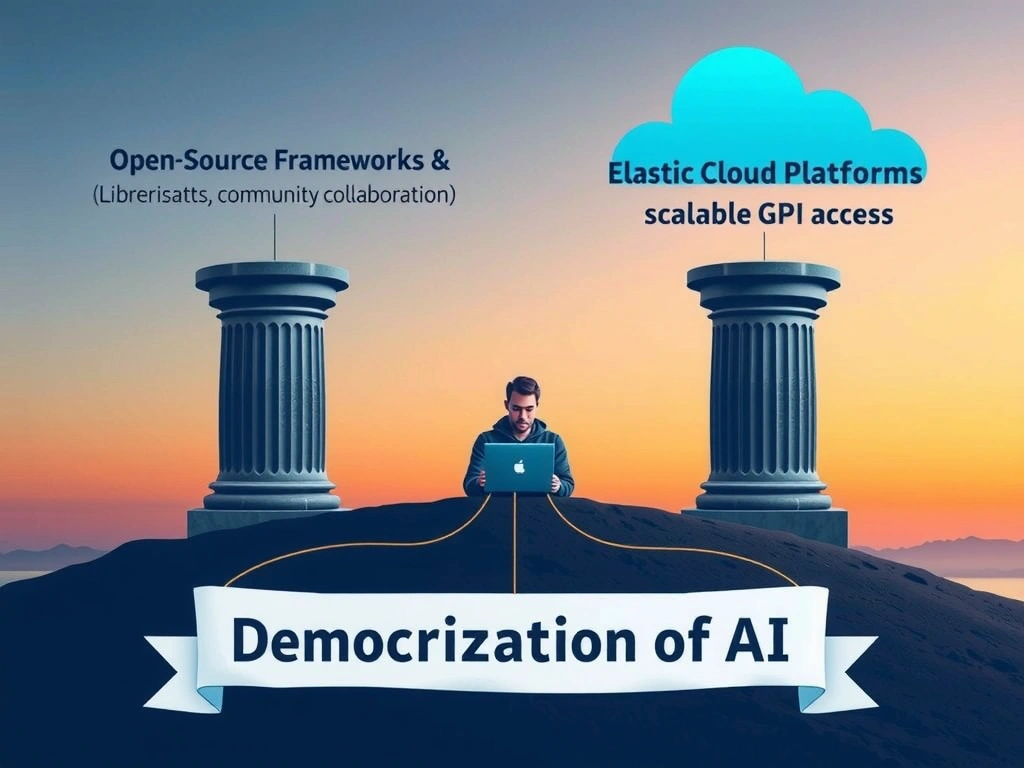
Think of it like this: back in the day, if you wanted to build an AI project, you needed to buy expensive, proprietary software and build a custom server room in your basement. But today, the game has completely changed. Anyone with a laptop and an internet connection can download open-source libraries like PyTorch or TensorFlow for free, and then rent raw, high-performance computing power in the cloud on demand. That's the democratization of AI in a nutshell! The other options listed here—like proprietary software, rising costs, and closed model checkpoints—are all hurdles that restrict access, not make it easier.
Full explanation below image
Full Explanation
The widespread accessibility and democratization of artificial intelligence can be attributed to two main pillars: the open-source software movement and the utility-based model of cloud computing. Open-source frameworks (such as PyTorch, TensorFlow, and Hugging Face) provide developers with free, production-ready libraries, standardizing model development and reducing the need to write complex algorithms from scratch. Simultaneously, cloud computing platforms (like AWS, Google Cloud, Azure, and Oracle Cloud) provide immediate access to specialized hardware, such as GPUs and TPUs, on a scalable, pay-as-you-go basis, eliminating the high capital expenditure required to purchase and maintain on-premises hardware. Option A is incorrect because closed-source, proprietary licenses restrict developer access and experimentation. Option B is incorrect because increasing model complexity creates a higher technical barrier to entry. Option D is incorrect because rising costs would impede democratization. Option E is incorrect because restricted access to pre-trained models would force teams to train models from scratch, which is financially and computationally prohibitive for most.