
A project manager asks you why the team needs to invest in expensive GPU hardware instead of running all deep learning training jobs on the existing multi-core CPU servers. Which of the following represents the most compelling technical justification for using GPUs in the training pipeline?
Select an answer to reveal the explanation.
Short Explanation and Infographic
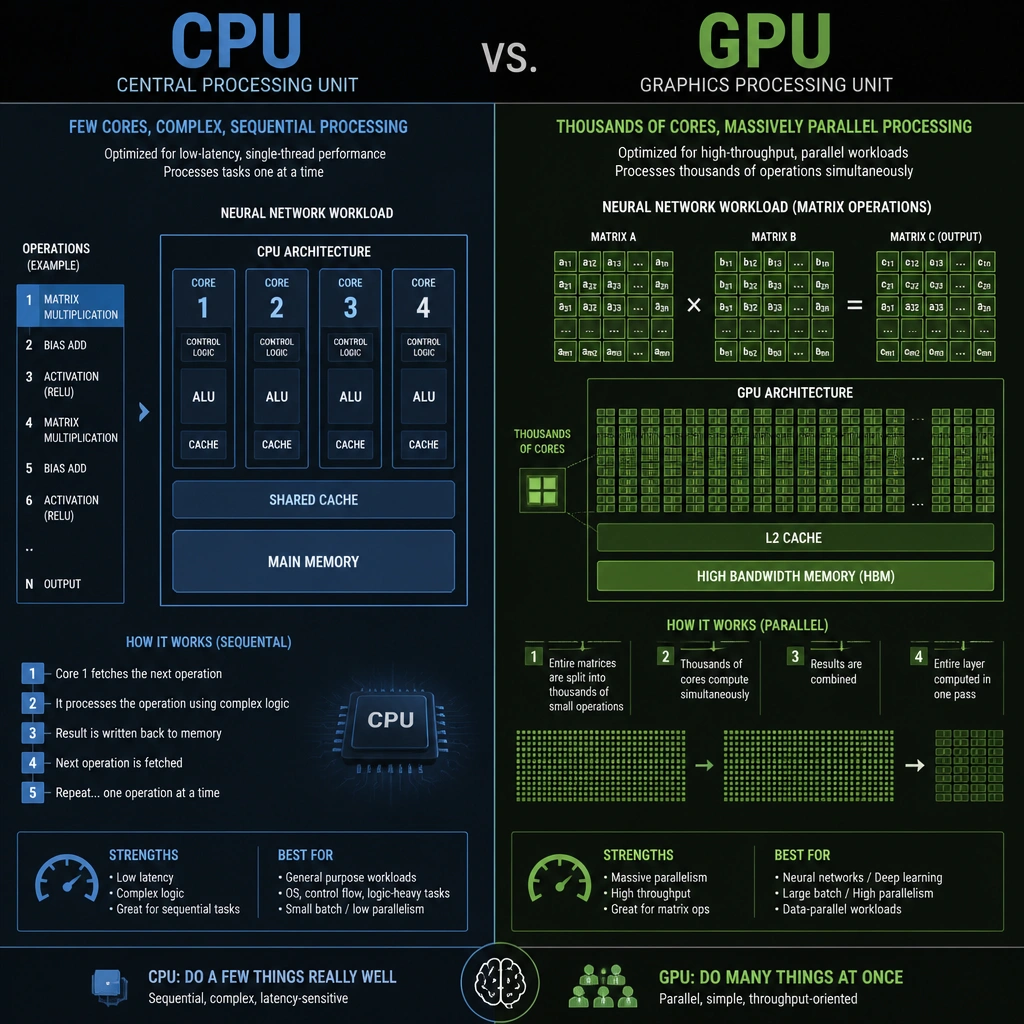
Here's a classic situation: your boss walks in and asks, 'Why are we spending thousands of dollars on these GPU rigs when we already have a rack full of fast multi-core CPUs?' You need to explain the math. Deep learning is basically just massive matrix multiplication. A CPU is like a Ferrari—it can run a few tasks incredibly fast one after another. But a GPU is like a giant train—it has thousands of tiny cores that can perform thousands of simple calculations all at the exact same time. By running these matrix operations in parallel on a GPU, you can shrink your training times from weeks or months down to just hours or days. Trust me, it doesn't make your code look prettier, and it doesn't automatically deploy your model for you. It's all about speed. Reducing that training loop time is the absolute lifeblood of AI development.
Full explanation below image
Full Explanation
Deep learning algorithms, particularly deep neural networks, are highly parallelizable. They consist primarily of matrix multiplications and vector additions, which can be executed simultaneously. - GPUs (Graphics Processing Units) are architected with thousands of smaller, simpler cores designed to handle parallel workloads. A CPU, by comparison, typically has a small number of complex cores optimized for sequential processing. By offloading matrix computations to the GPU, a deep learning pipeline can achieve massive speedups, dramatically reducing the overall training time for complex models (Option A). - Option B (code readability) is incorrect because writing GPU-accelerated code does not inherently make code cleaner or more readable; in fact, managing GPU memory allocations (e.g., calling .to('cuda') in PyTorch) adds slight complexity to the codebase. - Option C (deployment simplification) is incorrect because deploying a model to a GPU can introduce additional dependencies (such as CUDA drivers and runtime libraries), making the deployment process more complex than CPU-only environments. - Option D (visualization) is incorrect because while GPUs are excellent at 3D rendering, this is not the primary technical justification for using them to accelerate deep learning training pipelines.