
You are configuring a multi-node GPU cluster for distributed deep learning. In which of the following scenarios will implementing RDMA over Converged Ethernet (RoCE) provide the most significant boost to your training performance?
Select an answer to reveal the explanation.
Short Explanation and Infographic
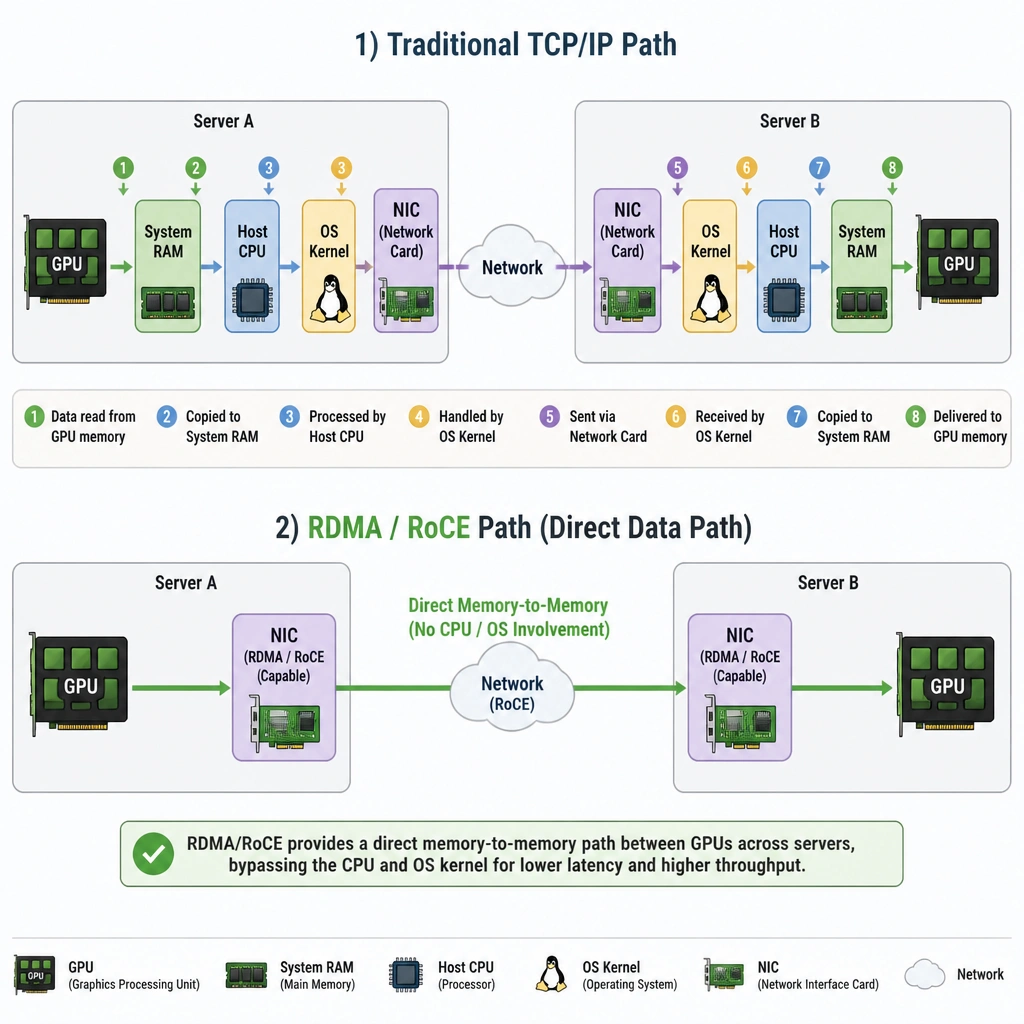
Alright, here's the deal with RDMA and RoCE. Normally, when servers talk over a network, the data has to go through the OS kernel, copy to system memory, and hit the CPU. That adds a ton of latency. RDMA lets one GPU write directly to the memory of another GPU on a completely different server, bypassing the host CPU and kernel entirely. Now, when do you actually need this? You need it when you're running distributed training across a bunch of nodes, and those GPUs are constantly swapping parameters during the backward pass (like in an All-Reduce operation). If your model fits on a single GPU, there's no network traffic, so RDMA does nothing. If your CPU is bogged down preprocessing images, RDMA won't help your CPU run faster. And if your network switches are already maxed out, bypassing the kernel won't create more physical bandwidth. It's all about speeding up those massive, frequent inter-node GPU updates.
Full explanation below image
Full Explanation
Remote Direct Memory Access (RDMA), and specifically RoCE (RDMA over Converged Ethernet), allows network adapters to transfer data directly between host memories without involving either operating system's kernel or CPU. This bypass reduces latency and CPU utilization while maximizing throughput. - In distributed deep learning (such as data-parallel or model-parallel training), multiple GPUs across different physical hosts must constantly synchronize gradients and parameters (typically using collective communication primitives like All-Reduce). Because these synchronizations occur at the end of every training iteration, network latency and bandwidth are the primary bottlenecks. RoCE is highly effective here (Option A) because it speeds up this inter-node GPU-to-GPU data transfer. - If a model fits on a single GPU (Option D), there is no inter-node communication, so RDMA offers no benefit. - CPU-based preprocessing bottlenecks (Option B) are resolved by optimizing CPU code or using GPU-accelerated libraries (like NVIDIA DALI), not by network protocols. - If a network is already operating at its maximum theoretical physical bandwidth capacity (Option C), switching to RoCE cannot bypass the hardware limitations of the physical links, although it would still reduce CPU overhead and latency.