
You are deploying a large language model (LLM) to handle real-time user queries, and the current latency is too high for a good user experience. Which of the following optimization techniques will most effectively reduce the time-to-first-token and overall inference latency on your NVIDIA GPU?
Select an answer to reveal the explanation.
Short Explanation and Infographic
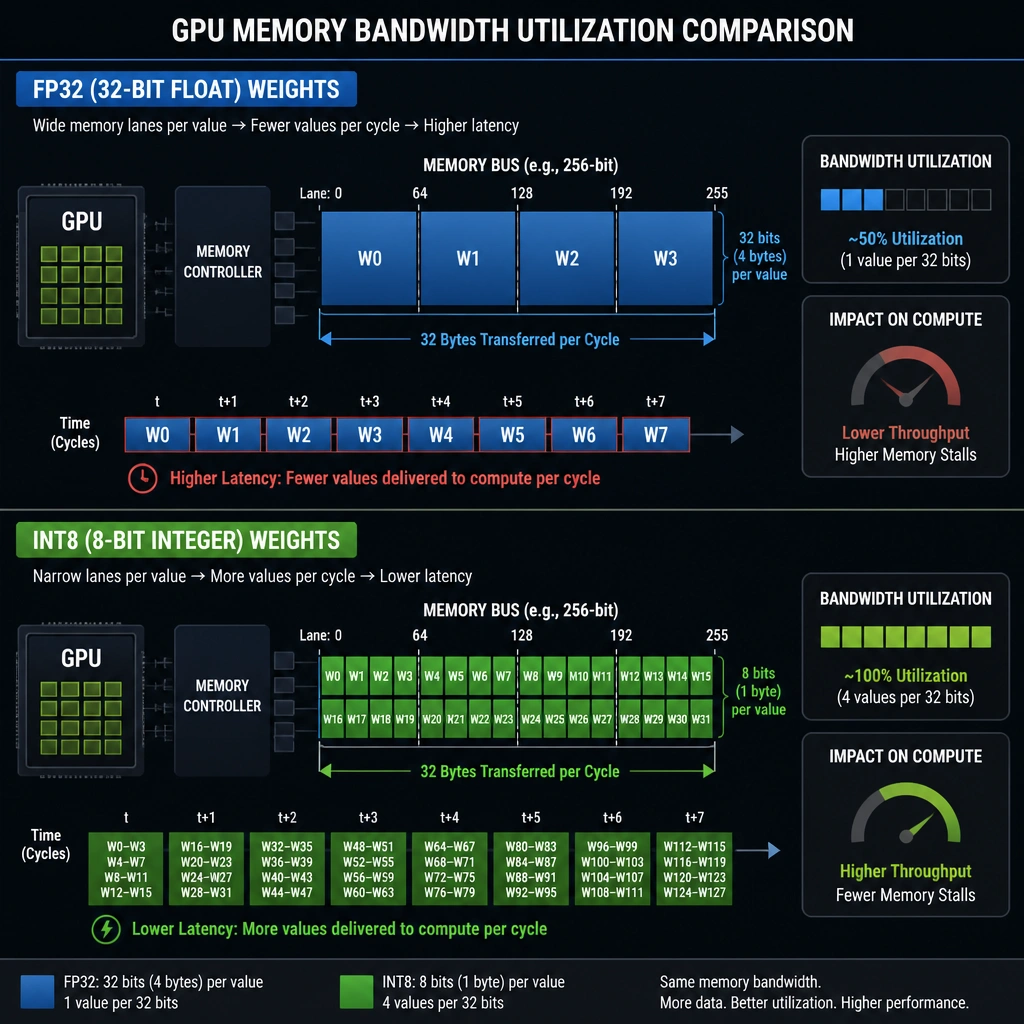
When you're running real-time inference for something like a chatbot, latency is king. If the user has to wait three seconds for the first word to appear, they're going to leave. So, how do we speed things up? Check this out: you need to look at precision. By default, models are often trained in FP32 (32-bit floating point). If you convert those weights to FP16 or INT8—a process we call quantization—you drastically shrink the model's memory footprint. That means less data has to travel over the memory bus, and the GPU's Tensor Cores can crunch the math much faster. Now, pay attention here: increasing your batch size actually improves throughput (total requests processed per second), but it usually increases the latency of individual queries. Downsizing your GPU will only slow you down, and just throwing more GPUs at the problem without rewriting your code to split the model won't do a thing. Quantization is your best friend for low latency.
Full explanation below image
Full Explanation
In real-time inference scenarios, the goal is to minimize latency (the time it takes to generate a response). For Large Language Models (LLMs), inference is heavily memory-bandwidth bound because the model weights must be loaded from GPU memory for every generated token. - Quantization or using lower-precision formats (such as FP16, BF16, or INT8) (Option C) directly addresses this bottleneck. By representing weights using 16 or 8 bits instead of 32 bits, the amount of data transferred from GPU memory to the compute cores is reduced by 50% to 75%. This also allows the GPU's Tensor Cores to perform more operations per second, leading to a substantial decrease in latency. - Increasing the batch size (Option A) maximizes GPU throughput (the total number of tokens generated per second across all users) but typically increases the latency for any single query, as the GPU must process more parallel calculations before returning results. - Using a less powerful GPU (Option B) will increase latency due to slower compute cores and lower memory bandwidth. - Adding more GPUs without modifying the model (Option D) does not automatically parallelize the inference workload; the model must be explicitly split (using tensor parallelism or pipeline parallelism) to see any performance benefit.