
When comparing an on-premises GPU cluster to a cloud-based GPU service for deep learning training, what is the primary operational disadvantage of the on-premises deployment model?
Select an answer to reveal the explanation.
Short Explanation and Infographic
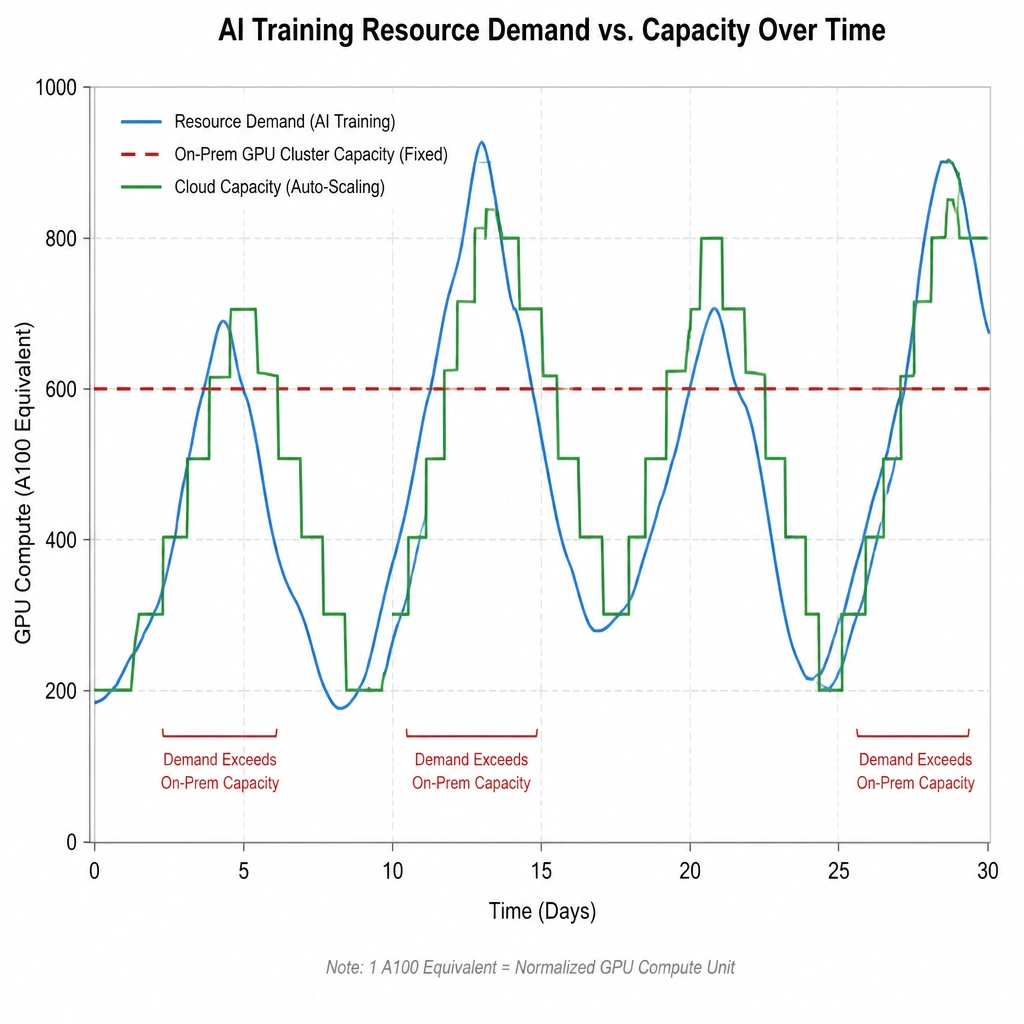
Think of it like this: your team is working on a model, and suddenly you need ten times the compute power because a major deadline is staring you in the face. If you're in the cloud, you can spin up those extra GPU instances in minutes. But if you're on-premises? You're stuck with whatever hardware is currently bolted into your racks. Buying and installing new physical servers takes weeks—sometimes months—for procurement, shipping, and setup. That lack of dynamic scaling, or elasticity, is the biggest operational headache with on-premises clusters. Now, don't get confused: you can run Docker, PyTorch, and use any pre-trained model you want on your own gear just as easily as in the cloud. The software stack is identical. But when it comes to shifting your compute resources on the fly, the cloud wins hands down.
Full explanation below image
Full Explanation
One of the defining characteristics of cloud computing is elasticity—the ability to provision and deprovision resources dynamically based on demand. In contrast, an on-premises GPU server cluster has a fixed capacity. If training demands spike (for example, during hyperparameter sweeps or near project deadlines), developers cannot instantly scale up their compute resources beyond the physical limits of their local hardware. Scaling up requires hardware procurement, physical installation, and configuration, which can take weeks or months. - The inability to scale compute resources dynamically (Option B) is the correct answer because it represents a key operational limitation of physical infrastructure compared to the cloud. - Support for container runtimes like Docker (Option A), standard frameworks like PyTorch and TensorFlow (Option C), and the use of pre-trained models (Option D) are software-level capabilities. These are fully supported in both cloud and on-premises environments, typically using the NVIDIA Container Toolkit and NGC (NVIDIA GPU Cloud) containers.