
You are planning the physical deployment of NVIDIA DGX A100 systems in your data center rack. To calculate power consumption and compute density, how many onboard NVIDIA A100 Tensor Core GPUs (Ampere architecture) will you find inside a single standard DGX A100 system?
Select an answer to reveal the explanation.
Short Explanation and Infographic
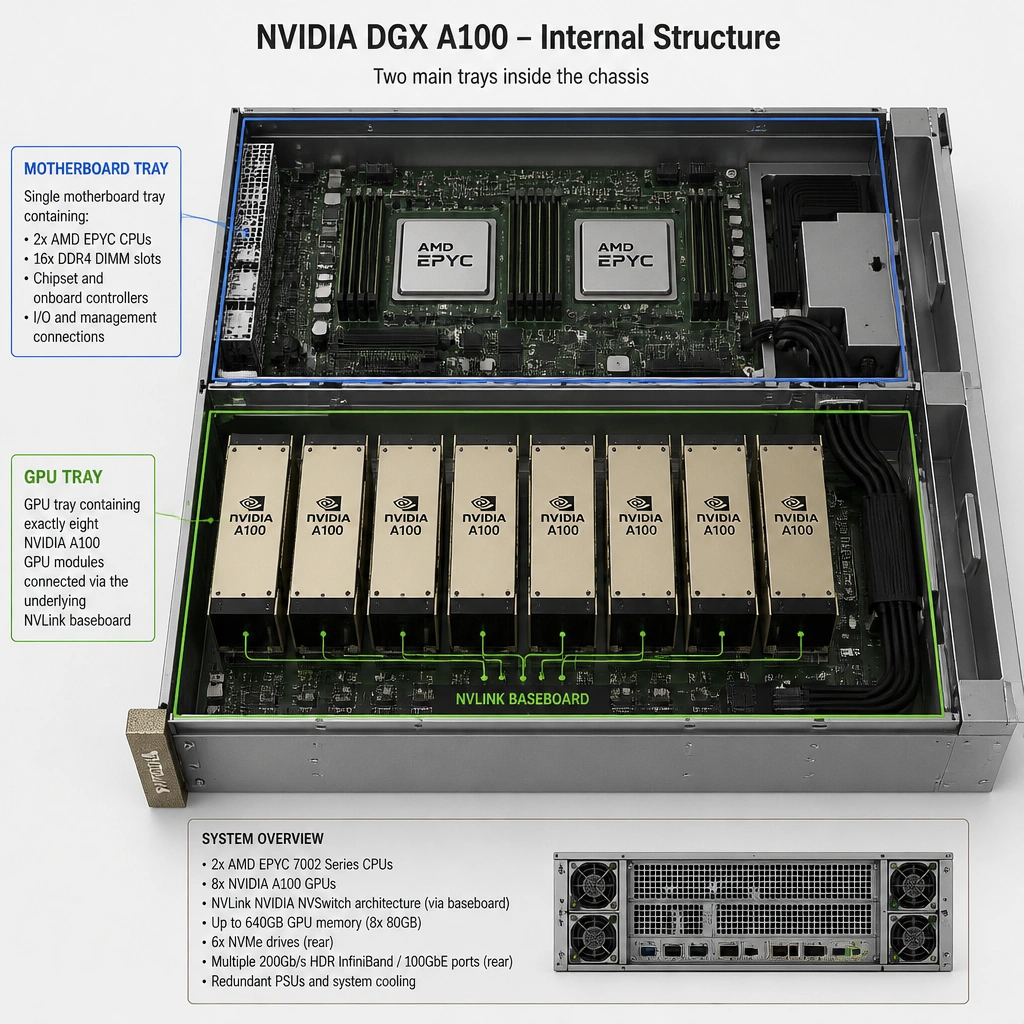
Okay, let's look at the hardware. The NVIDIA DGX A100 is a beast of a server, but you've got to know exactly what's under the hood when you're planning your power budgets and rack layouts. A standard DGX A100 system houses exactly eight A100 Tensor Core GPUs. They're all connected via a massive NVLink board on the inside, allowing them to act as a single, giant accelerator. If you think there are only two or four, you're underestimating the density of this box, and if you think there are sixteen, you're probably confusing it with a larger clustered deployment or multi-node setup. Remember this number: eight. It's the magic number for a single DGX A100 chassis.
Full explanation below image
Full Explanation
The NVIDIA DGX A100 is a foundational building block for AI enterprise infrastructure. A single standard 6U chassis contains exactly eight NVIDIA A100 Tensor Core GPUs based on the Ampere architecture. These eight GPUs are interconnected via six third-generation NVIDIA NVSwitch chips, providing a total bi-directional bandwidth of 4.8 terabytes per second. This architecture allows the system to operate as a single unified GPU using NVIDIA's NVSwitch fabric, or to be partitioned into up to 56 individual GPU instances using Multi-Instance GPU (MIG) technology. - 8 GPUs (Option B) is the correct hardware specification for the DGX A100. - 4 GPUs (Option A) and 2 GPUs (Option D) are incorrect configurations for a standard DGX A100, though some custom OEM servers may offer these counts. - 16 GPUs (Option C) is also incorrect; while some larger systems (like the older HGX-2 or certain DGX-2 systems) utilized 16 GPUs, the standard DGX A100 standardized on an 8-GPU configuration.