
When developing an AI-driven system that processes highly regulated data—such as patient healthcare files or secure financial transactions—why might an enterprise opt for an on-premises infrastructure deployment over a public cloud solution?
Select an answer to reveal the explanation.
Short Explanation and Infographic
Here's the deal: the public cloud is fantastic for quick scaling and convenience, but when you are dealing with ultra-sensitive data—think medical records or bank accounts—the rules change. If you put that data in the cloud, you're trusting someone else's security and physical servers. In highly regulated industries, regulatory bodies will hammer you if data crosses international borders or gets exposed. Going on-premises gives you absolute control over data residency and physical security. You know exactly where the drives are, who has physical keycard access to the server racks, and where the network packets are flowing.
Full explanation below image
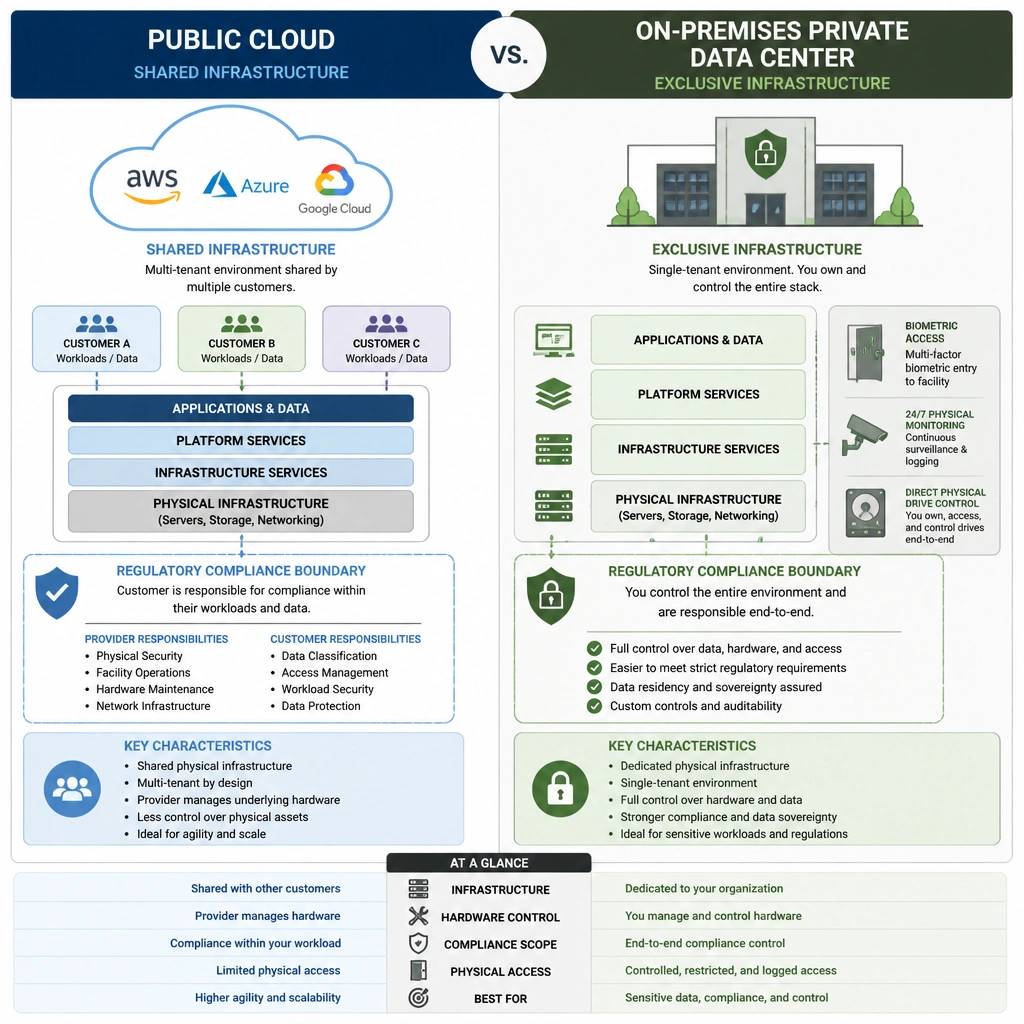
Full Explanation
The decision between deploying AI workloads on-premises versus in the public cloud involves balancing cost, scalability, management overhead, and security/compliance requirements. For organizations handling highly sensitive, regulated data (such as financial transactions subject to PCI-DSS, healthcare data subject to HIPAA, or user data subject to GDPR/CCPA), on-premises infrastructure offers distinct advantages in governance and compliance.
Key factors include: 1. Data Sovereignty and Residency: Many regulations require that specific types of data must reside within national borders or specific physical boundaries. Managing on-premises hardware ensures complete control over where the physical data storage media is located. 2. Physical and Network Security: An on-premises deployment allows the organization to control the physical access controls (such as biometric security at the data center door) and enforce air-gapped network configurations that are completely isolated from the internet. 3. Auditability: Enterprises can easily audit the entire hardware and software stack to prove compliance to regulators, without relying on third-party cloud vendor attestations.
Let's address the incorrect options: - Reduced operational overhead (Option A): This is actually a major benefit of the public cloud, which handles hardware provisioning, power, cooling, and virtualization layers. On-premises deployments require dedicated IT teams to manage hardware lifecycles. - Elastic scaling (Option C): Public clouds provide virtually infinite resources that can auto-scale dynamically in response to workload demands. On-premises capacity is capped by the physical hardware installed in the racks. - Lower TCO (Option D): While on-premises can have lower long-term costs for highly utilized, steady-state workloads, it is not a guarantee. On-premises requires high initial capital expenditures (CapEx) and continuous maintenance costs, which can exceed cloud costs if resource utilization is low or unpredictable.