
A deep learning team finds that training a massive recommendation system model on a single high-end workstation takes weeks and frequently crashes due to GPU Out-of-Memory (OOM) errors. Which of the following describes how migrating to a distributed, multi-GPU AI cluster resolves both the time and memory capacity constraints?
Select an answer to reveal the explanation.
Short Explanation and Infographic
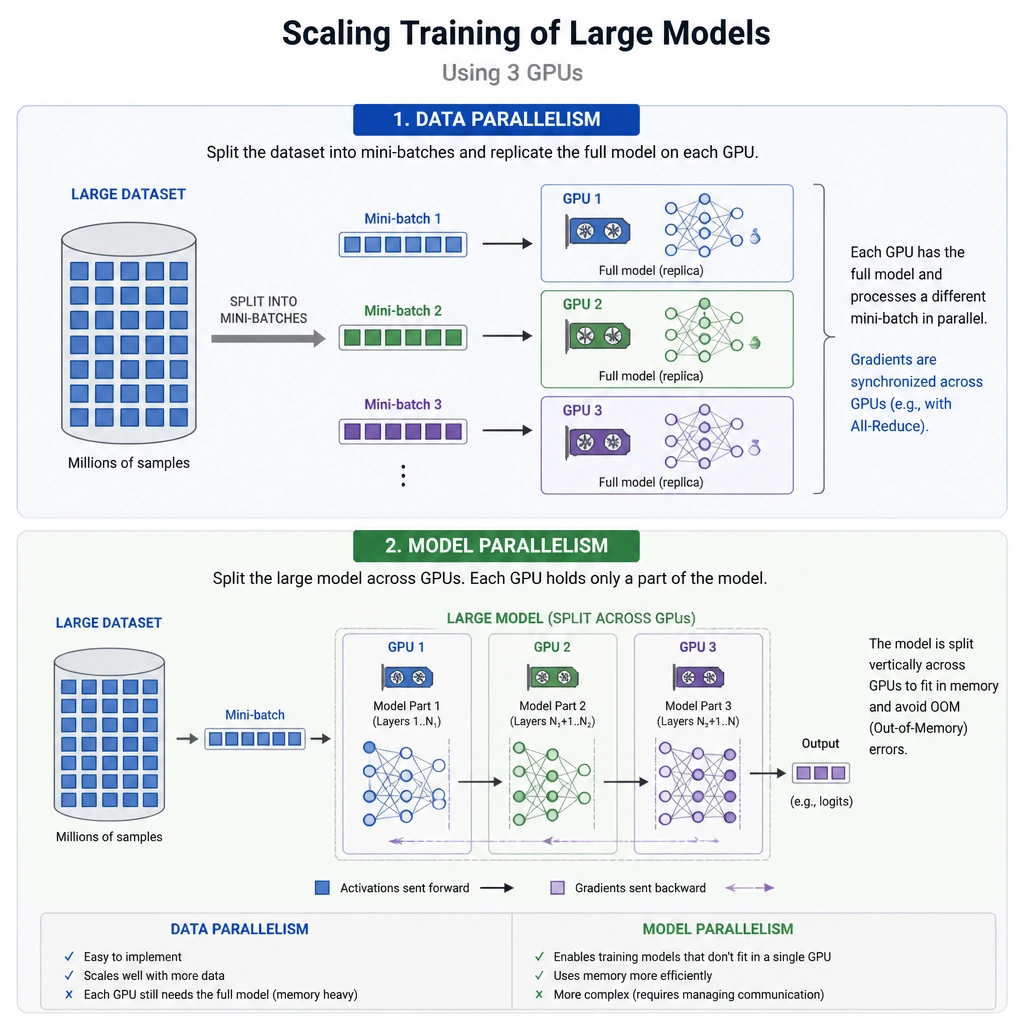
Imagine you have to paint a massive warehouse. If you only have one painter, it's going to take weeks. Plus, if the walls are too high, they can't even reach the top with their ladder! That's what happens when you hit a single GPU's memory limit. But if you bring in a whole crew of painters, you can split up the work (that's data parallelism) and use tall scaffolding to reach the high spots (that's model parallelism, where you split a giant model across multiple GPU memories). Moving to a multi-GPU cluster solves both of these headaches: you train in a fraction of the time, and you can finally fit those massive, cutting-edge models into memory.
Full explanation below image
Full Explanation
Training modern deep learning models (such as large language models or complex computer vision systems) on massive datasets creates significant computational and memory bottlenecks. A single GPU, regardless of its specifications, has physical memory limitations (typically ranging from 16 GB to 80 GB of VRAM) and a finite number of CUDA cores.
Migrating to a distributed, multi-GPU cluster solves these limits through two primary parallelization strategies: 1. Data Parallelism: The training dataset is split into smaller batches, and a copy of the model is placed on each GPU. Each GPU processes its slice of the data, computes gradients, and synchronizes them (typically via a collective AllReduce operation) before updating the weights. This drastically reduces the time required to complete a training epoch. 2. Model/Pipeline Parallelism: If the model itself is too large to fit into the VRAM of a single GPU, the network layers or parameters are partitioned across multiple GPUs. This allows teams to train massive models containing hundreds of billions of parameters that would otherwise trigger Out-of-Memory (OOM) errors on a single machine.
Let's examine the incorrect options: - Consumer GPUs and sequential loops (Option B): Distributed clusters typically utilize highly expensive, enterprise-grade GPUs (like NVIDIA H100s) and fast interconnects, which increases costs. Additionally, running sequential loops would not speed up training compared to parallel execution. - Global optimum guarantee (Option C): No optimization setup, including distributed training, guarantees convergence to a global optimum due to the highly non-convex nature of deep learning loss landscapes. - Generalization and gradient averaging (Option D): While gradient averaging is necessary to synchronize weights across parallel models, its purpose is to maintain mathematical parity with single-device training. It does not inherently improve the model's generalization capabilities or accuracy.