
In modern accelerated data centers, what is the primary operational advantage of introducing a Data Processing Unit (DPU) alongside traditional CPUs and GPUs?
Select an answer to reveal the explanation.
Short Explanation and Infographic
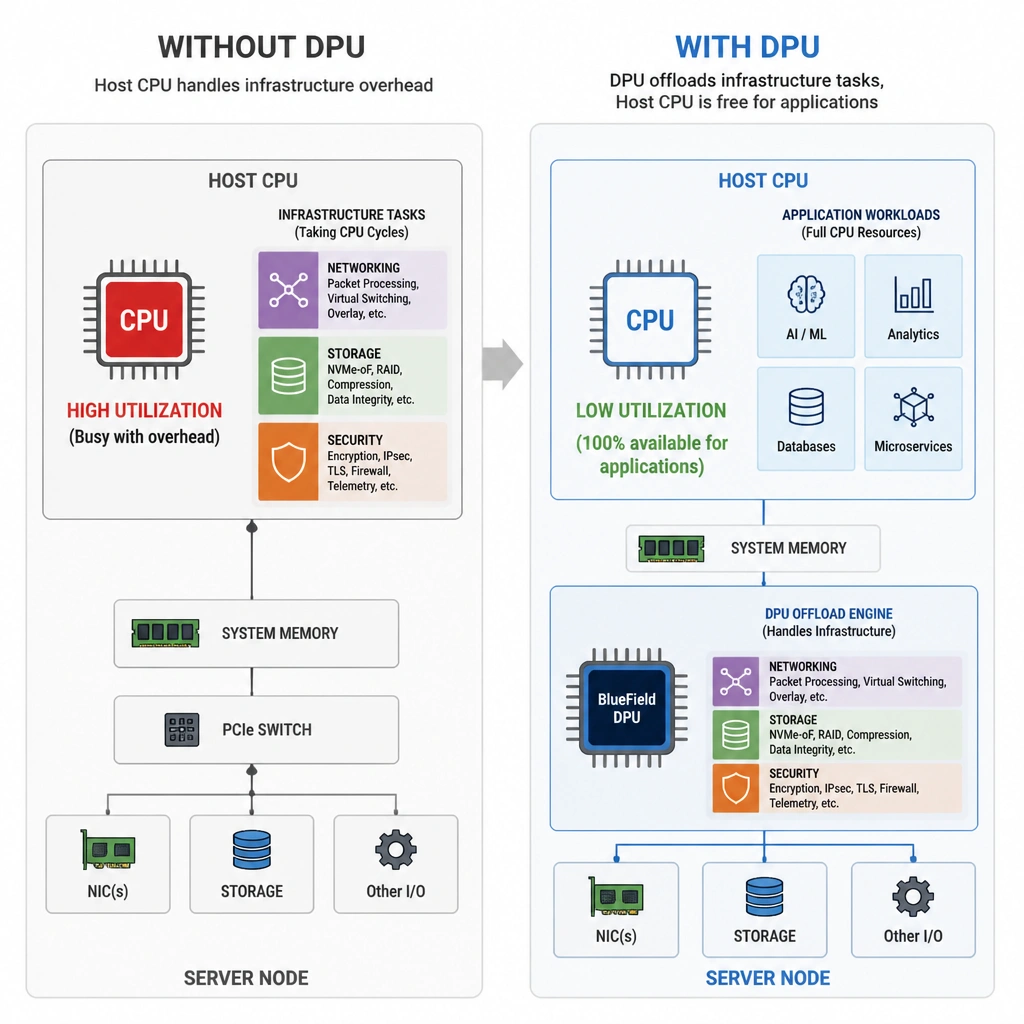
Think of your host CPU as the chef in a busy restaurant kitchen. If the chef has to stop cooking to wash dishes, take orders, and sweep the floor, the kitchen slows to a crawl. That infrastructure work is a huge tax! In a data center, the CPU spends up to 30% of its power just managing network packets, storage routing, and encryption keys. That's where a DPU, like NVIDIA's BlueField, steps in. The DPU takes over those "chores"—networking, storage virtualization, and security—letting your host CPU focus 100% of its energy on running the actual application workloads. It's all about efficiency and letting the main processor do what it does best.
Full explanation below image
Full Explanation
As data center workloads have scaled, the overhead of managing infrastructure services (often called the "datacenter tax") has grown significantly. Tasks such as processing network packets, virtualizing storage disks, routing traffic, managing firewalls, and executing encryption/decryption protocols can consume a substantial percentage of the host CPU's cores.
A Data Processing Unit (DPU) is a specialized System-on-Chip (SoC) designed to offload, accelerate, and isolate these infrastructure services. A typical DPU integrates high-performance network interfaces (such as 100/200/400 Gbps ports), programmable multi-core ARM CPUs, hardware acceleration engines for cryptography and storage virtualization, and a PCIe interface to connect to the host system.
By running software-defined networking (e.g., Open vSwitch), software-defined storage (e.g., NVMe-oF target simulation), and security agents directly on the DPU: 1. The host CPU is freed from low-level packet processing and encryption tasks, allowing those CPU cores to be rented out or used for business application logic. 2. Data center security is enhanced because the infrastructure control plane is physically isolated from the host OS, making it harder for a compromised host operating system to breach the network control layer.
Let's look at the incorrect options: - Option B is incorrect because DPUs do not modify the host CPU's clock speeds or directly overclock hardware. - Option C is incorrect because visual rendering and ray tracing are the domain of GPUs (Graphics Processing Units), not DPUs. - Option D is incorrect because DPUs are not general-purpose application hosts meant to replace the main CPU; they run specialized infrastructure services alongside the host CPU.