
Your company is a medium-sized retail business that wants to build and launch a custom customer churn prediction model, but you do not have millions of dollars to spend on a massive, dedicated supercomputing cluster or proprietary custom-built platforms. Which two of the following industry trends have most significantly lowered the barrier to entry, enabling smaller organizations to deploy sophisticated AI solutions without breaking the bank? (Choose two)
Select all correct answers, then click Submit.
Short Explanation and Infographic
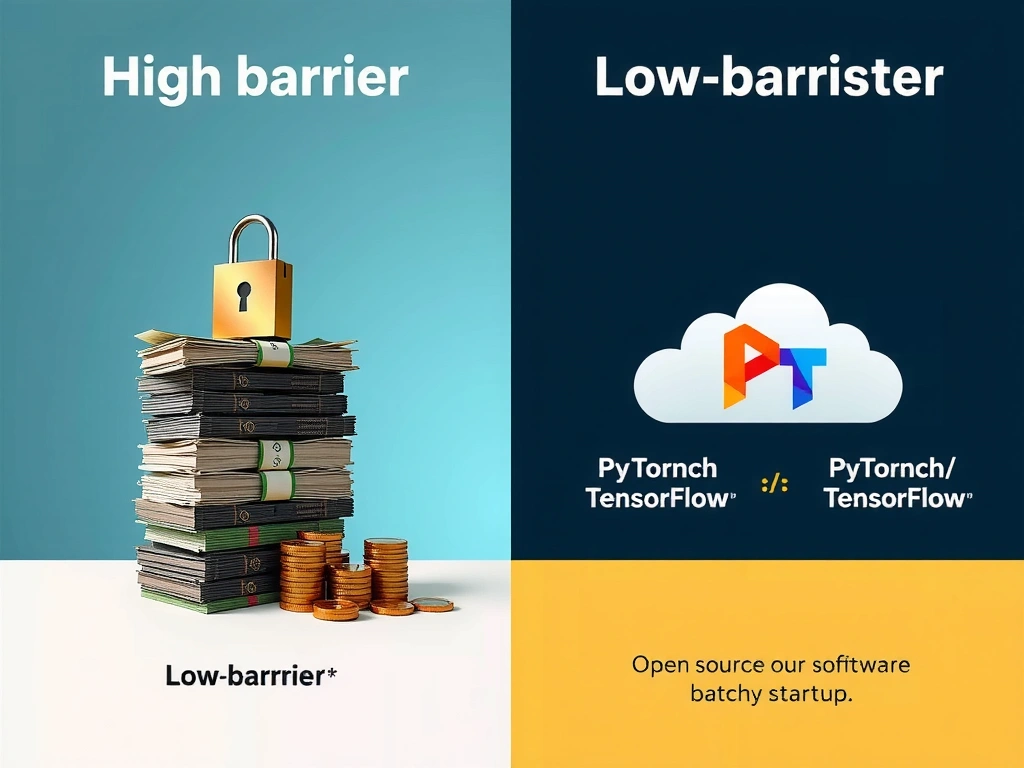
Here's the deal: back in the day, if you wanted to build anything resembling AI, you needed a massive checkbook and a team of PhDs writing algorithms from scratch on highly expensive, proprietary software. Not anymore! Today, you can spin up powerful computing instances in the cloud for the price of a couple of cups of coffee, and you can leverage open-source packages like PyTorch or TensorFlow without paying a single dime in licensing fees. These two factors—on-demand cloud platforms and open-source frameworks—have completely leveled the playing field for smaller teams. If you look at options B, C, D, and E, they all represent barriers that would block you, not help you! Got it? Sweet. Let's keep rolling.
Full explanation below image
Full Explanation
The democratization of artificial intelligence has been primarily driven by two key catalysts: cloud computing and open-source software. Cloud platforms (such as AWS, Azure, Google Cloud, and NVIDIA DGX Cloud) offer a pay-as-you-go model that allows smaller organizations to access massive computational infrastructure—including high-end GPUs—without upfront capital expenditures on physical data centers. Concurrently, open-source machine learning libraries (such as PyTorch, TensorFlow, and Hugging Face Transformers) provide developer teams with pre-built, state-of-the-art tools, architectures, and pre-trained models. Together, these elements dramatically reduce both the financial and technical barriers to entry. In contrast, options B and C describe proprietary constraints and rising licensing costs, which would restrict access to AI tools. Option D indicates a move away from open scientific collaboration, which would slow down public development, and Option E highlights high hardware costs, which present a major financial barrier for smaller enterprises.