
If a startup needs to build and deploy a custom machine learning product without investing millions of dollars in a physical GPU data center or paying steep licensing fees for proprietary software, which combination of modern industry factors represents their path of least resistance?
Select an answer to reveal the explanation.
Short Explanation and Infographic
Here's the deal—back in the day, if you wanted to do serious AI development, you had to have deep pockets. You needed to buy expensive specialized hardware and pay a fortune for proprietary software licenses. Today, the landscape is totally different. The barrier to entry has crashed down, and that's thanks to two big things: public cloud services and open-source software. You don't need to buy a million-dollar GPU cluster anymore; you can just rent one in the cloud for a few hours. And you don't need to write deep learning math from scratch; you can grab PyTorch or TensorFlow for free. This combination lets small startups compete with the big dogs right out of the gate.
Full explanation below image
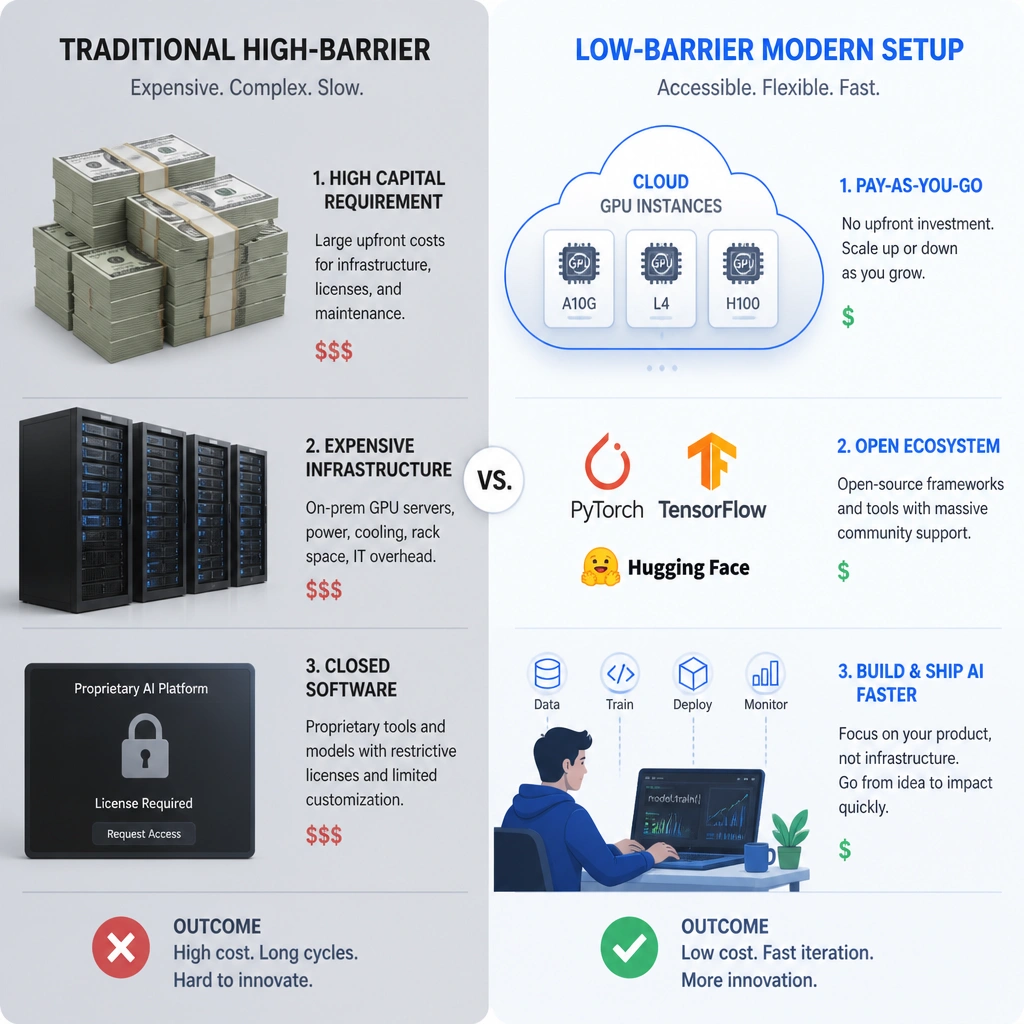
Full Explanation
Historically, developing advanced artificial intelligence solutions was limited to large corporations and academic institutions with massive budgets. This was due to the prohibitive capital expenditure (CapEx) required to build and maintain GPU-accelerated data centers, combined with the lack of standardized software tools.
In recent years, two primary drivers have democratized AI access for smaller organizations and startups: 1. Cloud-Based AI Platforms (IaaS/PaaS): Cloud providers offer scalable, on-demand access to state-of-the-art GPU infrastructure (such as NVIDIA H100s or A100s) and managed machine learning services. This shifts the financial model from high up-front capital expenditures to operational expenditures (OpEx), allowing organizations to pay only for the compute time they use. 2. Open-Source Software Frameworks: The proliferation of open-source libraries and frameworks (such as PyTorch, TensorFlow, Hugging Face, and Scikit-Learn) has eliminated the need to develop core deep learning algorithms from scratch. Developers can build on top of community-vetted, highly optimized codebases, drastically reducing development cycles.
Let's analyze the incorrect options: - Option B describes a high-barrier scenario, involving proprietary software licenses and capital-intensive on-premises hardware purchases. - Option C points to increasing complexity and reduced research funding, both of which would hinder accessibility and increase development costs. - Option D refers to edge computing and single-threaded CPU architectures. While edge computing is growing, legacy single-threaded CPU designs are not suitable for parallel deep learning workloads, and this combination does not address the core barrier to training large-scale models.