
An organization needs to deploy, manage, and orchestrate containerized AI inference workloads across a hybrid infrastructure that includes edge devices, on-premises servers, and multiple public cloud platforms. Which NVIDIA platform provides a centralized, secure cloud console designed specifically for orchestrating these distributed workloads and managing device status?
Select an answer to reveal the explanation.
Short Explanation and Infographic
Imagine you have AI models running on edge devices in fifty different retail stores, some on-premises servers at headquarters, and a bunch of instances in AWS. If you had to log into each one individually to deploy updates or check their health, you'd lose your mind! That's where NVIDIA Fleet Command comes in. It gives you a single, centralized cloud dashboard to orchestrate, update, and manage all those containerized workloads across your entire hybrid cloud and edge infrastructure. Think of it like Kubernetes, but tailormade by NVIDIA to make remote deployment a breeze. Triton and TensorRT are awesome tools, but they handle model serving and optimization, not remote machine orchestration.
Full explanation below image
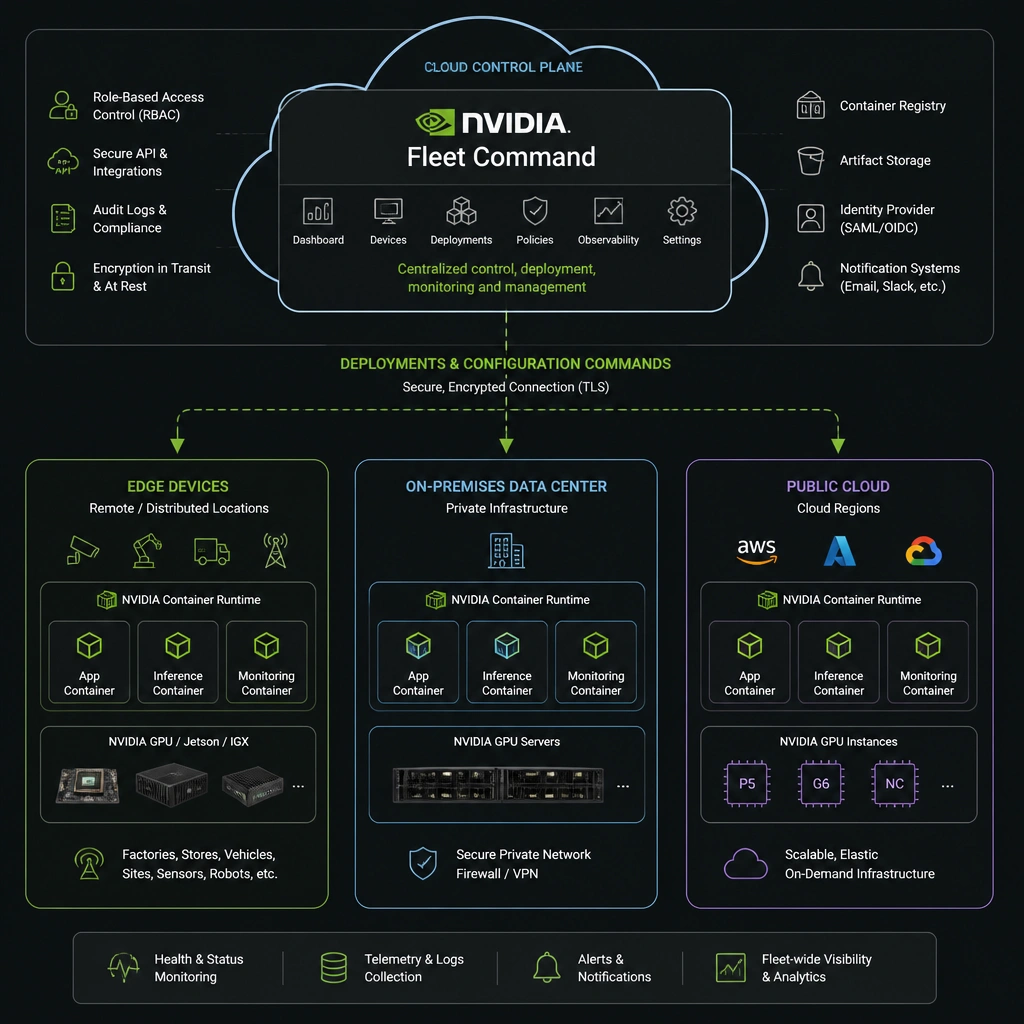
Full Explanation
Orchestrating containerized AI workloads in a hybrid or distributed environment (such as multi-cloud and edge locations) presents unique management and security challenges. NVIDIA Fleet Command is a cloud-based service designed to simplify these operations. It allows administrators to securely deploy, manage, and scale AI applications across distributed edge systems and data centers from a single centralized console. Fleet Command handles tasks such as remote system provisioning, application monitoring, over-the-air updates, and secure communication tunnels, making it highly suitable for hybrid cloud management of containerized workloads.
Let's review the incorrect options to see how they differ: - NVIDIA Triton Inference Server (Option A): Triton is an open-source inference serving software that allows teams to deploy trained AI models from any framework (TensorFlow, PyTorch, ONNX, etc.) on CPU or GPU-based infrastructure. While Triton excels at serving models and optimizing resource utilization on a given node, it does not act as a global orchestrator or control plane for multiple hybrid cloud endpoints. - NVIDIA RAPIDS (Option C): RAPIDS is a suite of open-source software libraries built on CUDA that accelerates data science pipelines, including data preparation, machine learning (using algorithms like XGBoost), and graph analytics. It does not provide infrastructure orchestration or remote device management. - NVIDIA TensorRT (Option D): TensorRT is a deep learning inference optimizer and runtime compiler. It takes trained neural networks and optimizes them (via precision calibration, layer fusion, and kernel selection) to run as fast as possible on NVIDIA GPUs. It is a compilation and optimization tool, not an orchestration framework.