
In an enterprise AI data center, why do network administrators configure a dedicated Out-of-Band Management (OOBM) network rather than managing switches and routers over the primary production data plane?
Select an answer to reveal the explanation.
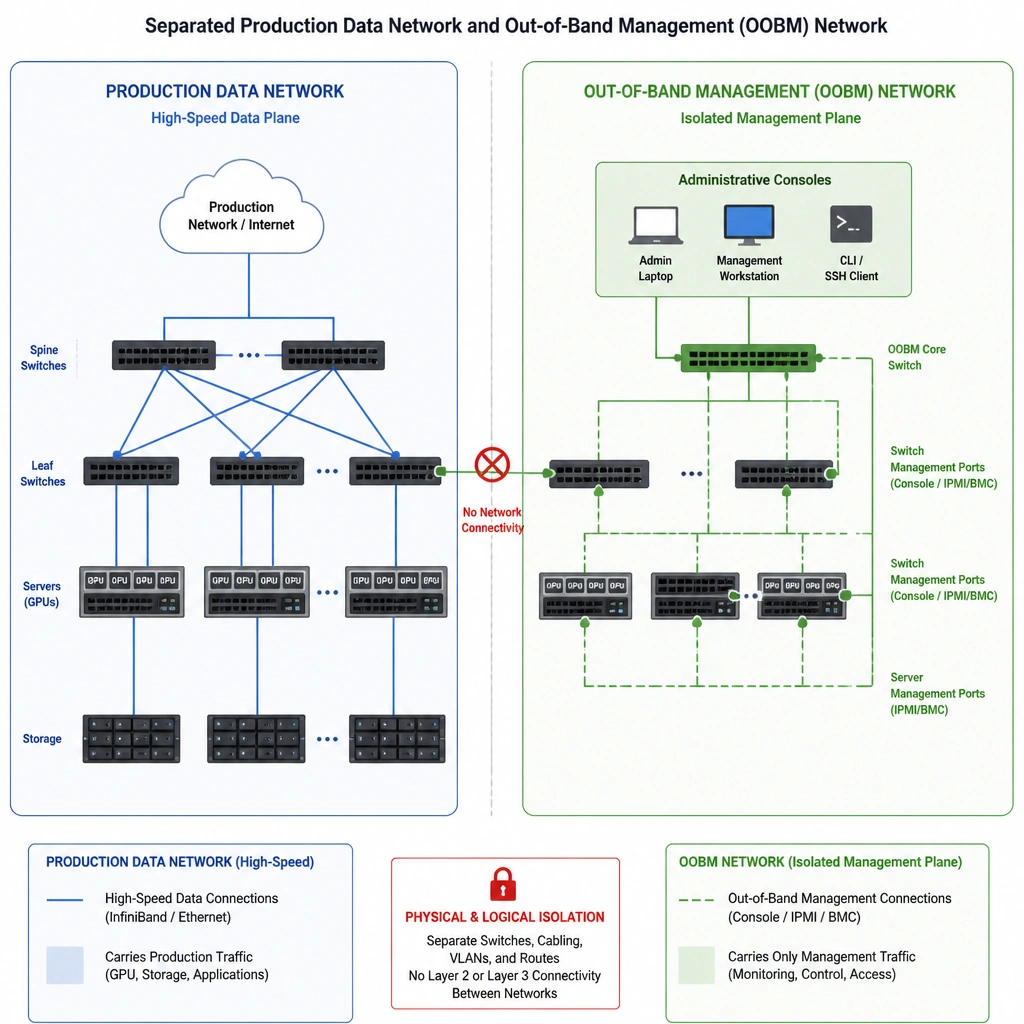
Short Explanation and Infographic
Imagine there's a massive multi-car pileup on the main highway. If the emergency vehicles have to use that same highway to get to the crash, they're going to get stuck in the traffic, too! That's exactly why you need an Out-of-Band Management (OOBM) network. It's like having a private, dedicated access road just for the engineers and administrators. If your main production network goes down or gets hit by a broadcast storm, you can still log into your switches and routers to fix the issue. Plus, keeping your management traffic off the main network shuts down security holes. Trust me, you do not want script kiddies or hackers sniffing around your switch management ports on the public data network.
Full explanation below image
Full Explanation
Out-of-Band Management (OOBM) refers to a network design practice where management interfaces of infrastructure devices (such as switches, routers, servers, and power distribution units) are connected to a completely separate physical or logical network, distinct from the in-band production data network.
The primary benefits of OOBM are two-fold: 1. Security Isolation: By segregating administrative traffic (such as SSH, HTTPS, SNMP, and console access) from the production data plane, the attack surface of the infrastructure is dramatically reduced. Unauthorized users on the production network cannot even route packets to the management ports of the critical network switches, preventing brute-force attacks, port scanning, and configuration tampering. 2. Operational Resilience: If the production network experiences a catastrophic failure—such as a loop, a severe broadcast storm, a DDoS attack, or a misconfiguration that shuts down data ports—network administrators can still access the management interfaces via the OOBM network. This allows them to diagnose the problem, roll back configurations, or reboot devices remotely.
Let's review the incorrect options: - Option A is incorrect because OOBM does not interface with GPU resource scheduling, cluster power management, or deep learning workloads; that is handled by orchestration software (like Kubernetes or Slurm) and driver-level tools (like NVIDIA System Management Interface / nvidia-smi). - Option C is incorrect because OOBM is focused on management access, not telemetry-driven cloud autoscaling. - Option D is incorrect because traffic prioritization and quality of service (QoS) for machine learning workloads are handled in-band on the high-speed data network (such as InfiniBand or RoCE), not on the lower-speed management network.