
In the context of high-performance computing and machine learning, which of the following accurately describes how the memory architecture of a graphics processing unit (GPU) contrasts with that of a central processing unit (CPU)?
Select an answer to reveal the explanation.
Short Explanation and Infographic
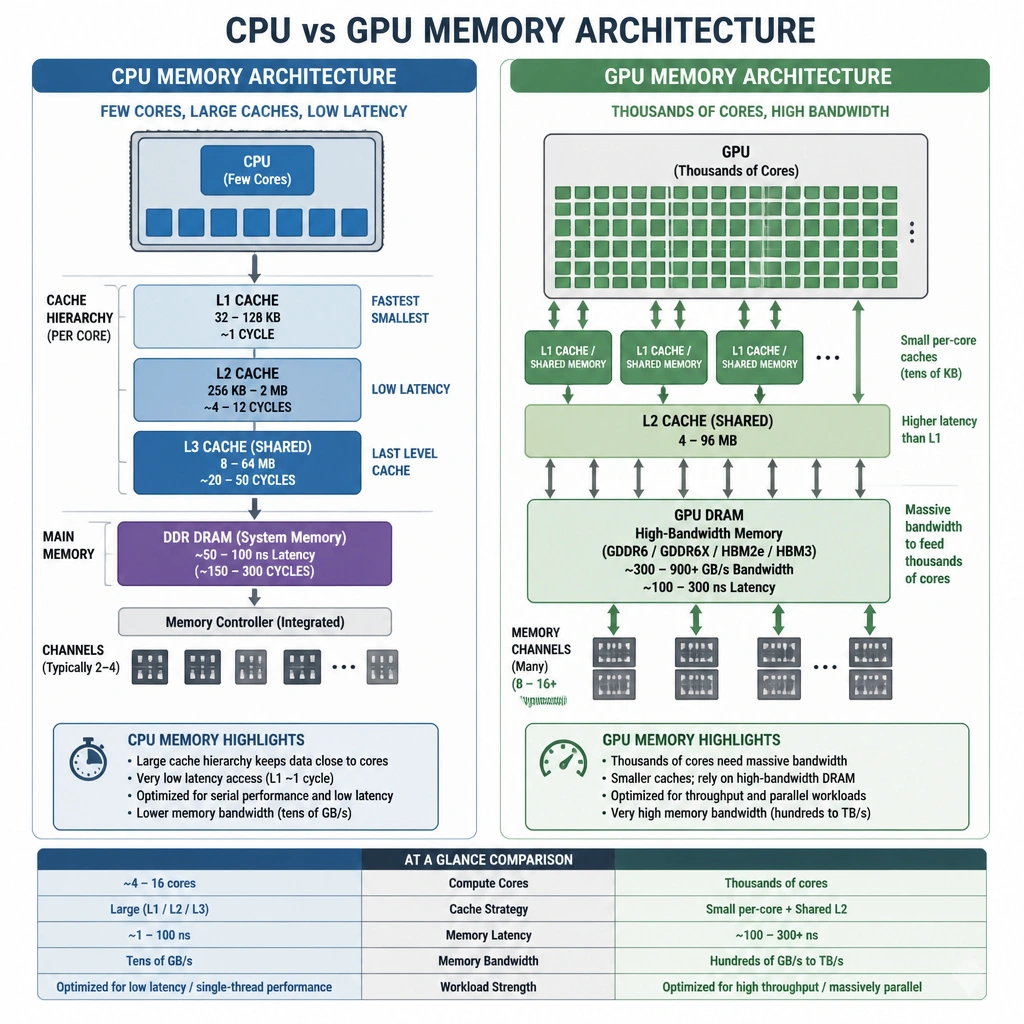
Think of it like this: a CPU is like a high-speed sports car. It's built to get a single passenger (a sequential thread of execution) from point A to point B as fast as humanly possible, relying on low-latency caches to keep things moving. A GPU, on the other hand, is like a massive multi-lane highway carrying thousands of commuter buses at once. It doesn't care if a single bus takes a fraction of a second longer, as long as it can move a massive amount of data in parallel. That's why GPUs use specialized High-Bandwidth Memory (HBM) and GDDR. They need to feed thousands of cores simultaneously. If you try to run a GPU on standard CPU DDR memory, it's like trying to fill a swimming pool with a soda straw—you'll starve those parallel cores of data!
Full explanation below image
Full Explanation
The fundamental difference between CPU and GPU memory architectures stems from their design objectives. A CPU is a general-purpose processor designed to handle complex, sequential tasks. It prioritizes low-latency execution of a single thread or a small number of threads. To achieve this, CPUs dedicate a large portion of their die area to complex control logic and massive hierarchical caches (L1, L2, and L3) that keep data as close to the processor cores as possible, minimizing latency when retrieving data from DDR system memory.
Conversely, a GPU is a throughput-oriented processor designed to perform massive parallel computations on thousands of threads simultaneously. Instead of focusing on minimizing latency for a single thread, GPU memory subsystems are designed to maximize data throughput (bandwidth) so that they can keep thousands of simple arithmetic logic units (ALUs) constantly busy. To achieve this, GPUs utilize specialized memory technologies like GDDR (Graphics Double Data Rate) or HBM (High-Bandwidth Memory). HBM, for instance, uses 3D stacked memory dies and an ultra-wide silicon interposer interface to deliver terabytes per second of bandwidth, which is essential for processing the large arrays and matrices found in deep learning models.
Let's look at the incorrect options: - Option A is incorrect because GPUs do not rely on serial memory channels; they use highly parallel buses. Also, CPUs do use caches to minimize latency, but the comparison is flawed. - Option C is incorrect because it reverses the technologies; GPUs use HBM and GDDR, whereas standard CPUs utilize DDR memory (though some specialized server CPUs have started adopting HBM, it is not their standard primary architecture). - Option D is incorrect because the architectural designs are radically different, not just different in memory capacity.