
You are designing the interconnect network for a multi-node GPU cluster dedicated to training large-scale deep learning models. Which network technology is essential for the inter-node data plane to minimize latency during multi-GPU synchronization by allowing GPUs to read and write directly to each other's memory across host boundaries without CPU intervention?
Select an answer to reveal the explanation.
Short Explanation and Infographic
Here's the deal—when you are training massive AI models across multiple servers, the GPUs have to talk to each other constantly. If they have to wait around for standard network stacks to process every packet, your expensive GPUs are going to sit idle. Not very efficient! That's where InfiniBand comes to the rescue. The magic key here is RDMA—Remote Direct Memory Access. Think of it like a VIP pass that lets one GPU write directly into the memory of another GPU on a completely different server, bypassing the CPU and OS networking stack entirely. Standard TCP/IP over Ethernet? Too much overhead. NVMe-oF? Great for storage, but not for inter-GPU communication. Gigabit Ethernet? That's strictly for your management plane. Trust me on this, for high-performance AI training, InfiniBand is the gold standard you need.
Full explanation below image
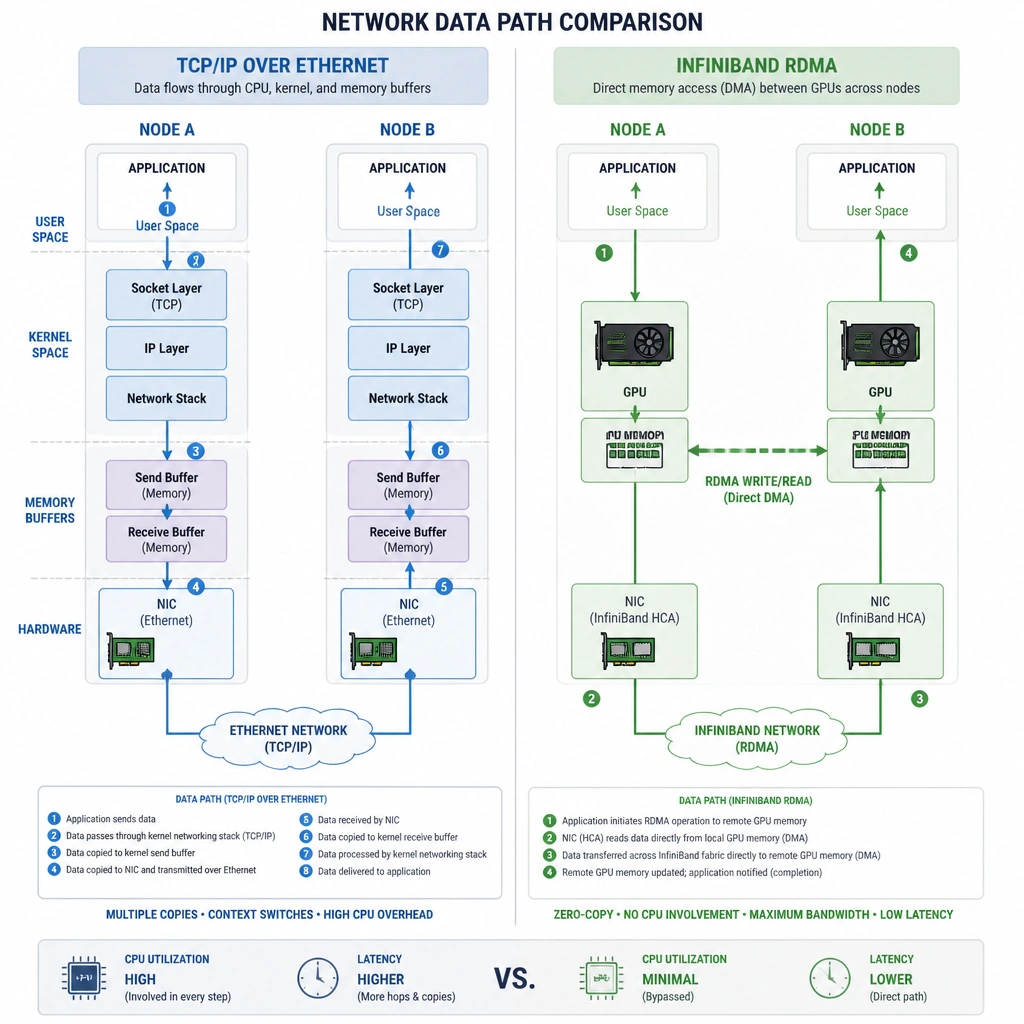
Full Explanation
In distributed AI training clusters, the communication between GPU nodes (often referred to as East-West traffic) is a major performance bottleneck. During distributed training paradigms like data parallelism or model parallelism, GPUs must continuously synchronize gradients and weights. Standard Ethernet utilizing the TCP/IP stack introduces significant latency because packet processing requires CPU interrupts, context switches, and copying data through multiple OS kernel buffers.
InfiniBand addresses these performance challenges by offering massive bandwidth and sub-microsecond latencies. Crucially, it supports Remote Direct Memory Access (RDMA), which allows network adapters to transfer data directly between application memories across different nodes without involving the operating systems or CPU cores of either host. In AI environments, this is enhanced via NVIDIA GPUDirect RDMA, allowing direct GPU-to-GPU communication over the InfiniBand fabric.
Let's look at the incorrect options: - TCP/IP over Ethernet (Option A), even at high speeds like 100 Gbps, still suffers from high CPU overhead and latency spikes due to the TCP protocol stack, making it sub-optimal for the intense, real-time synchronization required by distributed deep learning. - NVMe over Fabrics (Option C) is a protocol designed to extend NVMe commands across a network fabric, connecting servers to shared storage pools. It is not used for direct node-to-node GPU computation or synchronization. - Gigabit Ethernet (Option D) operates at 1 Gbps, which is far too slow for training workloads and is exclusively reserved for Out-of-Band Management (OOBM), system provisioning, and administrative control plane tasks.