
A startup is deploying a new AI-based fraud detection system. The engineering team needs to design the infrastructure budget. They are analyzing the resource profiles for the initial model training phase versus the subsequent production deployment phase. Which statement best captures the resource allocation differences they must plan for?
Select an answer to reveal the explanation.
Short Explanation and Infographic
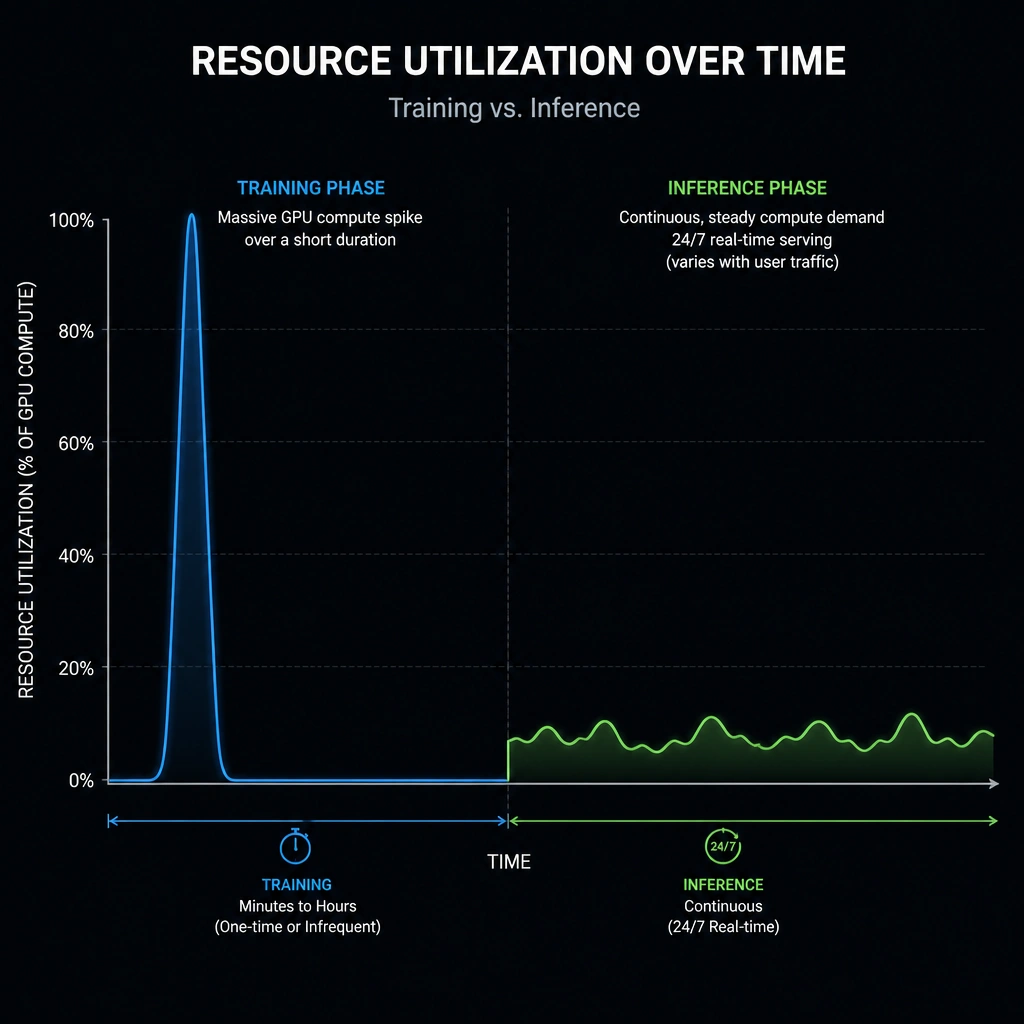
Here's the deal: if you try to budget your AI infrastructure as if training and inference are the same, you're going to go broke fast. Think of training like building a house. It's a huge, intensive project that requires a ton of workers (or in our case, a massive cluster of high-end GPUs) working non-stop for a few days or weeks. But once the house is built, you don't keep all those construction workers on the payroll. That's inference. Once the model is built, running it is much lighter. However, because users are actively querying it, your inference servers need to be online 24/7 and respond instantly. So, training is high-intensity and batch-oriented, while inference is continuous, lower-intensity, and low-latency. Got it? Sweet. Let's keep rolling.
Full explanation below image
Full Explanation
When designing AI infrastructure, engineers must differentiate between the resource consumption profiles of model training and model inference, as they have vastly different characteristics and optimization goals. Model training is a compute-heavy, batch-oriented task. During training, a model processes massive datasets over multiple epochs, using backpropagation to update weights. This requires high throughput and parallel processing capabilities, typically provided by multi-GPU or multi-node clusters. Because training is usually an offline process, it does not have strict real-time response requirements; the primary goal is maximizing GPU utilization to complete the job as quickly as possible. Resource usage is temporary and concentrated. In contrast, model inference (running the trained model in production) is a continuous, service-oriented task. While the computational load per request is much lower than training (since it only involves a single forward pass), the system must be available to respond to user requests 24/7. Inference is highly sensitive to latency and throughput constraints, as users expect immediate results (e.g., milliseconds for fraud detection or voice assistants). Consequently, resource allocation for inference focuses on scaling, high availability, and low latency rather than raw batch throughput. Let's review the options: Option B is correct because it correctly describes training as a high-intensity offline batch process and inference as a continuous, lower-intensity, real-time process. Option A is incorrect because training and inference have completely different resource demand profiles. Option C is incorrect because training requires high-performance, high-cost resources, while inference typically requires lighter resources per instance. Option D is incorrect because it reverses the latency and time-sensitivity characteristics of the two phases.