
During an executive briefing on your company's new technology roadmap, a board member asks how your team's proposed Large Language Model (LLM) initiatives relate to the broader corporate goals for Artificial Intelligence (AI) and Machine Learning (ML). Which statement provides the most accurate explanation of the hierarchical relationship between these concepts?
Select an answer to reveal the explanation.
Short Explanation and Infographic
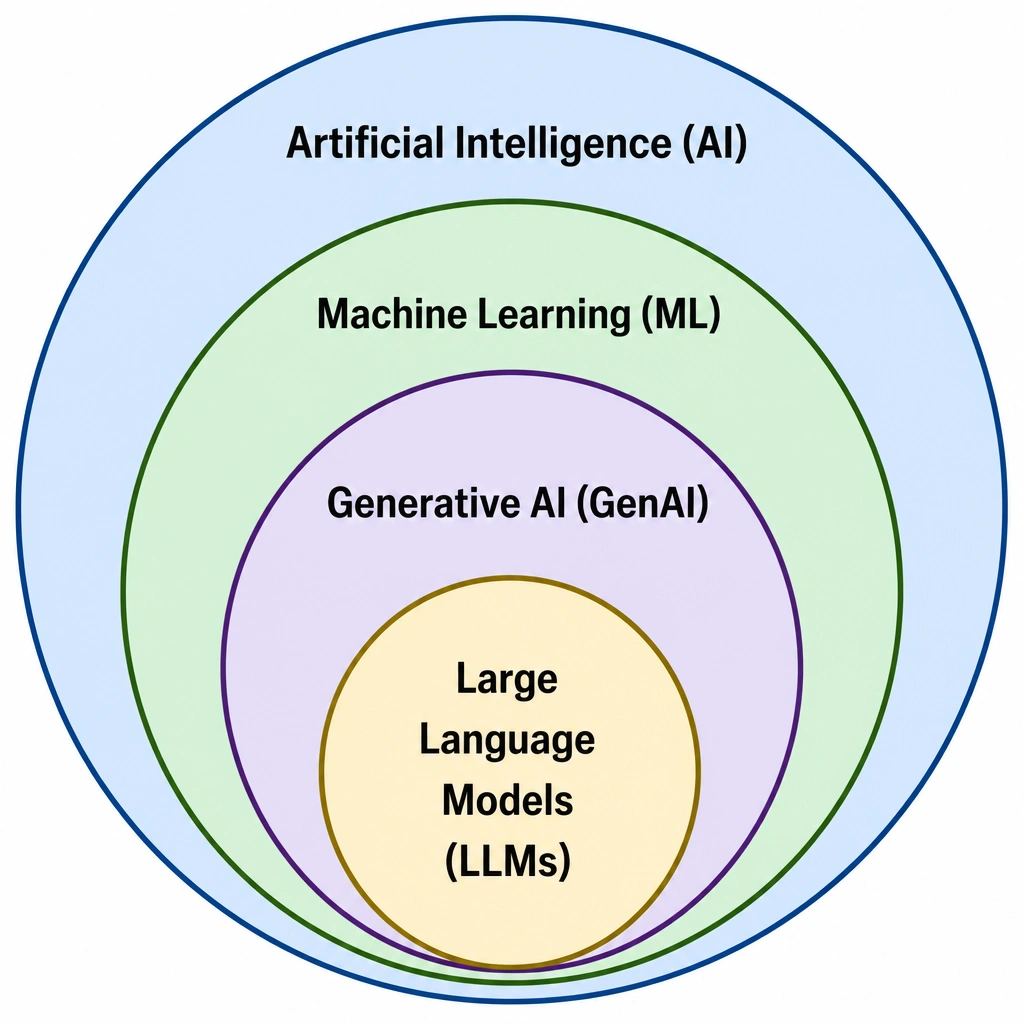
Think of it like nesting Russian dolls—or if you're a networking guy, like IP subnets. You have to understand how these terms fit together so you don't sound like a marketing brochure. The biggest, outermost circle is Artificial Intelligence (AI)—that's the broad science of making computers mimic human intelligence. Inside that, we have Machine Learning (ML), which is a specific subset of AI where systems learn from data without being explicitly programmed. Narrow it down further, and you find Generative AI (GenAI), which is a subset of ML focused on creating new content like text, images, or code. And finally, the smallest doll inside that is Large Language Models (LLMs), which are specific applications of GenAI that deal with natural language. Make sure you don't mix these up on the exam! Got it? Sweet. Let's keep rolling.
Full explanation below image
Full Explanation
In the field of computer science, terms like AI, ML, GenAI, and LLM are frequently used, but they represent distinct, nested levels of technology rather than equivalent or independent fields. 1. Artificial Intelligence (AI) is the broadest category. It encompasses any technique, system, or algorithm that enables computers to mimic human cognitive functions, such as reasoning, problem-solving, and learning. This includes everything from simple rule-based expert systems to complex neural networks. 2. Machine Learning (ML) is a major subset of AI. Instead of relying on hardcoded rules, ML algorithms use statistical techniques to learn patterns directly from data and improve their performance over time. Deep learning (neural networks) is a further subset of ML. 3. Generative AI (GenAI) is a specialized subset within Machine Learning (and specifically deep learning). While traditional ML focuses on classification or prediction (e.g., identifying a cat or predicting stock prices), Generative AI focuses on creating new, original content (such as text, images, audio, or code) based on the patterns it learned during training. 4. Large Language Models (LLMs) are a specific application and subset of Generative AI. They are deep learning models (typically based on the Transformer architecture) trained on massive corpora of text to understand, generate, and manipulate natural language. Let's evaluate the options: Option C is correct because it describes this precise nesting: AI -> ML -> GenAI -> LLM. Options A, B, and D are incorrect because they present inverted, flat, or disconnected relationships between these deeply integrated technologies.