
You are reviewing the hardware inventory for your company's deep learning data center, which includes several NVIDIA DGX A100 systems equipped with the 80GB GPU variant. When sizing a model for distributed training across a single DGX A100 node, what is the correct memory allocation structure and total capacity?
Select an answer to reveal the explanation.
Short Explanation and Infographic
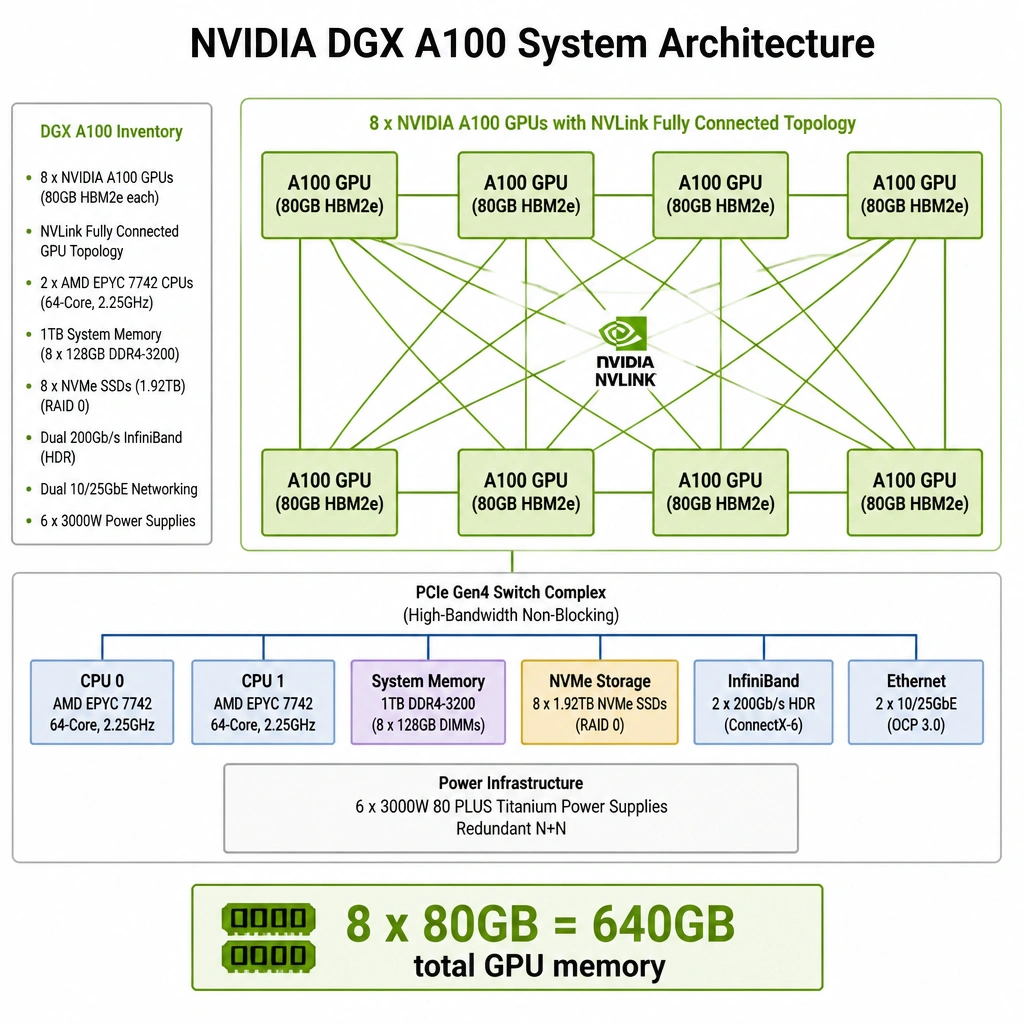
Okay, let's talk hardware specs. The NVIDIA DGX A100 is a beast of a server, but you have to know how its memory is laid out if you want to avoid out-of-memory errors during training. The 80GB version of the DGX A100 contains exactly eight physical A100 GPUs. Do the math: 8 GPUs times 80GB of high-speed HBM2e memory per card gives you a grand total of 640GB of GPU memory in that chassis. Now, pay close attention here: this memory is physically located on each individual GPU. It's not one big, unified 1 TB pool of RAM, and it's definitely not running off the slower host CPU memory. Even though high-speed NVLink connects these cards together to let them talk fast, each card still owns its 80GB chunk of VRAM. Keep this number in mind for the exam!
Full explanation below image
Full Explanation
The NVIDIA DGX A100 is a foundational building block for AI infrastructure. To design efficient parallel training jobs (using strategies like data parallel or model parallel training), engineers must understand the system's memory layout and limits. The DGX A100 system integrates eight NVIDIA A100 Tensor Core GPUs. In the 80GB GPU configuration, each of these eight GPUs is equipped with 80 GB of ultra-fast High Bandwidth Memory (HBM2e). Therefore, the total GPU memory available within a single DGX A100 system is 640 GB (8 GPUs × 80 GB/GPU). This memory is dedicated and local to each GPU. While NVLink and NVSwitch provide high-bandwidth, low-latency interconnects (up to 600 GB/s per GPU) that allow the GPUs to access each other's memory spaces (via Unified Memory / GPUDirect RDMA), the underlying physical architecture is still distributed. It is not a single unified physical memory pool, nor does it rely on the host system's RAM as its primary memory space. (Note: there is also a 40GB A100 variant, which yields 320 GB total memory across eight GPUs, but the question specifies the 80GB variant). Let's review the other options: Option A is incorrect because the DGX A100 does not have a 1 TB unified virtual memory pool; the physical limit of the 80GB GPU variant is 640 GB. Option C is incorrect because 320 GB total memory corresponds to the 40GB GPU variant of the DGX A100, not the 80GB variant. Option D is incorrect because GPUs use local HBM2e memory as their primary high-speed workspace, not the host CPU's system RAM.