
A data center houses a mix of GPU generations, including older NVIDIA V100s, newer A100s, and high-end H100s. To maximize resource efficiency and prevent queue bottlenecks, the platform engineering team is evaluating scheduler designs. Which scheduling strategy is most effective for optimizing resource utilization in this diverse environment?
Select an answer to reveal the explanation.
Short Explanation and Infographic
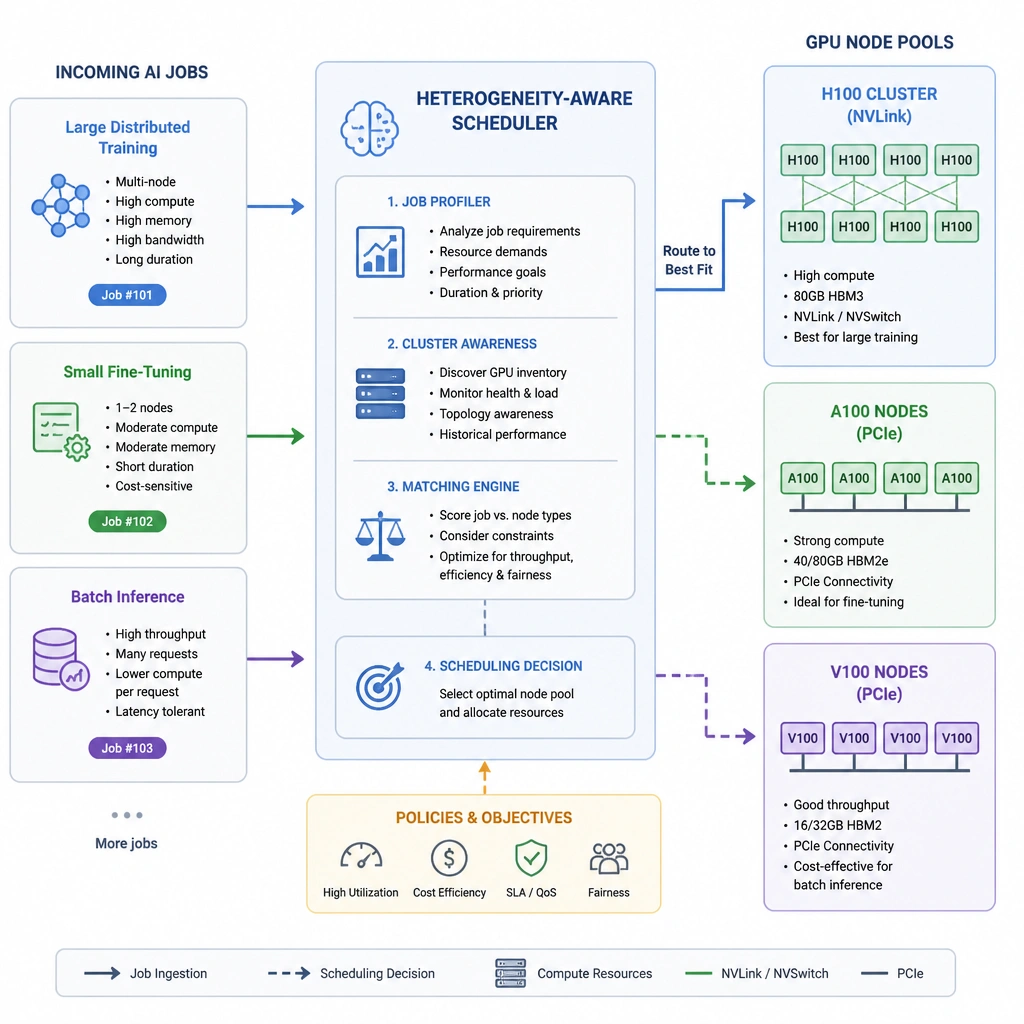
Here's the deal: in the real world, you're rarely going to have a data center filled with just one type of GPU. As you scale, you'll end up with a mix—some older V100s, some A100s, and if you're lucky, some H100s. If you just distribute jobs blindly using simple round-robin, you're going to have major headaches. A huge training job that needs high-bandwidth NVLink might get stuck on slow, older GPUs, while a tiny inference job wastes a premium H100. That's why we use heterogeneity-aware scheduling. The scheduler looks at the job, looks at the specific capabilities of each GPU type, and matches them up intelligently. It ensures the premium silicon does the heavy lifting, while older cards handle workloads that don't need high-speed inter-connects. It's all about placing the right workload on the right gear!
Full explanation below image
Full Explanation
In large-scale AI operations, clusters often contain a mixture of different GPU models acquired over time, resulting in a heterogeneous hardware environment. Managing these clusters with standard scheduling algorithms (like basic First-In-First-Out or naive round-robin) leads to severe resource underutilization and longer job completion times. Heterogeneity-aware scheduling is an advanced strategy designed specifically to address this challenge. It works by analyzing the performance characteristics, memory bandwidth, tensor core capabilities, and interconnect speeds (e.g., NVLink vs. PCIe) of the different GPU types in the cluster. It also monitors the specific demands of incoming AI jobs. For instance, a massive distributed training job requiring high inter-GPU communication bandwidth is directed to nodes with newer GPUs (like H100s or A100s) connected by NVLink. Conversely, smaller, single-GPU training runs or less demanding workloads are placed on older hardware (like V100s). This optimization maximizes overall throughput and prevents newer, expensive assets from being bottlenecked by jobs that could run just as well on older nodes. Let's examine the incorrect options: Option A is incorrect because shutting down older GPUs or restricting workloads to only the newest hardware wastes existing capital investments and decreases total cluster capacity. Option B is incorrect because schedulers do not automatically rewrite deep learning code or change model structures at runtime to force uniform execution across architectures. Option D is incorrect because a naive round-robin allocation ignores differences in GPU memory (e.g., 16GB V100 vs. 80GB A100) and computation speed, leading to out-of-memory errors and cluster inefficiency.