
An engineering firm wants to virtualize their 3D CAD and simulation workflows on virtual machines. The design team requires workstation-class graphics performance, support for professional design applications (like Maya or SolidWorks), and the ability to drive up to four 4K monitors from their virtual desktops. Which NVIDIA vGPU software license is designed specifically to meet these professional workstation requirements?
Select an answer to reveal the explanation.
Short Explanation and Infographic
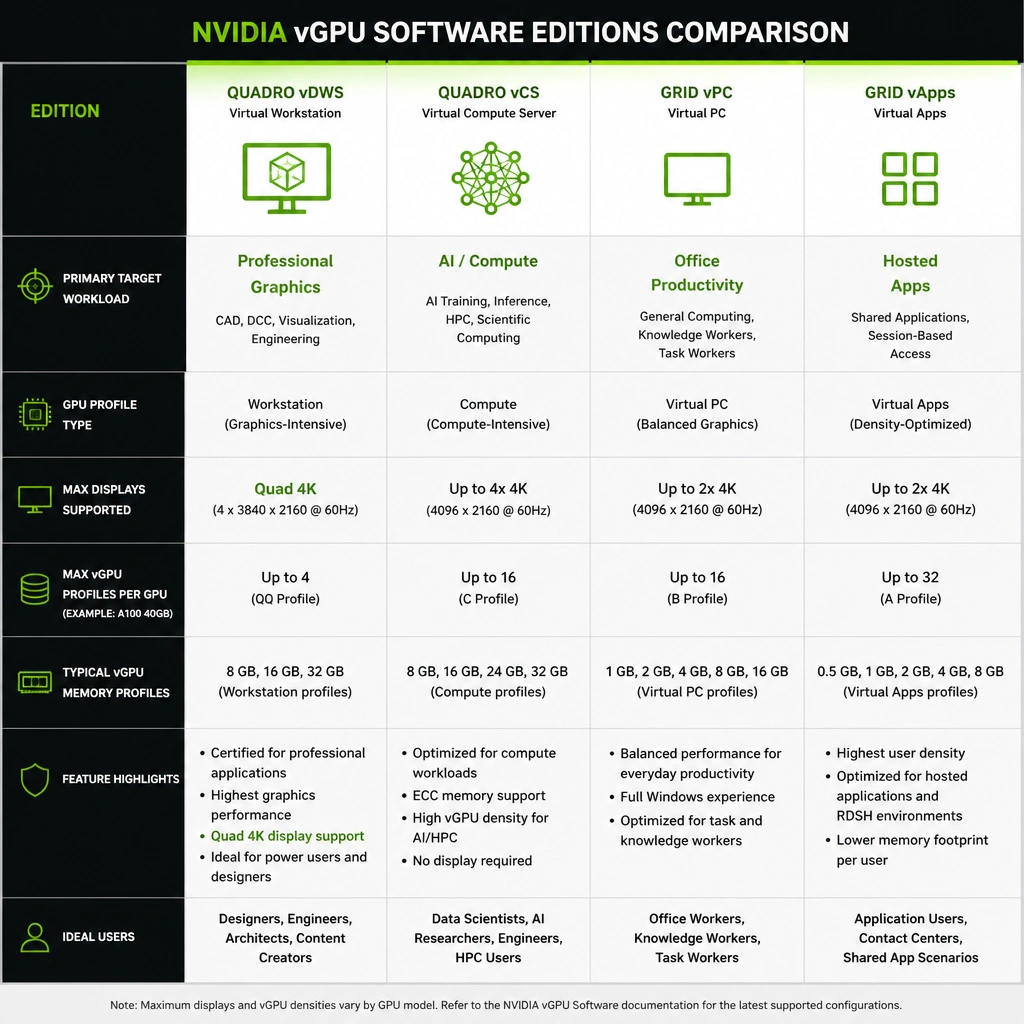
Think of it like this: not all virtual desktops are created equal. If you've got users who just need to check email and write documents, NVIDIA GRID vPC is fine—it supports dual 4K monitors and basic graphics. But when your boss walks in and says the 3D design and simulation team needs to run heavy CAD tools on virtual machines with four 4K monitors, vPC isn't going to cut it. You need the big guns: NVIDIA Quadro vDWS (Virtual DataCenter Workstation). This software variant delivers full workstation-class graphics performance and professional application certification directly to a VM. Remember, vCS is for server-side compute (like AI training without graphics), and vApps is for hosting apps through Remote Desktop Services. For high-end, multi-monitor professional graphics, vDWS is the answer!
Full explanation below image
Full Explanation
NVIDIA's virtual GPU (vGPU) technology enables multiple virtual machines to share the power of a physical GPU, or allows a single VM to harness multiple physical GPUs. NVIDIA packages this technology into different software editions tailored to specific workloads: NVIDIA Quadro Virtual DataCenter Workstation (Quadro vDWS) is engineered for professional designers, engineers, and creative artists. It supports professional workstation graphics features, specialized application certifications (ISV certifications), and advanced display configurations, including up to four 4K monitors or two 8K monitors. It provides the highest level of graphics acceleration available in a virtualized environment. Let's review the other options: Option A (vCS) is designed for compute-intensive workloads such as artificial intelligence, machine learning, and high-performance computing (HPC). It does not support professional graphics rendering or display outputs, making it unsuitable for CAD workstations. Option B (GRID vApps) is designed for organizations deploying Remote Desktop Session Host (RDSH) solutions, allowing users to access virtualized applications rather than a full desktop environment. Option D (GRID vPC) is aimed at office workers requiring general-purpose virtual desktops. While it does support hardware acceleration, it is limited to dual 4K displays and lacks the advanced graphics rendering features and ISV certifications of Quadro vDWS.