
Your boss walks in and asks why the finance department is seeing two wildly different billing patterns for your company's AI resources: one is a massive, concentrated burst of compute that runs for two weeks straight, while the other is a steady, low-intensity stream of requests that runs 24/7. How should you explain the fundamental computational differences between training and inference workloads that cause this?
Select an answer to reveal the explanation.
Short Explanation and Infographic
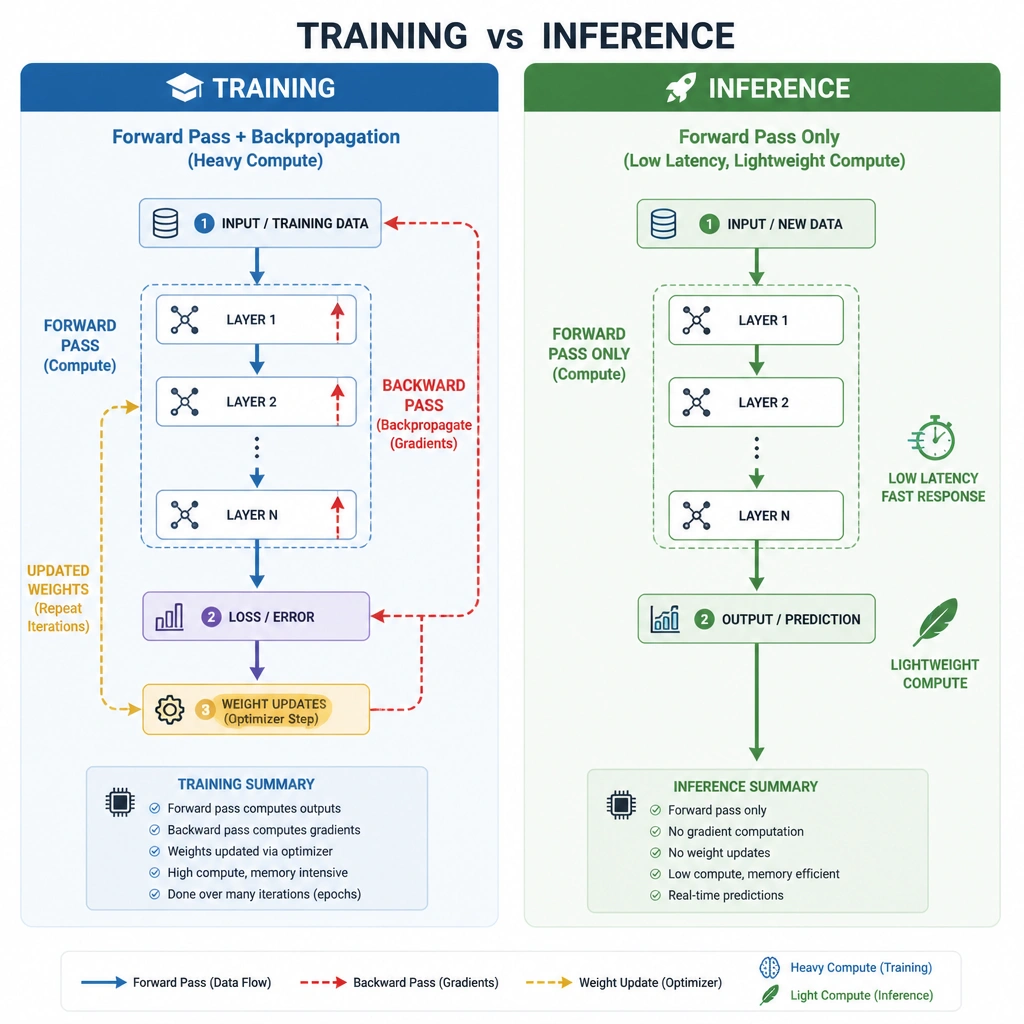
Check this out: training a model and running inference are like training for a marathon versus running to the mailbox. They are completely different beasts! When you train a model, you're running massive batches of data through the network, calculating the error, and using backpropagation to adjust millions or billions of parameters. This takes serious horsepower—we're talking clusters of GPUs working together for days or weeks. But inference? That's when the model is already trained and you ask it a question. It just does a single, lightweight forward pass to give you an answer. It needs to be super fast (low latency), but it doesn't need nearly the same computational muscle as training. Trust me, getting this distinction down is key for both the exam and keeping your cloud bill under control!
Full explanation below image
Full Explanation
In AI infrastructure design, understanding the distinction between training and inference is critical for proper resource provisioning and cost optimization. Model training is the phase where a neural network learns to make predictions from a dataset. This process is highly iterative and computationally intense. For each batch of training data, the system performs a forward pass to calculate predictions, computes the loss (the difference between the prediction and the actual target), and then performs a backward pass (backpropagation). Backpropagation calculates gradients and updates the weights of the network. Because this cycle repeats millions of times across massive datasets, training requires massive parallel computational power (usually clusters of GPUs or TPUs) and is optimized for maximum throughput. Inference, on the other hand, is the deployment phase where the pre-trained model is used to make predictions on new, unseen data. During inference, the model only performs a forward pass. There is no backpropagation, no gradient calculation, and no parameter updating. Consequently, inference requires significantly fewer computational resources (FLOPs) per request than training. However, inference is highly sensitive to latency and availability, as users expect real-time or near-real-time responses. Let's analyze the options: Option B is correct because it accurately captures the iterative backpropagation nature of training and the lightweight forward-pass nature of inference. Option A is incorrect because it reverses the compute requirements and incorrectly claims training runs on single-threaded CPUs. Option C is incorrect because inference does not reconstruct the neural network and does not require more FLOPs than training. Option D is incorrect because training and inference have fundamentally different resource profiles (throughput-optimized vs. latency-optimized), meaning a cluster designed for one is not automatically optimized for the other.