
You are setting up a high-performance network for a massive deep learning cluster and need to choose between standard Ethernet and InfiniBand. Which architectural characteristic of InfiniBand ensures ultra-low latency and prevents packet drops under heavy, synchronized AI training workloads?
Select an answer to reveal the explanation.
Short Explanation and Infographic
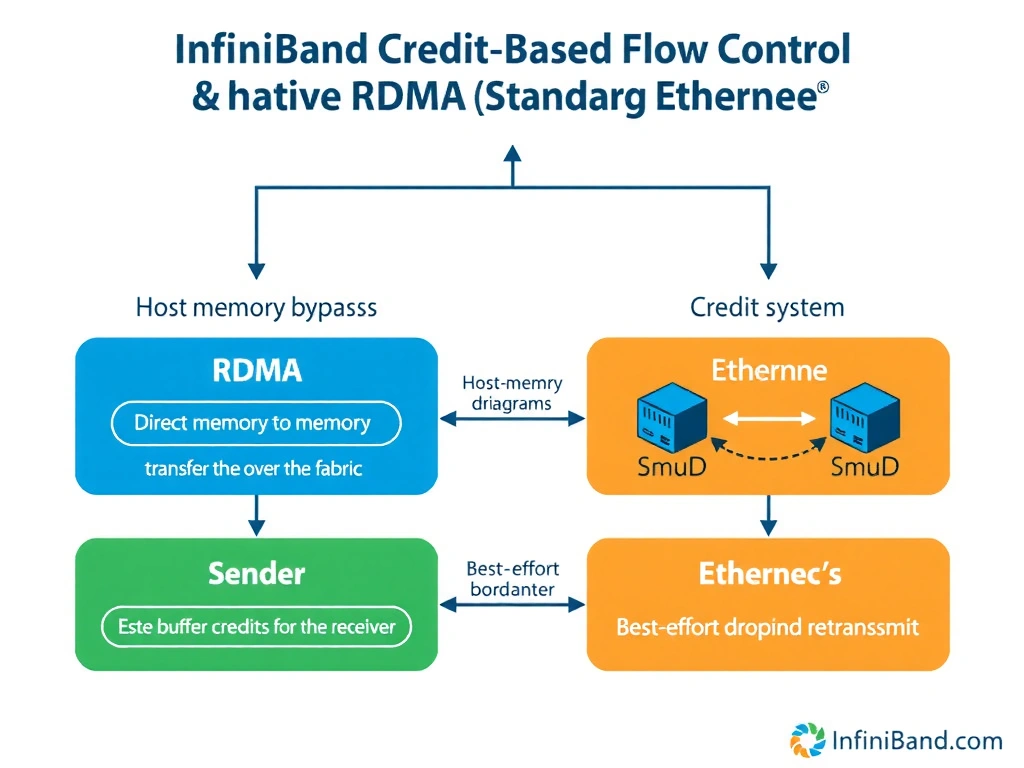
Okay, let's dive into InfiniBand because this technology is the backbone of modern AI networks! Here's the deal: standard Ethernet is great for the general office, but when you're syncing billions of parameters across hundreds of GPUs, you cannot afford packet loss or CPU overhead. InfiniBand uses a credit-based flow control system. This means a sender won't transmit data unless the receiver has confirmed it has buffer space. Boom—no drops! Plus, with native Remote Direct Memory Access (RDMA), data goes directly from one host's memory to another's without bothering the CPU. That's how we get sub-microsecond latencies. Remember, InfiniBand is a switched fabric, not a bus, and it prevents packet loss instead of just dealing with it later. Got it? Sweet. Let's keep rolling.
Full explanation below image
Full Explanation
InfiniBand (IB) is a specialized communication link and network fabric designed for high-performance computing (HPC) and large-scale AI environments. Unlike Ethernet, which was originally built for best-effort delivery and tolerates packet loss by relying on higher-layer protocols like TCP for retransmissions, InfiniBand is architected from the ground up as a lossless fabric. This lossless nature is achieved using a hardware-level, credit-based flow control mechanism. Before a node transmits a packet, it must receive a credit from the receiving switch or node, indicating that buffer space is available to store that packet. Because data is only sent when buffer space is guaranteed, packet drops due to buffer exhaustion are prevented rather than mitigated after the fact. This is critical for AI workloads where a single dropped packet can stall a massive collective operation (like All-Reduce) and idle thousands of GPUs. Furthermore, InfiniBand supports native Remote Direct Memory Access (RDMA). RDMA bypasses the operating system kernel and host CPU of both the source and target nodes, allowing network adapters to transfer data directly between application memory spaces. This dramatically reduces network latency, overhead, and CPU utilization, freeing up host processors to focus on actual computation. Let's look at why the other options are incorrect: Option B is incorrect because InfiniBand uses a switched fabric topology, not a bus-based shared medium. Shared-medium architectures are inefficient for high-density environments due to collision domains and bandwidth contention. Option C is incorrect because InfiniBand does not rely on TCP windowing or software-defined store-and-forward techniques for loss recovery; it prevents packet loss in hardware. Option D is incorrect because InfiniBand does not rely on high-tolerance retransmission buffers to absorb drops; its entire design prevents drops from occurring in the first place, avoiding the high CPU and latency penalties associated with retransmission.