
A systems engineer is troubleshooting synchronization bottlenecks in a cluster running large-scale distributed training jobs. Which architectural features of InfiniBand are designed to resolve these performance bottlenecks and optimize node communication? (Select all that apply)
Select all correct answers, then click Submit.
Short Explanation and Infographic
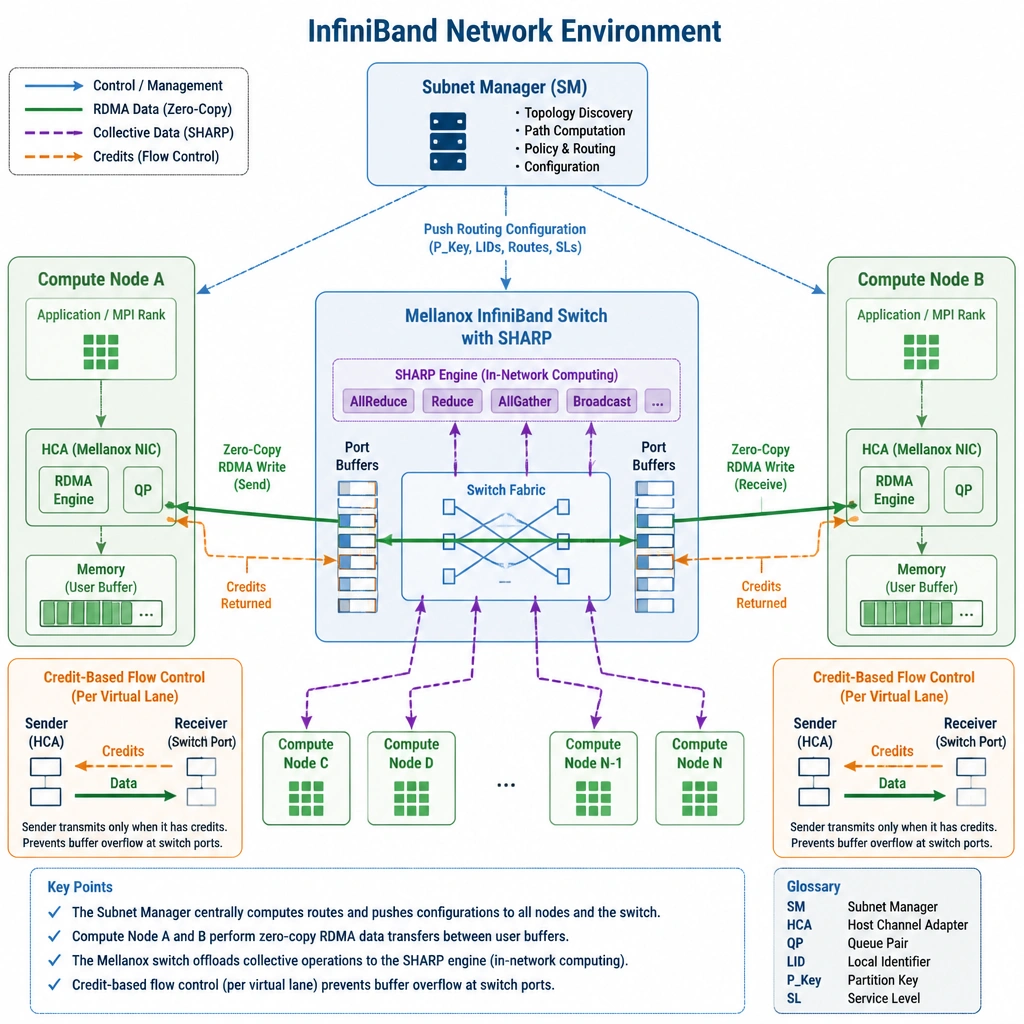
Think of it this way: when you're training a massive model, your servers are constantly talking to each other to update weights. If the network drops a packet or the CPU gets bogged down copying data, the whole training job stalls. Not good! InfiniBand solves this with four key features. First, it uses centralized subnet management to handle all routing and topology dynamically. Second, native RDMA lets servers write directly to each other's RAM, bypassing the CPU completely. Third, in-network computing allows the switches to perform mathematical operations, freeing up your GPUs. Finally, it's a lossless fabric that uses credit-based flow control to prevent packet drops in the first place, rather than just trying to recover from them later. Remember: InfiniBand avoids packet loss, it doesn't just tolerate it!
Full explanation below image
Full Explanation
In distributed deep learning, synchronization steps (such as AllReduce) can cause significant communication overhead. InfiniBand provides specialized hardware features designed to mitigate these latency and throughput bottlenecks: - Centralized Subnet Management (B): An InfiniBand subnet is managed by a centralized Subnet Manager (SM), which dynamically discovers the physical topology, assigns Local Identifiers (LIDs), and programs routing tables. This eliminates routing loops and ensures optimal paths. - Native RDMA (C): Remote Direct Memory Access allows network adapters to transfer data directly between application memory spaces on different hosts without CPU intervention, reducing latency to the microsecond level. - In-Network Computing (E): Capabilities like NVIDIA SHARP offload collective operations (e.g., aggregating gradients) directly to the network switches, reducing traffic volume across the fabric. - Lossless Fabric (F): Credit-based flow control at the link layer prevents buffer overflows. A sender will not transmit a packet unless the receiver confirms it has buffer credits, preventing packet drops due to congestion.
Let's evaluate the incorrect options: - Bus-based shared medium (A) is a legacy topology that shares bandwidth and causes collisions, whereas InfiniBand uses switched fabric. - High tolerance for network packet loss (D) is typical of standard Ethernet networks (like TCP/IP retransmissions), which introduce unpredictable latency spikes. InfiniBand's design is focused on preventing packet drops rather than tolerating them.