
When comparing NVIDIA GPUDirect Storage (GDS) and GPUDirect RDMA, what is the key distinction in their data paths and primary use cases?
Select an answer to reveal the explanation.
Short Explanation and Infographic
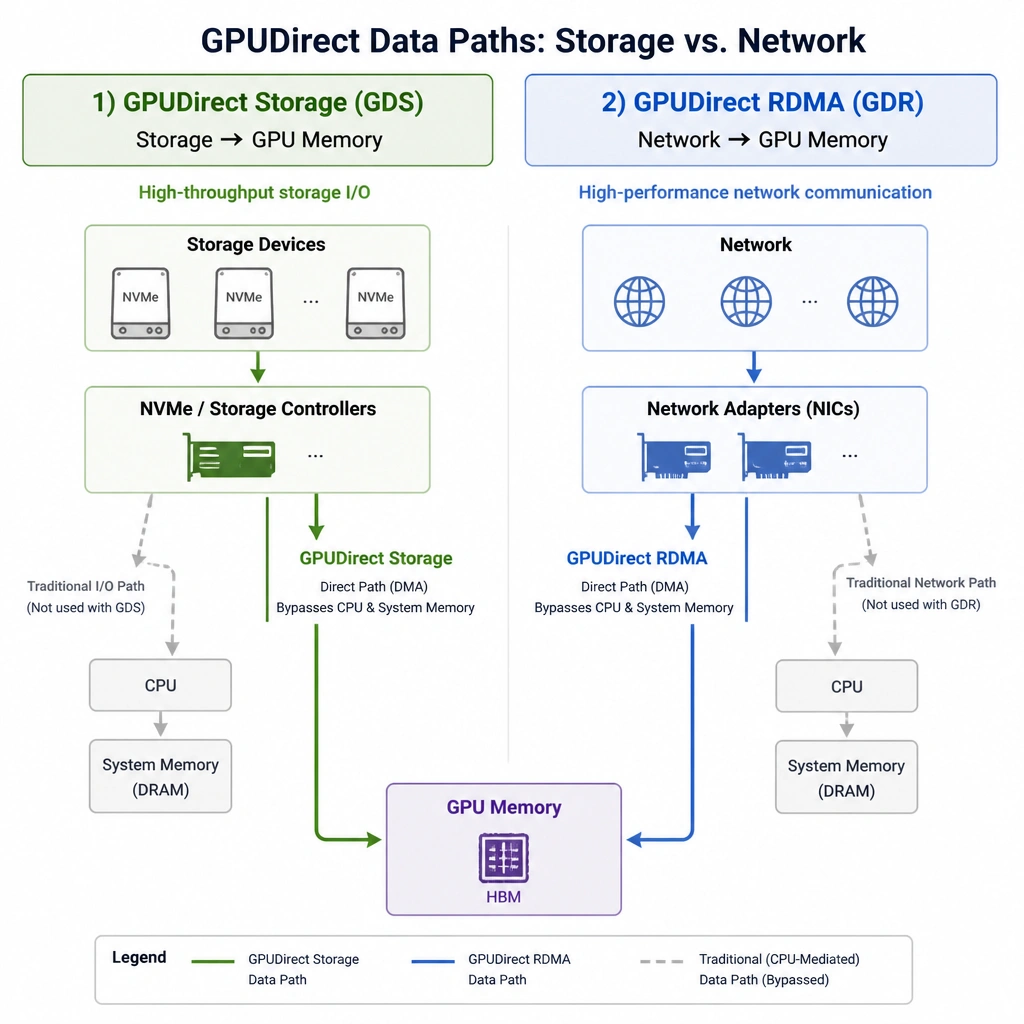
Okay, let's clear up some common confusion here. You've got all these 'GPUDirect' technologies, and they sound pretty similar. But here's the deal: GPUDirect RDMA is all about networking. It lets a GPU on one server talk directly to a GPU on another server across the network without asking the CPU for help. GPUDirect Storage (GDS), on the other hand, is all about files. It creates a direct path between your storage (like local NVMe drives or remote file systems) and the GPU's memory. Both of them bypass the CPU to save time, but GDS is for storage, and RDMA is for networking. Keep that distinction clean, and you'll nail this on the exam.
Full explanation below image
Full Explanation
NVIDIA's GPUDirect technology family is designed to optimize data paths by eliminating unnecessary data copies and bypassing the host CPU. However, GPUDirect Storage (GDS) and GPUDirect RDMA address different components of the data bottleneck. GPUDirect Storage (GDS) establishes a direct DMA (Direct Memory Access) path between storage devices (such as local NVMe SSDs or remote NVMe-oF/distributed file systems) and GPU memory. By avoiding the CPU's system memory bounce buffers, GDS increases I/O bandwidth, reduces latency, and decreases CPU utilization during data loading phases. GPUDirect RDMA (Remote Direct Memory Access) is a networking-focused technology that allows a GPU to exchange data directly with network adapters (NICs) on different hosts across a network. This enables direct GPU-to-GPU communication across the network, which is essential for distributed training tasks where nodes must constantly share gradients and parameters. Let's address the incorrect options: The assertion that GPUDirect Storage requires CPU bounce buffers is incorrect. The entire purpose of GDS is to eliminate these bounce buffers to speed up I/O. The statement that GPUDirect Storage is restricted solely to local NVMe drives is incorrect. GDS is fully capable of working with remote, network-attached storage systems and distributed filesystems (like Lustre or Weka) that support GDS. The assertion that GPUDirect Storage manages intra-node GPU-to-GPU communication is incorrect. Intra-node GPU-to-GPU communication is handled by NVLink, while inter-node GPU-to-GPU communication is facilitated by GPUDirect RDMA. GDS is dedicated strictly to storage-to-GPU data paths.