
In a multi-node distributed training cluster, how does NVIDIA GPUDirect RDMA (Remote Direct Memory Access) optimize communication during the gradient synchronization phase?
Select an answer to reveal the explanation.
Short Explanation and Infographic
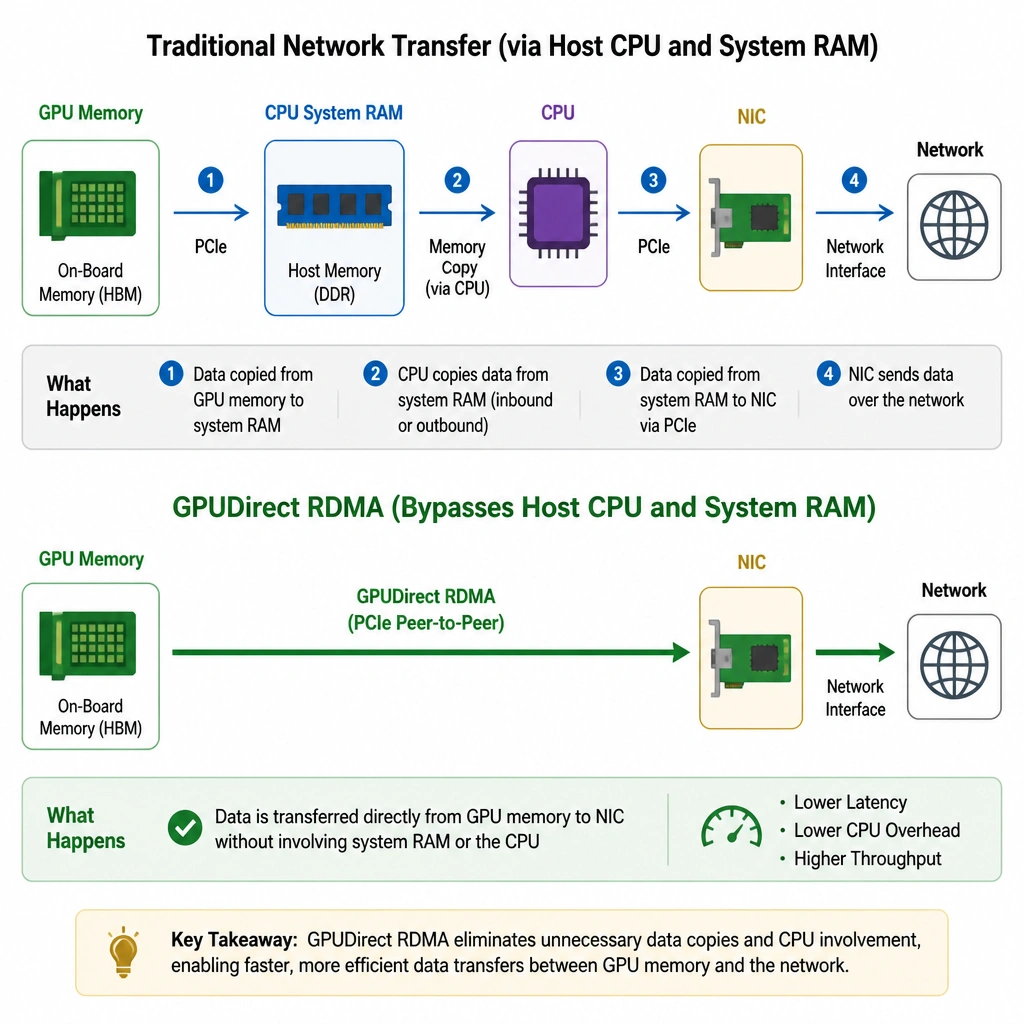
Check this out: in distributed training, your GPU nodes are constantly talking to each other, sharing gradients and updating weights. Normally, if GPU 1 on Node A wants to talk to GPU 1 on Node B, the data has to go from GPU 1's memory to system RAM, let the CPU package it up, send it to the network card, and then do the reverse on the other side. That's a lot of copying, and the CPU gets bogged down. GPUDirect RDMA changes the game. It lets the network card (NIC) talk directly to the GPU's VRAM. No CPU bounce buffers, no system RAM detour. It's direct, blazing fast, and keeps the CPU free. That's a massive win for multi-node training.
Full explanation below image
Full Explanation
Distributed deep learning training requires frequent communication between nodes to synchronize gradients and model parameters (e.g., during AllReduce operations). In traditional network transfers, data must be copied from GPU memory (VRAM) to host system memory (RAM) via the PCIe bus, processed by the host CPU, sent to the network interface card (NIC), and then go through the same reverse path on the receiving node. This creates a significant latency bottleneck and consumes CPU cycles. NVIDIA GPUDirect RDMA (Remote Direct Memory Access) solves this by enabling a direct peer-to-peer data path between the GPU's memory and the network adapter (such as an InfiniBand or RoCE-enabled Ethernet NIC). This allows the NIC to read or write GPU VRAM directly over the PCIe bus without involving the host CPU or copying data into system RAM. This dramatically reduces network latency, increases communication throughput, and frees up CPU resources, which is essential for scaling performance in large, multi-node AI clusters. Looking at the incorrect options: Distributing processing loads evenly is the task of distributed training frameworks (like PyTorch DistributedDataParallel) and orchestrators, not a low-level data transfer technology. Dynamically scaling active GPU nodes is handled by autoscaling mechanisms in cluster managers or cloud orchestrators (like Kubernetes Cluster Autoscaler). Providing hardware-level ECC for Ethernet cables is incorrect. ECC is a memory reliability feature (e.g., on the GPU's VRAM), and network error correction is handled by network protocols (like TCP or InfiniBand link-layer retry mechanisms), not GPUDirect RDMA.