
During a stress test of an AI training cluster, a system administrator reviews the metrics from nvidia-smi and focuses on the GPU power utilization percentage. What does this specific metric represent?
Select an answer to reveal the explanation.
Short Explanation and Infographic
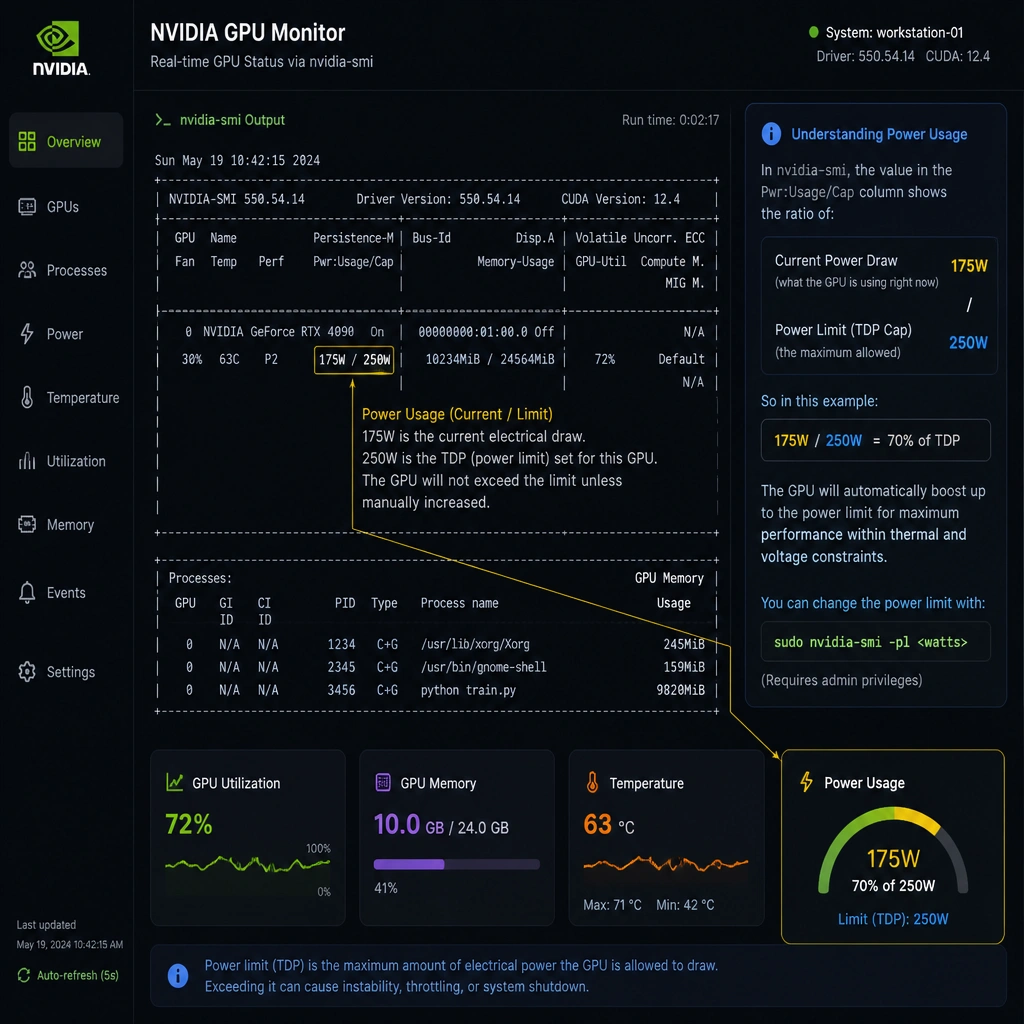
When you're monitoring your GPUs with nvidia-smi — and trust me, you'll be running that command a lot — you need to understand what the numbers are telling you. Power utilization isn't telling you how many cores are busy or how fast the clock is ticking. It's strictly about electricity. It measures how much power the GPU is pulling right now compared to its Thermal Design Power (TDP), which is the maximum wattage it's designed to draw. If a GPU has a TDP of 250W and it's drawing 125W, your power utilization is sitting at 50%. It's a great proxy for workload intensity, but at its heart, it's just a power meter.
Full explanation below image
Full Explanation
In GPU performance monitoring, tracking power consumption is vital for understanding workload behavior, system thermal health, and power distribution limits. The GPU power utilization metric (often viewed via the NVIDIA System Management Interface, or nvidia-smi) measures the current real-time electrical draw of the GPU as a percentage of its Thermal Design Power (TDP) or maximum power limit. For instance, if an enterprise GPU has a configured power limit of 300 watts and is currently drawing 150 watts, the power utilization is reported as 50%. This metric serves as an excellent proxy for workload intensity because executing dense matrix multiplications on Tensor Cores draws significantly more power than idle states or memory transfers, but it is fundamentally a physical measurement of power, not compute activity. Let's address the incorrect distractors: The percentage of GPU cores that are active is incorrect. Core utilization (often called GPU utilization) represents the percentage of time that one or more kernels were executing on the GPU over a sample period, but it doesn't measure the physical count of active cores. The percentage of time spent in active computation is another representation of execution time slice utilization, which does not measure raw electrical power draw. The ratio of current memory bandwidth to maximum limits is incorrect. This is referred to as memory utilization or memory bandwidth utilization, which measures the read/write activity on the GPU's memory bus.