
When designing a multi-node GPU cluster to train large language models, what is the primary benefit of deploying a workload orchestrator/resource manager such as Kubernetes or Slurm?
Select an answer to reveal the explanation.
Short Explanation and Infographic
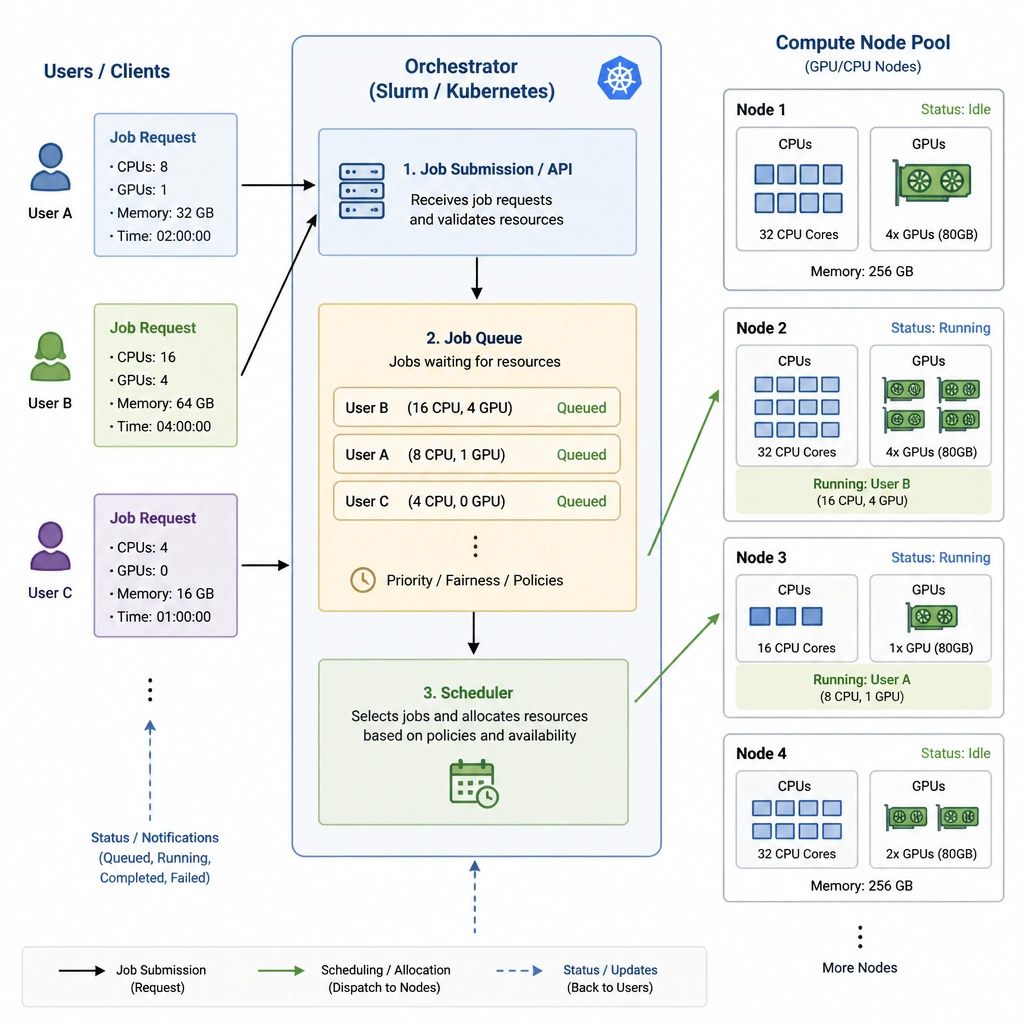
Imagine you've got a cluster of 64 GPU nodes and your data scientists are constantly trying to run their training jobs. If they had to manually log in, check which GPUs are free, and launch scripts, it would be a total nightmare. That's why we use workload managers like Slurm or Kubernetes. Think of them as the air traffic controllers for your cluster. They take incoming jobs, find the best nodes with the right amount of free GPU memory, and schedule the workloads automatically. They can also spin up more replicas when traffic spikes. They keep the hardware running efficiently and save you from massive headaches.
Full explanation below image
Full Explanation
In large-scale AI environments, managing a cluster of compute nodes manually is inefficient and error-prone. Resource managers and workload orchestrators like Slurm (Commonly used in High-Performance Computing or HPC) and Kubernetes (Commonly used in cloud-native enterprise environments) automate the scheduling, deployment, allocation, and scaling of AI workloads. When a user submits an AI training or inference job, the orchestrator evaluates the resource requirements (such as the number of GPUs, CPU cores, system memory, and storage) and matches them with available resources in the cluster. It handles queuing, coordinates distributed execution across multiple nodes, manages job lifecycles, and can automatically scale resources up or down based on demand. This ensures maximum hardware utilization and a streamlined developer workflow. Let's review the incorrect options: Configuring low-level physical network interfaces is incorrect. While orchestrators interact with network plugins (like CNI in Kubernetes), the underlying physical network interfaces (such as InfiniBand or Ethernet adapters) and IP subnets must be configured beforehand by network administrators or cluster provisioning tools. Monitoring hardware metrics like fan speeds and temperatures is incorrect. Although orchestrators can react to node health status, the actual monitoring of physical metrics is the job of baseboard management controllers (BMCs), IPMI tools, or dedicated hardware monitoring daemons (like Prometheus exporters), not the orchestrator itself. Encrypting model weights at rest is incorrect. Data-at-rest encryption is handled by the storage subsystem, filesystem security features, or specialized security tools, rather than the workload scheduler.