
A network engineer is configuring a standard NVIDIA DGX A100 system equipped with 80GB GPU variants. What is the total aggregate GPU memory (VRAM) available to workloads across all installed accelerators in this single system?
Select an answer to reveal the explanation.
Short Explanation and Infographic
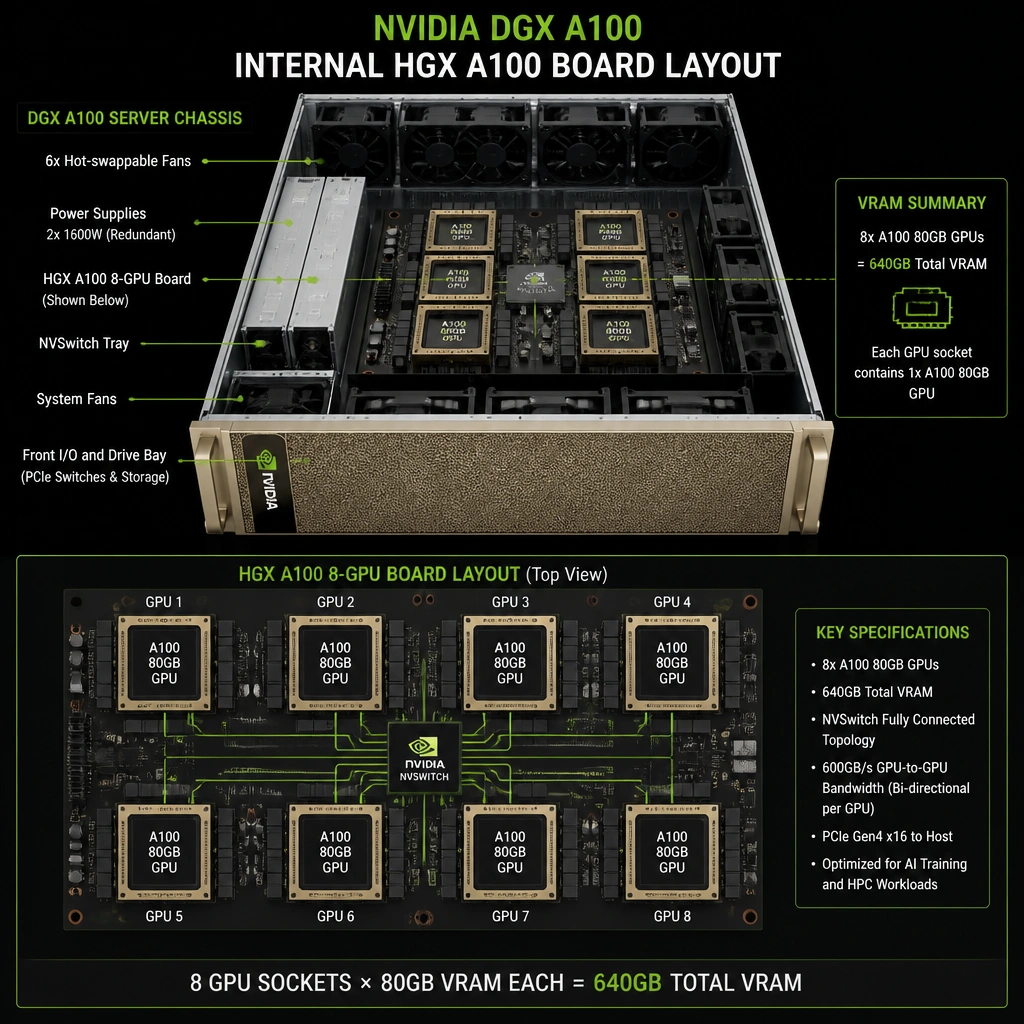
Here's the deal with the DGX A100: it is an absolute beast of a system. Inside one of these units, you've got 8 NVIDIA A100 Tensor Core GPUs. Now, the A100 comes in a couple of flavors, but the high-end standard is the 80GB version. If you multiply those 8 GPUs by 80GB of VRAM each, you get a grand total of 640GB of ultra-fast HBM2e memory. That's a massive pool of memory for running huge models. Make sure you memorize this math because knowing the hardware specs of the DGX lineup is a favorite topic on the exam.
Full explanation below image
Full Explanation
The NVIDIA DGX A100 is a foundational building block for AI enterprise infrastructure. It integrates 8 NVIDIA A100 Tensor Core GPUs into a single system, connected via third-generation high-speed NVLink interfaces. The A100 GPU was released in two memory configurations: a 40GB variant and an 80GB variant. For the 80GB version, which is standard in many enterprise DGX A100 deployments, the system features a total aggregate GPU memory of 640GB (8 GPUs x 80GB per GPU = 640GB). This memory uses High Bandwidth Memory (HBM2e) technology, providing over 16 terabytes per second of memory bandwidth across the system, which is crucial for keeping the GPU cores saturated during massive parallel computations. Let's review the incorrect options: 320 GB represents the aggregate memory of a DGX A100 system equipped with the older 40GB GPU variants (8 x 40GB = 320GB). While this was a real configuration, it is not the capacity of the 80GB GPU variant system. 480 GB and 800 GB do not align with any standard DGX A100 configurations. 800 GB would imply ten 80GB GPUs, but the physical architecture of the DGX A100 system is fixed at exactly 8 GPUs on a single HGX baseboard.