
A startup wants to evaluate NVIDIA Base Command Manager (formerly Bright Cluster Manager) to manage their newly built AI cluster. What specific constraint applies to the free/community tier of this software?
Select an answer to reveal the explanation.
Short Explanation and Infographic
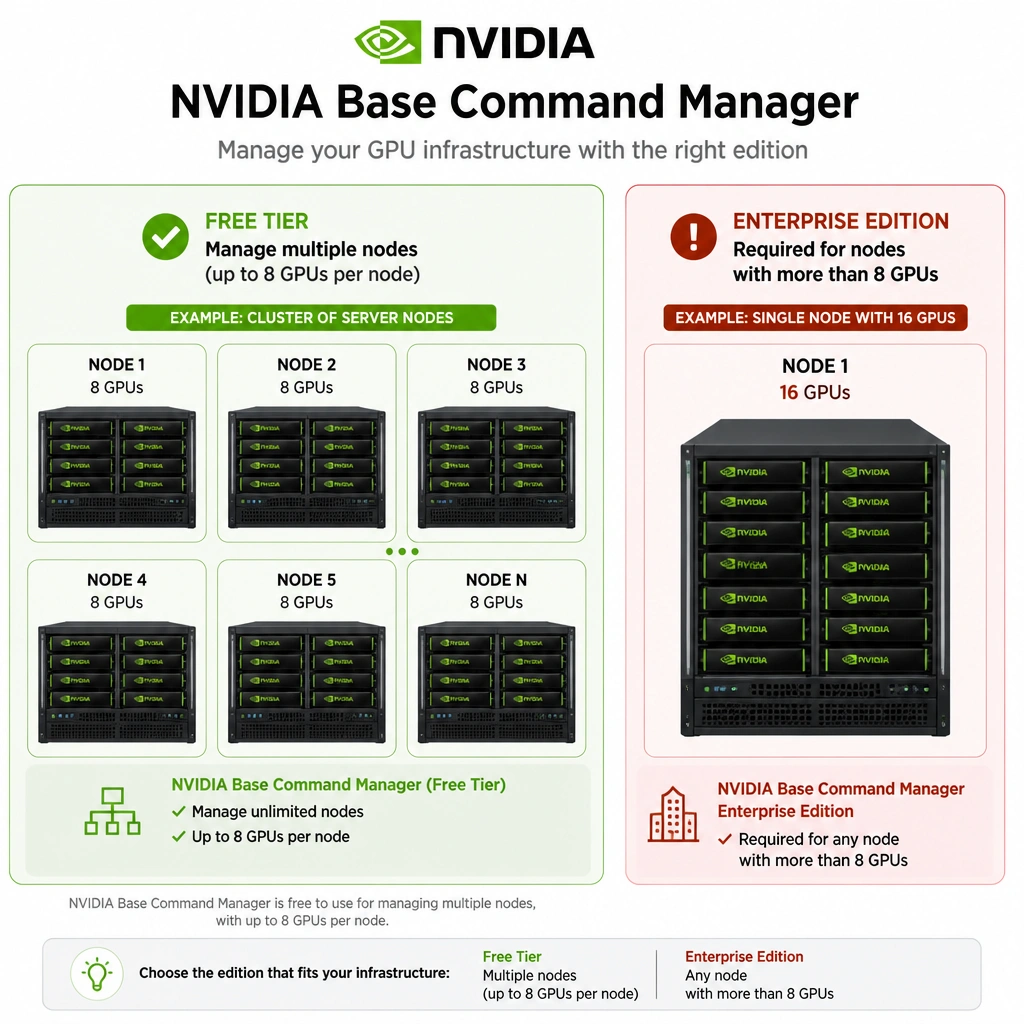
Okay, let's talk cluster management. NVIDIA Base Command Manager is an awesome tool for setting up and running your AI clusters. Now, NVIDIA wants you to adopt it, so they offer a free community tier. But pay close attention here: the catch isn't how many total nodes you can have in your cluster. Instead, the limit is that you can only manage systems that have up to 8 accelerators (GPUs) per server. If you buy a massive custom rig with 10 or 16 GPUs stuffed into a single system, you'll need the enterprise license. For standard nodes with 4 or 8 GPUs, the free tier works like a charm no matter how many nodes you stack.
Full explanation below image
Full Explanation
NVIDIA Base Command Manager (which evolved from Bright Cluster Manager) provides robust provisioning, monitoring, and management tools for AI clusters. To make it accessible for testing, development, and smaller deployments, NVIDIA offers a free/community tier. The key licensing constraint of this free tier is that it is limited to managing individual systems that contain up to 8 accelerators (GPUs) per node. There is no restriction on the overall number of nodes in the cluster, meaning you can scale your cluster to a large number of servers as long as no single system in that cluster exceeds the 8-GPU limit. This allows organizations to build and manage substantial GPU clusters using standard 4-GPU or 8-GPU server configurations without incurring licensing costs during their initial buildout. Looking at the other options: Limiting the cluster to 8 physical nodes is incorrect. The restriction is based on the number of accelerators per system, not the total node count of the cluster. Restricting support exclusively to NVIDIA DGX hardware is incorrect. Base Command Manager is designed to manage heterogeneous clusters, supporting certified OEM servers from major vendors alongside DGX systems. Capping the total cluster size at 100 nodes is incorrect. Again, the free tier licensing focuses on per-node accelerator density rather than cluster-wide server counts.