
A team is training a deep learning model on a massive dataset that exceeds the local VRAM capacity of a single GPU. They want to scale the training process to handle the massive volume of input data without reducing the model's architectural complexity or compromising on accuracy. Which training approach is most effective?
Select an answer to reveal the explanation.
Short Explanation and Infographic
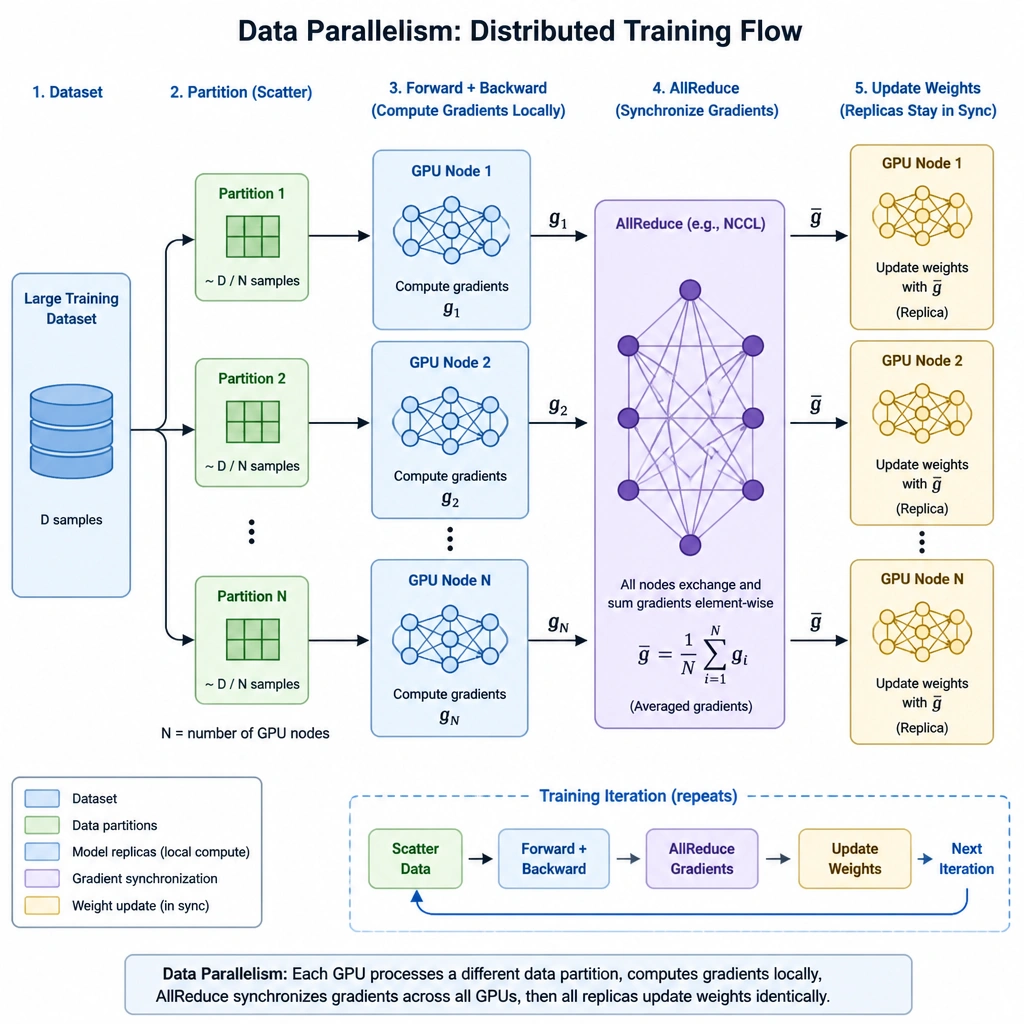
Check this out: when you're dealing with massive datasets, a single GPU is going to run out of memory fast. If you try to bump up the batch size on that single card, you'll just trigger an 'Out of Memory' error and crash your script. Not cool. The industry-standard solution is data parallelism. You replicate your model on multiple GPUs, split your huge dataset into chunks, and feed a chunk to each GPU. They process their pieces in parallel, share their gradient updates, and sync up. This way, you don't have to compromise on your model's size or complexity. It's how the big leagues train models.
Full explanation below image
Full Explanation
When training deep learning models on exceptionally large datasets, a single GPU node often runs out of memory (VRAM) or takes an unacceptable amount of time to complete training. The primary method to overcome this bottleneck is data parallelism. In a data-parallel configuration, the entire model is replicated across multiple GPUs (which can reside on different physical nodes). The training dataset is divided into distinct partitions, and each GPU processes a different slice of the data simultaneously. During the backward pass, the gradients calculated on each GPU are averaged and synchronized (typically using an AllReduce operation) to update the model weights uniformly. This allows the cluster to handle massive training datasets efficiently by expanding both compute power and aggregate memory capacity. Let's look at the other options: Increasing the batch size actually increases the memory footprint on the GPU because more activations must be stored in VRAM during the forward pass. This would exacerbate single-node memory limitations, likely leading to out-of-memory (OOM) errors. Forcing training to run entirely on host system RAM bypasses the GPU's parallel processing capabilities. CPU memory is indeed larger and cheaper, but training deep learning models on a CPU is extremely slow and impractical for large-scale projects. Shrinking the network's architectural complexity is a compromise that reduces model capability. While it fits the model into a single GPU's VRAM, it often results in lower model accuracy and does not address the core issue of scaling to leverage massive datasets.