
As organizations scale their artificial intelligence initiatives, which dominant machine learning trend is specifically designed to overcome the bottlenecks and high costs associated with manually labeling massive datasets?
Select an answer to reveal the explanation.
Short Explanation and Infographic
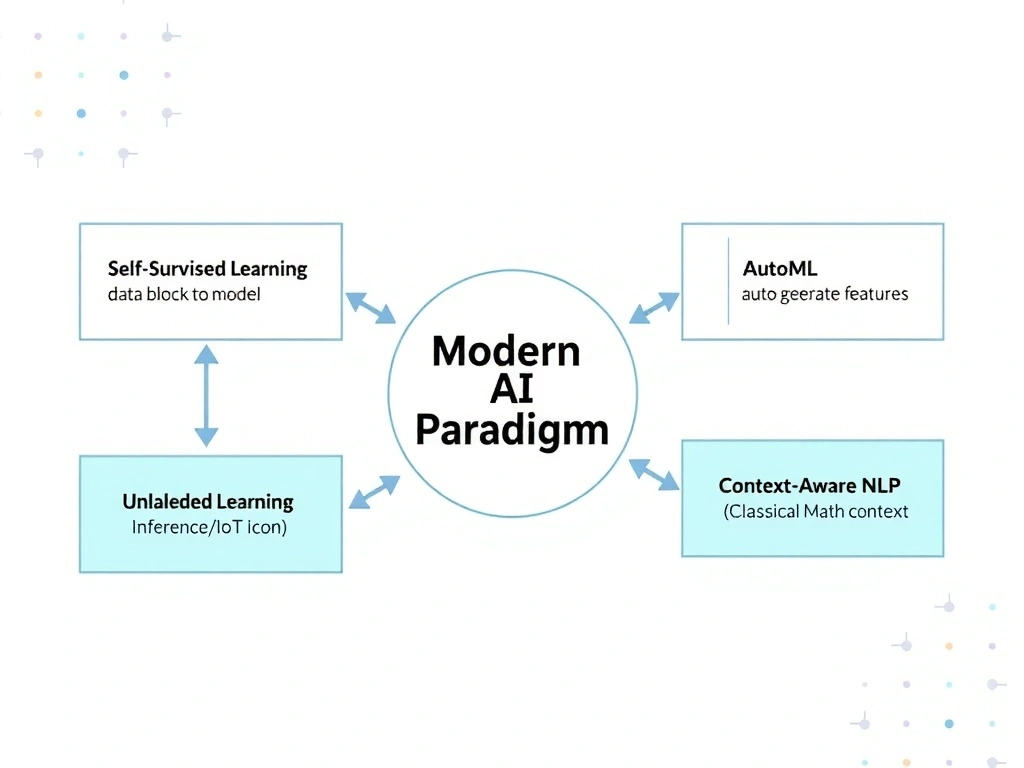
Here's the deal: labeling data is a massive pain and costs a fortune. If you've ever had to sit there and manually label thousands of images, you know what I mean! That's why the industry is moving fast toward self-supervised learning. The cool thing is, it lets the model learn from unlabeled data first, building up its own understanding of the world. Then, you only need a tiny bit of labeled data to fine-tune it. It saves time, saves money, and keeps your project moving. The other options here are either going backward in time or just plain wrong. Got it? Sweet. Let's keep rolling.
Full explanation below image
Full Explanation
Data curation and labeling are among the most expensive and time-consuming phases of the machine learning lifecycle. To address this bottleneck, modern AI development is heavily shifting toward self-supervised learning (SSL). SSL is a learning paradigm where the training task is formulated from the unlabeled data itself (e.g., predicting a masked word in a sentence or a hidden patch of an image). By pretraining a model on vast quantities of unlabeled data, the system develops a deep, generalized representation of the data. Consequently, the model can be fine-tuned using a much smaller labeled dataset, significantly reducing the cost and complexity of manual data annotation. Regarding the other choices: Complete transition to rule-based expert systems is incorrect. Expert systems are a legacy AI paradigm that cannot scale to handle complex, high-dimensional tasks like computer vision or generative language modeling. Restricting projects to run exclusively on centralized cloud databases is incorrect because edge AI and hybrid cloud architectures are growing trends. Processing data directly on local edge devices minimizes latency, conserves bandwidth, and enhances user privacy by keeping sensitive data localized. Reverting to manual feature engineering is incorrect. A key strength of deep learning is automatic representation learning, where the network learns features directly from raw inputs. Relying primarily on manual feature engineering would represent a step backward in pipeline efficiency.