
As machine learning architectures and deployment strategies evolve, which of the following represent key technical trends shaping the current landscape of AI development? (Select all that apply)
Select all correct answers, then click Submit.
Short Explanation and Infographic
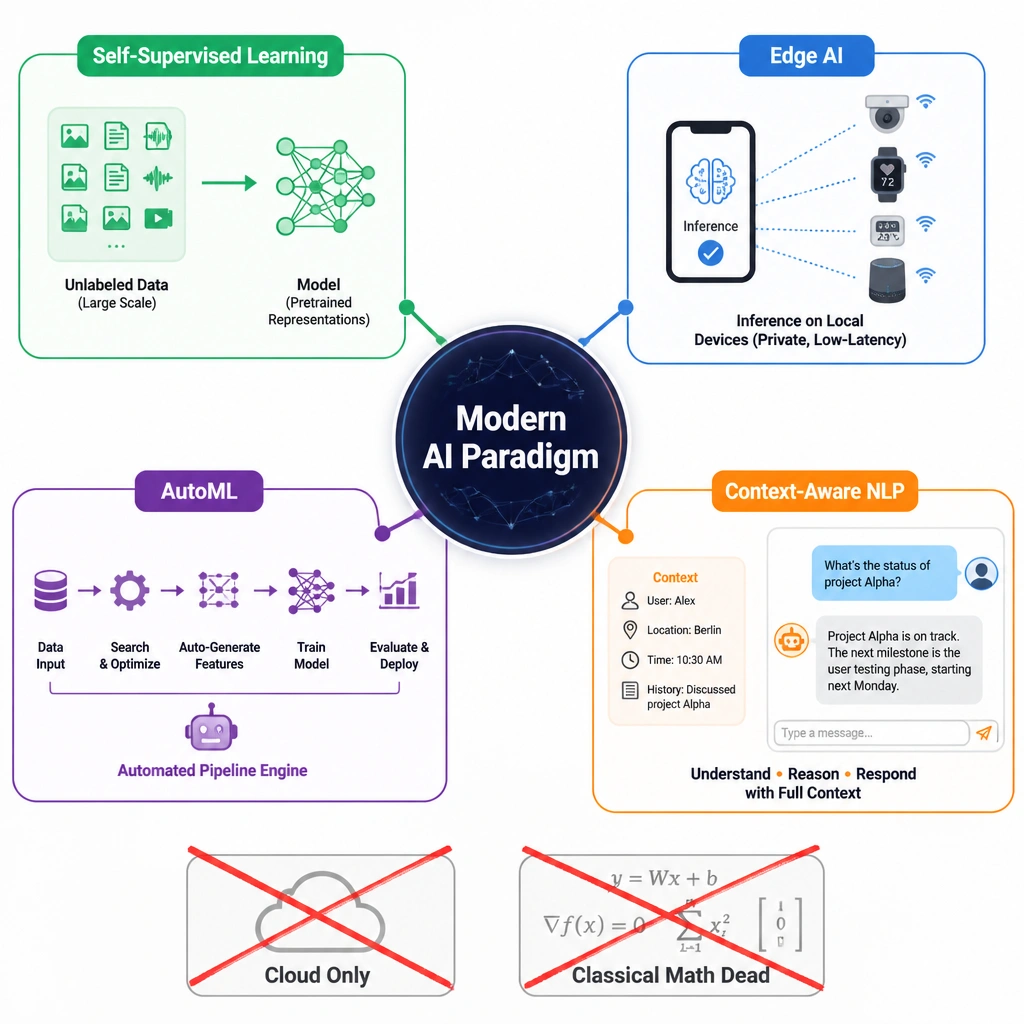
Here's the deal: AI is moving fast, and you need to know where the industry is heading. First off, labeling data by hand is slow and expensive. That's why self-supervised learning—where models learn from unlabeled data—is a huge trend. Second, we can't send everything to the cloud; edge AI brings inference right to devices like your phone or a smart camera to cut latency and boost privacy. Third, AutoML and automated feature engineering are streamlining how we build models. And fourth, NLP is getting incredibly good at understanding context. But don't fall for the trap that classical statistics are dead—we still use them every day! And we definitely aren't abandoning edge computing; hybrid setups are the future. Got it? Sweet.
Full explanation below image
Full Explanation
The machine learning and artificial intelligence landscape is defined by several key technological trends that optimize efficiency, developer velocity, and deployment scope: - Self-Supervised Learning (A): This paradigm allows models to learn representations from unlabeled data (for example, by predicting masked parts of an image or text). It drastically reduces the cost and bottleneck of manually labeling massive training datasets. - Edge AI (B): Processing AI models locally on endpoint hardware (smartphones, IoT gateways, autonomous vehicles) eliminates WAN latency, saves network bandwidth, and keeps sensitive user data on the device, satisfying strict privacy constraints. - Automated Feature Engineering/AutoML (C): Tools that automate data preparation, feature selection, and hyperparameter tuning enable faster prototyping and lower the barrier of entry for developing high-performance models. - Context-Aware NLP (D): Modern transformer-based architectures capture long-range contextual dependencies and nuanced user intent, enabling highly sophisticated conversational agents and document understanding.
Let's look at why the other options are distractors: - Total replacement of classical statistics (E) is incorrect. Classical statistical models (e.g., linear regression, time-series forecasting, clustering) remain highly relevant due to their low compute requirements, speed, and mathematical explainability. - Singular focus on centralized cloud infrastructure (F) is incorrect. The industry is moving toward hybrid architectures where training is done in centralized data centers or clouds, but inference is distributed to the edge.