
A company is planning to run high-throughput, low-latency computer vision inference services inside a standard data center. The hardware platform needs to prioritize power efficiency, low operating costs, and space efficiency in high-density rack servers. Which GPU solution is most suitable for this environment?
Select an answer to reveal the explanation.
Short Explanation and Infographic
Okay, let's dive in. If your boss walks in and asks you to set up an enterprise inference cluster, you've got to think about power, cooling, and reliability. Sure, gaming cards like the RTX 4090 are fast, but they draw a ton of juice and lack enterprise support. And running inference on pure CPUs? Not happening if you want low latency. The NVIDIA T4 is the sweet spot here. It's a 70-watt worker bee designed specifically to fit into enterprise servers and crush inference workloads without melting your power bill. Trust me on this, sticking gaming gear in a data center is a recipe for a phone call you don't want at 2 AM.
Full explanation below image
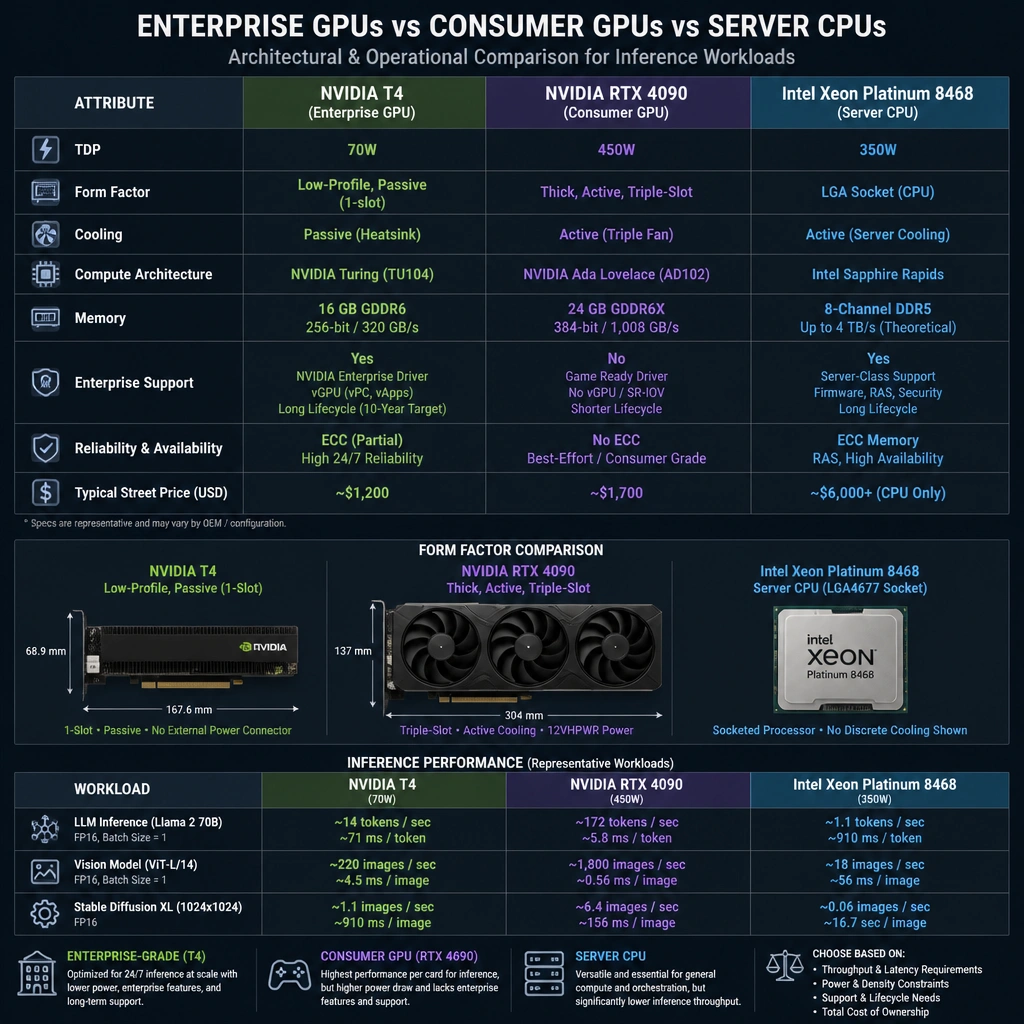
Full Explanation
When deploying machine learning models for production inference in an enterprise data center, three primary constraints must be balanced: performance (throughput and latency), power efficiency, and operational reliability. The NVIDIA T4 GPU is built on the Turing architecture and is specifically optimized for scale-out server environments running inference workloads. With a thermal design power (TDP) of only 70 watts and a low-profile PCIe form factor, it easily integrates into standard rackmount servers without requiring specialized power delivery or cooling infrastructure. It includes Tensor Cores that support mixed-precision (FP16, INT8, INT4) execution, which drastically accelerates deep learning models while minimizing energy consumption. Conversely, consumer-grade GPUs like the GeForce RTX 4090 and RTX 3070 are designed for client workstations and gaming PCs. They draw massive amounts of power (up to 450W for the RTX 4090), require bulky active cooling solutions that do not align with standard data center server airflow, and lack the enterprise-grade drivers, long-term support lifecycle, and hardware virtualization features required for data center operations. Using standard server CPUs for deep learning inference is technically possible but fails to meet high-throughput, low-latency requirements. CPUs lack the massive parallel processing capabilities of GPUs, leading to significant latency bottlenecks and higher overall infrastructure costs when scaling to meet demand.